


Posted on 5 November 2026
Monthly Accounting Report Template
- The Monthly Accounting Report Template uses the company's accounts, including assets and liabilities, to monitor business operations regularly.
- The template includes key financial indicators and accounts that affect the company’s financial performance and help ensure business continuity.
- Visual data representation is a key feature of the template, making it easier to identify positive and negative trends, analyze them quickly, and take appropriate action.


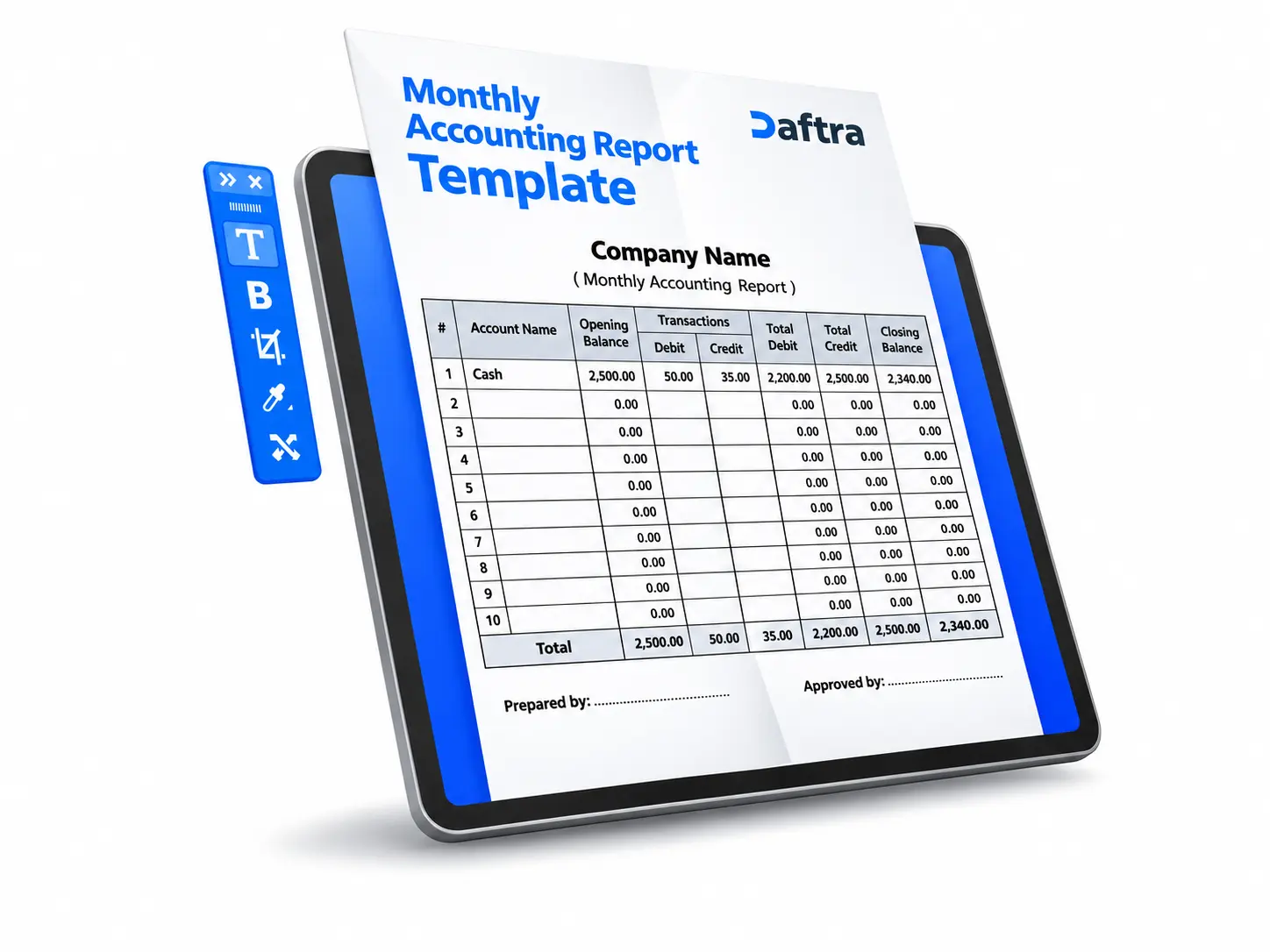
 Manage Your Monthly Financial Reports with Daftra
What Is a Monthly Accounting Report Template?
A monthly accounting report template is a consolidated report that tracks overall business performance through account balances. It covers the closing balances for each month, so it can link to other templates that record transactions as they occur. You may find indicators and ratios in the template that we have covered separately in other templates, but this consolidated report gives you the opportunity to check on your business through a single quick overview.
What Are the Elements of a Monthly Accounting Report Template?
The elements of a monthly accounting report template can be classified into two categories as follows:
- Accounts: An account represents one side of a financial transaction and has a distinct name. It may have a previous balance and a current balance. Each account in the report is either a main account in the chart of accounts or a subaccount under one of the main categories. Accounts can also be classified by function. The template includes credit accounts that reduce the company's financial resources (liabilities) and debit accounts that increase the company's resources (assets).
- Assets: The template includes current assets because they change month to month, unlike fixed assets, which generally maintain their value throughout the year. Assets therefore include accounts such as accounts receivable, cash, advances, and inventory, with the option to add other assets.
- Liabilities: The company's obligations require attention and monthly monitoring so they do not become debts the company cannot repay, especially when interest is involved. Liabilities therefore include loans, salaries payable, notes payable, and other credit accounts.
- Indicators: Indicators show how well the company follows the financial policies and strategies designed to align with its business model and achieve its targeted profits. Key indicators to include in the monthly accounting report are gross profit margin, operating expense ratio, current ratio, and operating income margin.
You May Also Download
How to Use a Monthly Accounting Report Template
In this section, we cover the main steps for using a monthly accounting report template or a similar template. Keep in mind that some steps may be added or omitted depending on each individual situation.
1- Identify the Part of Your Business Covered by the Report
You can use the template to prepare a monthly accounting report for a specific part of your business rather than the business as a whole. Many construction companies run more than one project at the same time, while most factories run more than one production line, each producing a different product. For this reason, we recommend using the template for each element separately. Alternatively, you can use it to combine all business elements in one report, although this may become somewhat complicated if your company is large and has many details. You should therefore identify the project, production line, or branch covered by the report from the beginning.
2- Classify Revenue and Expenses
One of the template's most important functions is tracking sales and identifying indicators that compare revenue and expenses. You should therefore have all data relating to operating costs, cost of sales, and direct costs, whether fixed or variable, as well as revenue sources such as product sales, service provision, equipment rental, and others. Enter the totals of all these values in their designated places in the template to obtain useful indicators easily.
3- Identify the Asset and Liability Accounts Relevant to You
To estimate your company's current liquidity, determining total current assets and liabilities is one of the most important steps. Once you enter total assets and liabilities, the liquidity ratio will appear. This is one of the most important liquidity ratios companies use. A generally safe ratio often ranges between 1.5 and 2.
4- Compare Expected and Actual Values
One of the template's main advantages is that it can cover an entire quarter. You can therefore estimate total monthly expenses and revenue based on team performance and the conditions prevailing in previous months. A chart makes it easier to compare values and see whether actual results exceeded expectations or vice versa.
Why Is a Monthly Accounting Report Template Important?
This template offers several benefits that you should not overlook as an accounting manager or business owner, as follows:
Template Flexibility and Adaptability to Your Business Needs
Although the template is designed for monthly use, you can also use it to cover a quarter or an entire financial year, allowing you to compare account balances across different months. The template also allows you to add more cells and rows to suit the accounts managed by your business without affecting the charts or formulas it contains.
Identifying Risks and Addressing Them Before It Is Too Late
Every business may face liquidity shortages, difficulty making payments, or even bankruptcy. This report identifies indicators that these risks may arise in the near future. It provides quick and comprehensive analyses that alert the reviewer and encourage sound decisions.
Improving Financial Estimates and Forecasts
One of the most important elements available in the template is budget estimation, which represents expected monthly expenses and revenue. With practice, repeated use of the figures and the template, and study of the target market, you can gradually produce estimates that are closer to actual results.
Who Benefits from a Monthly Accounting Report Template?
The main parties that benefit from a monthly accounting report template include the following:
- Managers and Business Owners: The report helps them track revenue, expenses, profits, and cash flows, enabling more efficient decisions.
- Accountants: The report helps them organize the month's results, making it easier to review accounts and prepare financial reports.
- Financial Managers: The report helps them analyze financial performance, compare actual results with the budget and forecasts, and identify variances.
- Internal Auditors: The report helps them review accounts, verify the accuracy of balances and transactions, and detect errors and discrepancies.
- Department and Branch Managers: he report helps them track department and branch results and evaluate the revenue, expenses, and costs associated with their activities.
- Investors and Partners: The report gives them a periodic picture of the company's financial position and helps them assess changes in performance and profitability.
Common Mistakes When Preparing a Monthly Accounting Report
The most common mistakes made when preparing a monthly accounting report include the following:
- Incomplete Data: Starting to prepare the report before recording all sales, purchases, expenses, collections, and payments for the month in question.
- Neglecting Adjustments and Reconciliations: Failing to reconcile bank, customer, supplier, and inventory balances with accounting records before approving the report.
- Recording Data in the Wrong Accounting Period: Recording revenue and expenses in the wrong month, resulting in inaccurate figures.
- Incorrect Accounting Classification: Recording transactions in the wrong accounts.
- Neglecting Accrued and Prepaid Expense and Revenue Adjustments: Failing to record accrued expenses (expenses that relate to the month but have not yet been paid) and accrued revenue (revenue that relates to the month but has not yet been collected), or forgetting to exclude amounts relating to future periods from prepaid expenses and unearned revenue (amounts paid or received in advance). This violates the accrual accounting principle and affects the accuracy of the results.
- Neglecting to Review Entries and Documents: Failing to conduct a thorough review and relying solely on recorded entries without checking for duplicate or incorrect entries.
- Performing Accounting Procedures Manually: This increases data-entry and calculation errors.
- Failing to Compare Results: Not analyzing changes in revenue, expenses, and profits, which prevents variances from being detected.
- Neglecting to Document Adjustments: Making changes to entries or figures without explaining them, making the review process more difficult.
- Neglecting Inventory: Failing to record and update inventory movements and the cost of goods may make the report inaccurate.
Tips for Preparing an Accurate Monthly Accounting Report
The most important tips to follow when preparing an accurate monthly accounting report include the following:
- Ensure All Financial Data Is Complete: Review the recording of all sales, purchases, expenses, collections, and payments for the month.
- Apply the Accrual Accounting Principle: Record revenue and expenses in the period to which they belong, taking accrued and prepaid expenses and deferred revenue into account.
- Perform Regular Adjustments and Reconciliations: Reconcile bank balances with bank statements, customer and supplier balances with their records, and physical inventory with inventory records, resolving any differences before approving the report.
- Reconcile Subsidiary Ledgers with the General Ledger: Ensure total customer, supplier, and inventory balances in the subsidiary ledgers match the corresponding general ledger accounts.
- Review Accounting Entries and Adjustments: Examine manual entries, accrual entries, depreciation entries, and expense entries, and verify that they have been recorded correctly.
- Analyze Results and Compare Them with Previous Periods: Compare revenue, expenses, profits, and balances with the previous month or the budget, then identify the reasons for any changes.
- Review and Document Closing Procedures: Check the figures for reasonableness and consistency, and retain documents relating to adjustments, amendments, and explanations for future reference.
Frequently Asked Questions
Who Is Responsible for Preparing the Monthly Accounting Report?
The accountant or accounting officer usually prepares the monthly accounting report. In organizations with a finance team, the accounting manager or finance manager reviews the monthly accounting report before approving it.
When Is the Monthly Accounting Report Prepared?
The monthly accounting report is prepared immediately after the accounting period ends and the monthly closing procedures are complete. These include recording all transactions, performing adjustments and reconciliations, and reviewing accounts.
How Can I Ensure the Accuracy of the Monthly Accounting Report?
The main requirements for ensuring the accuracy of the monthly accounting report include:
- Reviewing the completeness of financial transactions
- Performing bank reconciliations
- Reconciling customer, supplier, and account balances
- Ensuring revenue and expenses are recorded in the correct period
- Reviewing entries and analyzing variances
What Are the Most Important Indicators to Track in a Monthly Accounting Report?
Indicators usually vary depending on the organization's business activity. However, key indicators include revenue, profit rate, profit margin, operating expenses, net profit, cash flows, customer and supplier balances, and variances between actual results and the budget.
What Is the Difference Between an Accounting Report and a Financial Report?
Accounting Report: An accounting report focuses on monitoring and analyzing an organization's financial data and includes details of accounts, adjustments, indicators, and variances.
Financial Report: A financial report presents an organization's financial information, such as the income statement, statement of financial position, and cash flow statement, based on the organization's purpose and accounting policies.






 Invoicing
 POS
 Offers
 Installments
 Sales Commission
 KSA E-Invoice Software
 EGY E-Invoice Software
 JO E-Invoice Software
 E-Invoice Software
 Chart of Accounts
 Asset Management
 Cost Centers
 Expenses
 Cheque Cycle
 UAE VAT-Tax
 Product Management
 Purchases
 Purchase Cycle
 Suppliers
 Requisitions
 Stocktaking
 Organizational Structure
 Personnel Management
 Attendance and Leave
 Contracts
 Payroll
 Requests
 Work Orders
 Booking Management
 Rental and Unit Management
 Time Tracking
 Work Flow
 Lease Contracts
 Manufacturing Management
 Client Follow-Up
 Loyalty Points
 Points and Credits
 Memberships
 Insurance Management
 Daftra ERP Full App
 Point of Sales App
 Point of Sales for Desktop – Support Offline Mode
 AI Expenses Scanner App
 Employee Attendance, Sign & ESS App
 E-invoice Reader App
 Inventory Stocktaking App