


Posted on 22 September 2026
Trial Balance Template
- The Trial Balance is prepared at the end of the accounting period to verify balances across General Ledger accounts, so the total debit balances equal the total credit balances.
- The Trial Balance helps simplify audit activities performed by both internal and external auditors.
- It is the first step in the review process. When there are no arithmetic errors, the responsible team can move to the next stage of auditing and preparing financial statements.


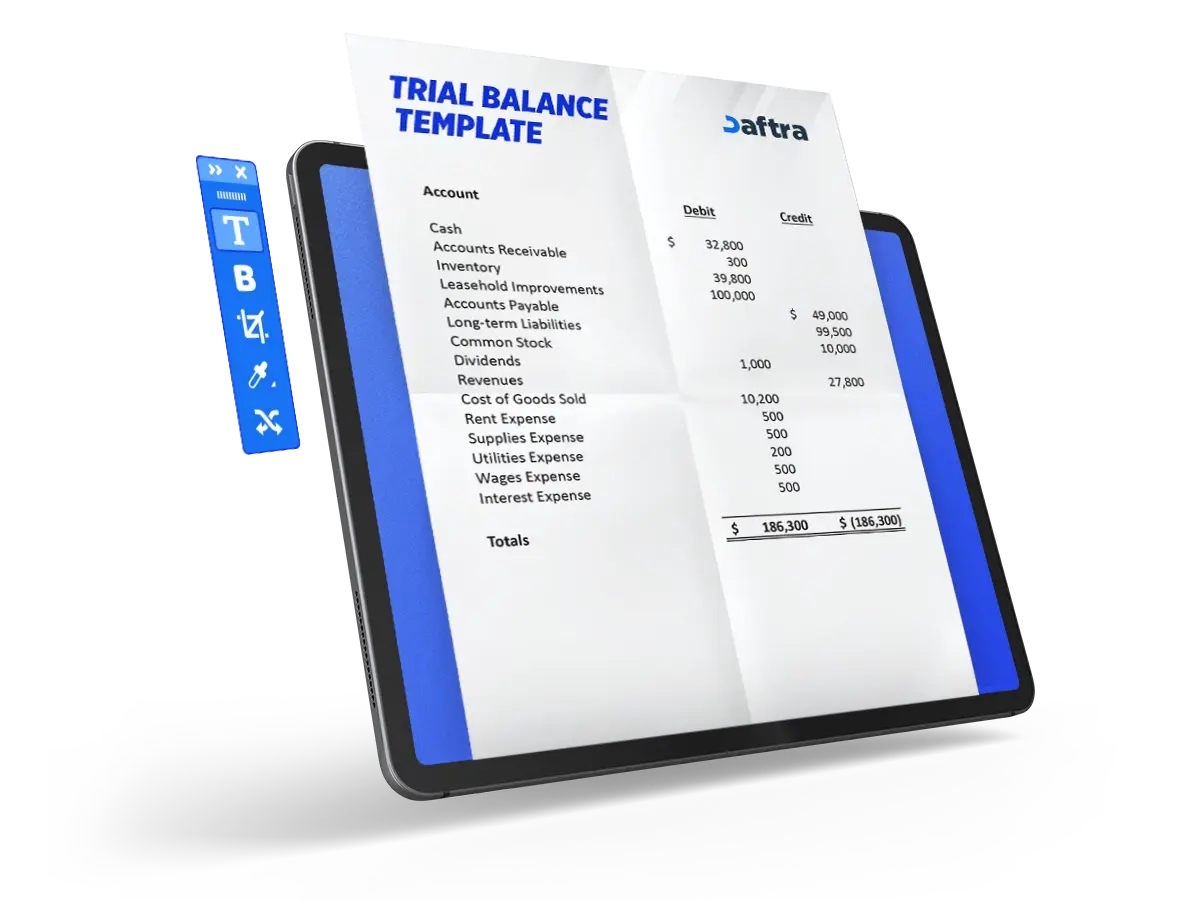
 Register with Daftra and generate trial balance automatically
What Is a Trial Balance Template?
A Trial Balance is a ledger or table that brings together all active General Ledger accounts used by the company and classifies them into debit and credit accounts. It is called a trial balance because it verifies that the total balances in the credit and debit columns are equal. When this condition is met, it indicates that the accounts are mathematically sound and accurate from an accounting perspective. The Trial Balance is prepared at the end of the accounting period.
Why Is a Trial Balance Template Important?
The importance of a Trial Balance Template comes from several benefits it provides to business operations and accounting processes:
- Detecting arithmetic errors: During double-entry bookkeeping, an accountant may make an entry error. The role of the Trial Balance is to detect these errors. If the total credit balances do not equal the total debit balances, there is an arithmetic or recording error.
- Preparing financial statements: The Trial Balance is the basis for preparing financial statements, providing stakeholders such as investors, managers, and others with an integrated view of the business.
- Evaluating financial performance: Through the Trial Balance, it becomes easier to identify areas for improvement that the business can adopt to strengthen its financial resources, whether by reducing expenses, increasing revenue, or applying other improvements.
- Auditing and legal compliance: An accurate Trial Balance supports compliance with the regulations set by the state regarding accounting and account management. It also helps ensure that internal and external audits run smoothly.
What Are the Elements of a Trial Balance?
A Trial Balance consists of several basic elements:
- Account name
- Credit balance
- Debit balance
- Total balances
You May Also Download
How to Prepare a Trial Balance
A Trial Balance can be prepared at the end of the accounting period by following these steps:
1- Display the General Ledger Accounts
A Trial Balance is another way to organize the accounts found in the General Ledger, making the review process easier. Therefore, the first step is to ensure that the General Ledger is prepared and that its accounts can be displayed.
2- Classify the General Ledger Accounts
Accounts can be classified by debit and credit nature. However, this may create confusion because some accounts may appear as debit accounts in one transaction and credit accounts in another.
3- Create the Totals Trial Balance
It is preferable to begin by preparing the Totals Trial Balance. In this step, all debit totals for each account and all credit totals for the same account are added. Before moving to the next step, make sure that the total debit balances equal the total credit balances.
4- Create the Balances Trial Balance
To obtain the net balance for each account, subtract the credit balance from the debit balance. If the net balance is negative, it is a credit balance. If the net balance is positive, it is a debit balance. In this case as well, make sure that total debit balances equal total credit balances.
Types of Trial Balance
There are three main types of Trial Balance. They follow the same format, but the accounting treatments differ:
1- Unadjusted Trial Balance
This is the traditional Trial Balance before taking adjusting entries into account. It includes all daily financial transactions related to General Ledger accounts.
2- Adjusted Trial Balance
Once you make adjustments through the required accounting entries and post them to the General Ledger, you can prepare the Adjusted Trial Balance. It includes the final balances in all accounts.
3- Post-Closing Trial Balance
After recording and posting closing entries, the Post-Closing Trial Balance includes only real accounts: assets, equity, and liabilities.
Mistakes to Avoid When Using a Trial Balance
When preparing a Trial Balance, human errors may occur. The following mistakes should be avoided:
- Duplicate entries: Entering the same number more than once, which may prevent the two sides from balancing.
- Reversed entries: Placing debit balances in the credit column, or credit balances in the debit column.
- Single-sided entries: Some accounts may be credit-only or debit-only, so they appear on one side. It is possible to overlook this and place the balance on the wrong side.










 Invoicing
 POS
POS Offers
 Installments
 Sales Commission
 KSA E-Invoice Software
 EGY E-Invoice Software
 JO E-Invoice Software
 E-Invoice Software
 Chart of Accounts
 Asset Management
 Cost Centers
 Expenses
 Cheque Cycle
 UAE VAT-Tax
 Product Management
 Purchases
 Purchase Cycle
 Suppliers
 Requisitions
 Stocktaking
 Organizational Structure
 Personnel Management
 Attendance and Leave
 Contracts
 Payroll
 Requests
 Work Orders
 Booking Management
 Rental and Unit Management
 Time Tracking
 Work Flow
 Lease Contracts
 Manufacturing Management
  Client Follow-Up
 Loyalty Points
 Points and Credits
 Memberships
 Insurance Management
 Daftra ERP Full App
 Point of Sales App
 Point of Sales for Desktop – Support Offline Mode
 AI Expenses Scanner App
 Employee Attendance, Sign & ESS App
 E-invoice Reader App
 Inventory Stocktaking App