


Posted on 4 October 2026
Accounting Rate of Return (ARR) Calculation Template
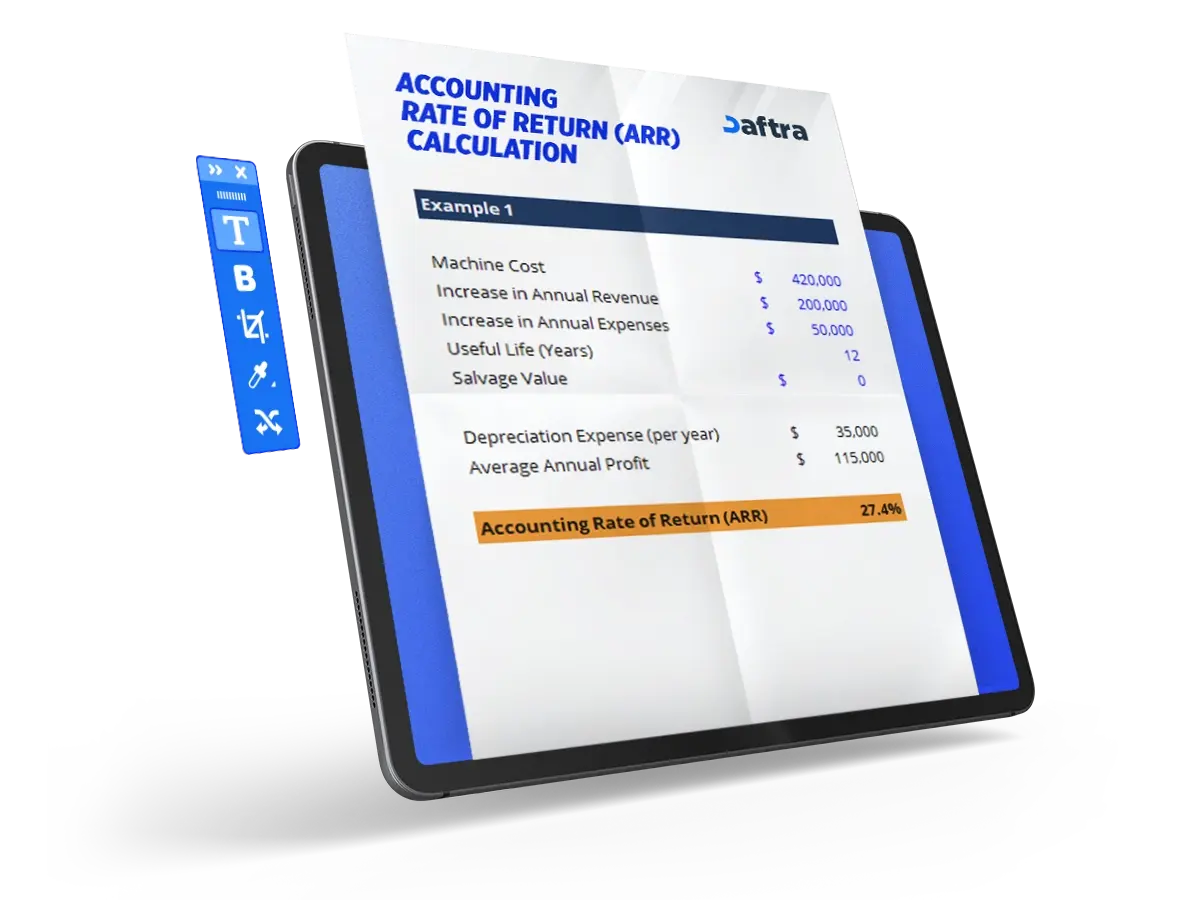
- The Accounting Rate of Return Template evaluates a company's performance and its ability to generate profits from invested assets.
- The Accounting Rate of Return helps investors make investment decisions by showing an investment's expected return.
- It compares expected returns from different investments and identifies the more favorable option.


 Register with Daftra and calculate ARR automatically
What Is an Accounting Rate of Return Template?
The Accounting Rate of Return (ARR) Template is an analytical tool used in finance and investment to estimate a project's potential return. This template helps investors and companies estimate the profit a specific investment can generate relative to the initial investment.
The general formula for calculating the Accounting Rate of Return is:
Accounting Rate of Return (ARR) = (Average Annual Profit / Initial Investment) x 100
Where:
- Average Annual Profit is the average annual net profit the project can generate.
- Initial Investment is the amount invested in the project at the beginning.
The Accounting Rate of Return can be used as a decision-making tool when companies need to assess a specific project's feasibility. However, ARR has limitations and does not account for important factors such as changes in the value of money over time.
Use our SIP Calculator to calculate investment value and return automatically and for free.
What Are the Elements of an Accounting Rate of Return Template?
An Accounting Rate of Return (ARR) Template includes several key elements used to calculate ARR and assess the feasibility of a specific project. The main elements include:
- Average Annual Profit: This is the average net profit the project can generate over its useful life. It is usually calculated by adding total profits over the project's active years and dividing by the number of those years.
- Initial Investment: This is the amount invested in the project at the beginning. It may include the cost of purchasing equipment or property and any other expenses related to launching the project.
- Useful Life: This refers to the period during which the project is expected to remain active and operational. Useful life can be specified in years.
- Salvage Value: This is the expected value of the project at the end of its useful life. It may be zero if there is no remaining value.
- Depreciation: This refers to the decrease in the value of property or equipment over time and can be used to calculate annual depreciation.
- Accounting Rate of Return (ARR): This is the percentage used to estimate the investment return from the project. It is usually calculated by dividing the average annual profit by the initial investment and multiplying the result by 100.
These are the main elements used to calculate the Accounting Rate of Return and estimate project feasibility.
Use our Percentage Calculator to calculate a percentage between two or more numbers, add a percentage to a number, or extract a percentage from a number automatically and for free.
How to Use an Accounting Rate of Return Template
The Accounting Rate of Return (ARR) Template can help estimate the feasibility of a specific project and support investment decisions. To calculate ARR, follow these steps:
1- Calculate Average Annual Profit
To calculate the average annual net profit the project can generate, add the total profits over the project's active years and divide by the number of those years.
2- Calculate Initial Investment
Calculate the amount that needs to be invested in the project at the beginning. This may include the cost of purchasing equipment, property, and any other expenses related to launching the project.
3- Calculate the Accounting Rate of Return (ARR)
Divide the average annual profit by the initial investment, then multiply the result by 100 to convert it to a percentage.
ARR = (Average Annual Profit / Initial Investment) x 100
4- Analyze the Results
After calculating the Accounting Rate of Return, you can use the result to support an investment decision. If the ARR is high and exceeds the company's required rate of return, this may indicate that the project is financially feasible. If the ARR is very low, it may indicate that the project is not financially viable.
It should be noted that the Accounting Rate of Return depends on certain estimates and assumptions and does not take into account changes in the value of money over time. In addition, compare ARR with other criteria and use it as part of a broader analysis when making investment decisions.
Why Is an Accounting Rate of Return Template Important?
The Accounting Rate of Return (ARR) Template is important for several reasons, making it a useful analytical tool in investment decision-making:
- Estimating financial feasibility: The ARR Template helps estimate the financial feasibility of a specific project. If the Accounting Rate of Return exceeds the company's required return, this indicates that investing in the project may be worthwhile.
- Ease of calculation: The Accounting Rate of Return is relatively simple to calculate and easy to understand. Many investors and business decision-makers can calculate it quickly to estimate the expected return from a specific project.
- Comparison between multiple projects: ARR can be used to compare several projects and choose the best option among them. This is useful when making multiple investment decisions and allocating financial resources effectively.
- Short-term decisions: ARR can be used for short-term decisions where investors do not need to consider complex estimates of future money values.
However, it is important to note that the Accounting Rate of Return has some limitations. For example, it does not consider changes in the value of money over time, and it does not fully reflect opportunity costs and other important factors that may affect investment decisions. Therefore, ARR should be used as part of a comprehensive analysis when making investment decisions.
Use the Compound Return Calculator to calculate compound returns on different transactions and investments automatically and for free.
Who Benefits from an Accounting Rate of Return Template?
The Accounting Rate of Return (ARR) Template can help a wide range of individuals and entities. The main beneficiaries include:
- Individual investors: Investors looking for investment opportunities can use the ARR Template to estimate the expected return from a specific project. This can help them decide whether to invest in that project or in another opportunity.
- Companies and businesses: Companies and businesses use the ARR Template to assess the feasibility of new projects or estimate the return on investment in existing projects. Companies can use this template to decide whether to expand production or launch a new product.
- Financial consultants: Investment consultants, accountants, and business analysts use the ARR Template to estimate expected returns for their clients. Financial consultants can provide a comprehensive financial assessment of client projects using this template.
- Government institutions and nonprofit organizations: These entities can use the ARR Template to evaluate investments in projects that serve the community or support their charitable objectives.
- Researchers and academics: Researchers and academics can use this template in studies and research related to investment evaluation, project management, and financial decision analysis.
In general, anyone or any entity involved in investment decisions or business projects can use the Accounting Rate of Return Template to estimate expected returns and make informed financial decisions.








 Invoicing
 POS
POS Offers
 Installments
 Sales Commission
 KSA E-Invoice Software
 EGY E-Invoice Software
 JO E-Invoice Software
 E-Invoice Software
 Chart of Accounts
 Asset Management
 Cost Centers
 Expenses
 Cheque Cycle
 UAE VAT-Tax
 Product Management
 Purchases
 Purchase Cycle
 Suppliers
 Requisitions
 Stocktaking
 Organizational Structure
 Personnel Management
 Attendance and Leave
 Contracts
 Payroll
 Requests
 Work Orders
 Booking Management
 Rental and Unit Management
 Time Tracking
 Work Flow
 Lease Contracts
 Manufacturing Management
  Client Follow-Up
 Loyalty Points
 Points and Credits
 Memberships
 Insurance Management
 Daftra ERP Full App
 Point of Sales App
 Point of Sales for Desktop – Support Offline Mode
 AI Expenses Scanner App
 Employee Attendance, Sign & ESS App
 E-invoice Reader App
 Inventory Stocktaking App