


What is Islamic Accounting and Its Most Important Accounting Standards



Table of contents:
- Key Summary
- What is Islamic Accounting?
- History of Islamic Accounting
- Key Objectives of Islamic Accounting
- What is the Importance of Islamic Accounting?
- What are the Standards of Islamic Accounting?
- What are the Fundamental Principles of Islamic Accounting?
- What are the Most Prominent Standards of the Accounting and Auditing Organization for Islamic Financial Institutions?
- What are the types of financial contracts in Islam?
- What are the Methods of Accounting in Islamic Financial Institutions?
- What Is the Difference Between Islamic Accounting and Conventional Accounting?
- What is the Difference Between Islamic Banks and Traditional Banks?
- What is the Importance of Accounting and Auditing Standards for Islamic Financial Institutions?
- Applications of Islamic Accounting in Financial Institution
- How Do You Follow Islamic Accounting Principles Easily Through Daftra?
- Frequently Asked Questions
The beginning of Islamic history and the spread of Islam among nations and societies marked the very beginning of differences in financial transactions between the accounting methods advocated by Islam and the accounting methods that society followed at that time. To this day, there remains an objective difference between Islamic accounting standards and current international standards.
The Islamic accounting system has proven its merit in comparison to other accounting systems, some of which have collapsed and been forgotten over time. Throughout this period, the Islamic accounting system has served as a successful and exemplary model for other cultures and societies to the extent that they have adopted some accounting principles from this system. Many Western scholars have expressed their admiration for the Islamic accounting system in numerous books, not only as an accounting system that regulates finances between people, but also because it is built upon fundamental values and principles.
What follows covers the importance of Islamic accounting, its principles, its most prominent standards, and the key differences between Islamic and traditional accounting.
What is Islamic Accounting?
Islamic accounting, or "Sharia accounting", is an accounting system that works to organize financial transactions according to Islamic principles derived from the specific rules in Islamic Sharia.
Working with the Islamic accounting system requires applying justice and equality in distributions and financial transactions among all individuals, and not discriminating between contracting parties. It also adopts transparency and disclosure as its principle, which means the necessity of disclosing all financial information related to activities and business operations among all concerned parties to build trust and credibility between them.
The Islamic accounting system takes Sharia as its methodology and guiding reference in accounting work, which ensures the absence of any activities that violate Islamic Sharia, such as usury, fraud, illegitimate speculation, gambling, and games of chance.
In summary, the answer to the question of what Sharia or Islamic accounting is is that it is completely based on Islamic teachings and the examination of the legitimacy of all operations that take place, with accounting being completely founded on Islamic rules.
History of Islamic Accounting
The roots of Islamic accounting trace back to the Prophet Muhammad's time, when honesty and transparency in recording financial dealings were core values, with the Quran laying the basis for accounting through verses instructing believers to document their dealings. This continued under Caliph Umar, whose rule saw organized accounting practices across the Islamic state well before comparable systems appeared elsewhere.
As Islamic governance matured, accounting became tied to zakat administration and the public treasury (Bayt al-Mal), requiring accurate registers for fair collection and distribution of funds. A manuscript by Al-Mazindarani (765 AH/1363 CE) describes specialized registers for land tax, expenditures, and treasury funds, with the accountant's profession (al-katib) requiring technical skill, Sharia knowledge, and trustworthiness. This practice continued through the Ottoman Empire.
The modern chapter began in the early 1970s, when rising oil prices brought a surge of wealth to the Middle East. This fueled demand for Islamic banking institutions, creating a pressing need for accounting built around avoiding interest (riba) and reflecting Islamic finance's distinct objectives, rather than simply adapting conventional accounting.
As Islamic banks multiplied, each developed its own accounting policies, making financial statements hard to compare internationally. To address this, AAOIFI was founded in 1990 and later headquartered in Manama, Bahrain, to develop unified accounting, auditing, governance, and Shari'ah Standards worldwide. Islamic accounting has since kept evolving alongside international standards, balancing financial transactions and channeling surplus resources to serve society.
Key Objectives of Islamic Accounting
Islamic accounting for a business owner isn't just a values statement; it sets concrete accounting objectives that shape how your books are built and read.
1- Accurate Zakat calculation
A core objective is measuring assets at their current market value rather than historical cost, since zakat is due on the present-day worth of zakatable assets, not what they cost when acquired. This means your accounting policies must support fair-value measurement, not just book value, directly affecting how inventory, receivables, and investments are valued on your statements.
2-Decision-useful financial information
Like conventional accounting, Islamic accounting aims to give owners, investors, and creditors reliable data for decisions about profitability, liquidity, and cash flow, but filtered through Sharia screens, so any income or investment flagged as non-compliant is separated out rather than blended into ordinary results.
3- Broader accountability reporting
Beyond reporting to shareholders, the framework treats the business as accountable to a wider circle, reflected practically in comprehensive disclosure: zakat paid, social/charitable spending, and confirmation that income sources are halal, all as standard line items rather than optional extras.
4- Building Sharia compliance into the accounting process itself
Screening transactions for interest (riba) and prohibited activities at the point of recording, so compliance is auditable directly from the books rather than reconstructed later.
What is the Importance of Islamic Accounting?
After learning about Islamic accounting and its origins, an important question arises: "What is the role and importance of Islamic accounting?" in business and society in general. In a few simple points, we will clarify this importance and the value of Islamic accounting:
1- Compliance with Islamic Sharia Commands
One of the most influential roles of Islamic accounting in a Muslim's life is this type of accounting's compliance with Islamic commands, which is considered an obligation for every Muslim.
2- Benefiting from Islamic Wisdom
In the presence of halal and haram, Islamic accounting helps in benefiting from this matter and submitting to the principles of halal and haram.
3- Comprehensiveness
Islamic accounting software includes different types of software, guidelines, and accounting practices.
4- Increasing Transparency and Improving Work Ethics
By adhering to Islamic instructions and applying them in accounting, work becomes more transparent, and commitment to work ethics becomes clearly evident.
5- Absence of Individual Interests
Thanks to the absence of individual interests in applying Sharia accounting, this helps eliminate individual greed that some individuals and officials seek through applying traditional accounting.
6- Enhancing Trust and Integrity of the Financial Software in Accounting
The presence of integrity in the financial software achieves a balance between profitability and the public interest of society.
7- Controlling Financial Crimes
Controlling crimes related to fraud, theft, forgery, and deception results from carefully examining financial transactions and ensuring their compliance with Islamic Sharia provisions.
After explaining the great impact that Islamic accounting has, which consists of reducing financial crimes and increasing transparency and trustworthiness, in addition to promoting public interest, we have understood why Islamic accounting is considered important.
What are the Standards of Islamic Accounting?
To apply Islamic accounting correctly, one must know its standards well and apply them accurately. Today, the Accounting and Auditing Organization for Islamic Financial Institutions (AAOIFI) formally issues and regularly updates these standards, publishing Financial Accounting Standards (FAS), Shari'ah Standards, Governance Standards, and Auditing Standards. Below are the core rules that shape how Islamic accounting is applied in practice:
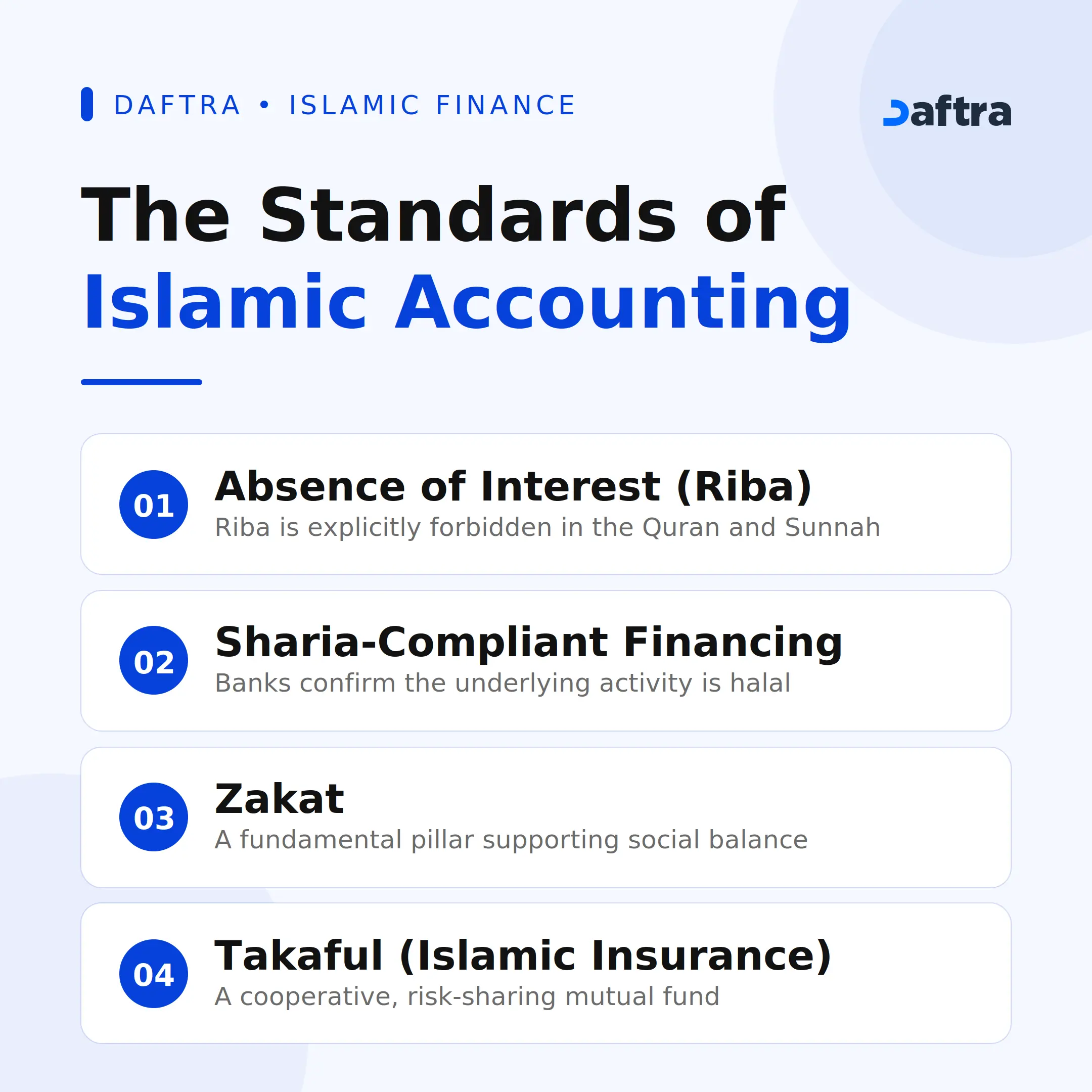
1- The Absence of Interest (Riba)
Islamic banking prohibits borrowing with interest or paying/receiving fixed annual or monthly interest, since riba is explicitly forbidden in the Quran and Sunnah. Instead of interest, transactions are structured around real assets, trade, or profit-and-loss sharing arrangements like Mudaraba and Musharaka, each governed by its own AAOIFI accounting standard for recognizing profits, losses, and capital contributions.
2- Sharia-Compliant Structuring of Trade and Project Financing
Before financing a project, Islamic banks don't just assess its financial feasibility the way conventional banks do; they also confirm the underlying activity is halal. AAOIFI's Sharia Standards guide this screening by setting permissibility rules for specific financing structures such as Murabaha, Ijarah, Istisna'a, and Salam. Once a structure is confirmed as Sharia-compliant, its own accounting standard governs how it's recognized and reported.
3- Zakat
Zakat is a fundamental pillar of Islam and remains one of the most important obligations Islamic banks must meet, as it supports social balance across different classes. AAOIFI addresses zakat through two standards: Zakah, which sets out how zakat is calculated, and Financial Reporting for Zakah, which governs how zakat obligations are disclosed in financial statements.
Note: Tax and zakat differ. Zakat is a legislative pillar owed to God to achieve social justice, while tax is a civic obligation owed to the state to achieve national and social balance.
4- Takaful (Islamic Insurance)
Takaful is a cooperative risk-sharing arrangement built on Islamic insurance principles, where members contribute to a shared fund used to compensate anyone who suffers a covered loss, functioning more like a mutual contribution fund than a conventional donation fund. This is no longer just a general principle: AAOIFI now has two dedicated, currently issued accounting standards covering it: FAS 42 (Presentation and Disclosures in the Financial Statements of Takaful Institutions) and FAS 43 (Accounting for Takaful: Recognition and Measurement), which set out exactly how contributions, the Takaful fund, and claims are recognized and reported.
What are the Fundamental Principles of Islamic Accounting?
Islamic accounting principles rest on a worldview broader than avoiding interest; they combine core Islamic concepts with specific accounting rules that reshape how transactions are recognized, measured, and disclosed.
1- Tawhid and Khilafah
At the foundation is Tawhid, the belief that all wealth ultimately belongs to God, which frames every accounting entity as a trustee (khalifah) managing resources on His behalf, not an absolute owner. This shapes the accountant's role: the institution is answerable not only to shareholders, but to a wider circle of stakeholders and, ultimately, to God for how it generated and used its funds.
2- Prohibition of Riba
Riba cannot be recognized as legitimate earnings under any circumstance. This directly changes classification and disclosure: interest-based income must be separated from ordinary revenue rather than blended into it, and a lawful return must instead arise from trade, lease, or investment participation in a real commercial activity carrying real risk.
3- Avoiding Gharar and Maysir
Islamic accounting rejects contracts built on excessive ambiguity or gambling-like speculation, since accounting reflects the underlying contract structure. In practice, this pushes toward clearer documentation, asset-linked transactions, and fuller disclosure; the accountant must understand a transaction's substance, not just record it mechanically.
4- Profit and Loss Sharing (Justice)
Where funds are invested through Mudaraba or Musharaka, profit must be allocated according to the agreed ratio. At the same time, losses must follow actual economic responsibility, a sharp contrast to interest-based finance, where the financier's return stays fixed regardless of outcome. This ties reward directly to risk and reflects the broader Islamic principle of justice: rights and obligations are recognized fairly, without exploiting any party.
5- Full Disclosure and Social Accountability
Because Islamic institutions answer to a wider set of stakeholders, shareholders, investment account holders, regulators, and society, disclosure goes beyond conventional earnings reporting. Financial statements are expected to make visible whether Sharia rules were followed, whether any prohibited income arose, how zakat obligations were calculated and met, and how the institution's activities served the broader public good, not just its own profitability.
What are the Most Prominent Standards of the Accounting and Auditing Organization for Islamic Financial Institutions?
The Accounting and Auditing Organization for Islamic Financial Institutions (AAOIFI) organizes its work into four main groups of numbered standards: Shari'ah Standards (SS), Accounting Standards (FAS), Governance Standards (GS), and Auditing Standards (AS), alongside a separate Code of Ethics document that is not numbered as a standalone series.
Each group governs a different layer of an Islamic financial institution's operations: SS determines whether a transaction is Sharia-compliant, FAS governs how it is recorded and reported, GS governs how the institution structures its Sharia oversight, and AS governs how compliance is independently reviewed. Below are the most prominent standards within each group.
Shari'ah Standards (SS)
Shari'ah Standards set the religious permissibility rules for specific Islamic finance contracts and instruments; they answer whether a transaction is halal before any accounting treatment is applied.
AAOIFI has issued around 60–61 Shari'ah Standards to date (the draft English translation of all Shari'ah Standards spans SS 1–61, with SS 55 "Contests and Prizes" among the most recent additions); here are 10 of the most foundational:
Accounting Standards (FAS)
Financial Accounting Standards govern how Sharia-compliant transactions are recognized, measured, presented, and disclosed in the financial statements. AAOIFI has issued more than 50 FAS to date; the numbering has now reached FAS 53, "Istisna-Based Development Contracts." Here are 10 of the most widely applied:
Governance Standards (GS)
Governance Standards define how Sharia oversight is structured and operated within an Islamic financial institution. AAOIFI currently has 17 formally issued Governance Standards:
Two additional standards have been approved in principle by AAOIFI's Governance and Ethics Board (AGEB) but are not yet formally issued: GS 24 "Governance and Management of Investment Accounts" (approved in principle, 10 December 2025) and GS 25 “Principles of Assessment of Necessity for Obtaining Conventional Reinsurance by Takaful Institutions”.
Auditing Standards (AS)
Auditing Standards govern how an institution's Shari'ah compliance and financial reporting are independently reviewed. AAOIFI currently has 3 issued Auditing Standards, following a revision project that replaced the older SOAA 1–5 series:
What are the types of financial contracts in Islam?
Islamic financial contracts can be organized and classified using a widely used approach in Islamic jurisprudence and Islamic banking literature: classification by the nature and subject matter of the contract.
1- Ijarah Contracts (Lease Contracts)
Ijarah is the sale of a known usufruct for a known consideration over a specified period. In essence, it is a "sale of benefit" rather than a sale of the asset itself. Ownership of the underlying asset remains with the lessor throughout the contract term, while only the right to use and benefit from the asset is transferred to the lessee.
Sub-types:
- Operating Ijarah.
- Ijarah Muntahia Bittamleek (Lease Ending in Ownership)
- Forward Ijarah.
- Parallel Ijarah.
- Ijarah to the Purchaser.
- Key conditions of Ijarah.
2- Sale Contracts (Bay')
A sale is the exchange of property for property in a specified manner, meaning the transfer of ownership of an asset or usufruct in exchange for a price. Sale contracts are among the most widely used contracts in contemporary Islamic banks and constitute a significant portion of their financing portfolios.
Main types:
- Spot Sale.
- Bay' al-Muajjal / Installment Sale
- Murabahah
- Tawarruq
- Salam
- Istisna'
- Bay' al-Arbun
- Bay' al-Dayn
- Bay' al-Wafa
- Bay' bil Khiyar
- Barter Sale
3. Partnership Contracts (Sharikah)
These contracts involve two or more parties who jointly contribute capital and/or labor and agree to distribute profits according to pre-agreed ratios. In contrast, losses are distributed according to the parties' respective capital contributions.
An exception is Mudarabah, where the capital provider bears the financial loss unless the loss results from misconduct, negligence, or a breach of the agreed terms by the working partner.
Sub-types:
- Musharakah
- Mudarabah
- Diminishing Musharakah
- Muzara'ah
- Musaqah
- Mugharasah
- Mudarabah Investment Deposits
4- Exchange Contracts (Sarf / Mubadalah)
This category includes contracts whose subject matter involves exchanging two countervalues of the same type, such as cash for cash, or of different types subject to specific rules, as in currency exchange.
These contracts are characterized by strict conditions on immediate possession and, where required, equivalence, to prevent riba.
Sub-types:
- Sarf
- Barter
- Sale of debt for debt
- Debt-exchange elements within related financial instruments
Other Types of Contracts Within the Same Classification
Because this classification is based on the nature and subject matter of the contract, other important families of contracts complement the overall framework but do not fall directly under sale, lease, partnership, or exchange contracts.
A- Security and Guarantee Contracts
- Rahn
- Kafalah
- Hawalah
B- Agency and Safekeeping Contracts
- Wakalah
- Wadiah
C- Charitable and Gratuitous Contracts
- Qard Hasan
- Waqf
- Hibah
D- Service Contracts
- Ju'alah
What are the Methods of Accounting in Islamic Financial Institutions?
The methods of applying accounting in Islamic financial institutions depend on following the standards of the Accounting and Auditing Organization for Islamic Financial Institutions (AAOIFI), and these are the most prominent steps and methods followed for Islamic accounting:
1- Receiving Cash Deposits
One of the most important methods of accounting in Islamic financial institutions is receiving various cash deposits from clients and investing them while bearing risk jointly in case of loss.
2- Speculation with Depositors' Funds
Trading and speculation with depositors' funds while prohibiting lending them.
3- No Interest Earned
Neither the financial institution nor the client receives interest from the other party according to the nature of the financial transaction, and Islamic financial institutions do not impose penalties for delayed payment or settlement.
4- Commitment to Current Accounts Only
Only current accounts represent obligations on Islamic financial institutions.
5- Measurement and Evaluation
Measuring and evaluating projects and assets based on financial indicators such as Return on Investment (ROI) and Return on Assets (ROA) with the aim of evaluating project performance and achieving financial goals.
Thus, we can summarize the methodologies of accounting in Islamic financial institutions as working on measuring and evaluating projects, speculation, the absence of interest, and speculation with depositors' funds.
What Is the Difference Between Islamic Accounting and Conventional Accounting?
Islamic and conventional accounting don't just use different vocabulary for the same transactions; they rest on different legal foundations, and that shapes how a contract is structured, recognized, and disclosed. Below is a summary of the key differences, followed by a worked example showing where the two approaches actually diverge.
Key Points of Difference:
| Point of Comparison | Conventional Accounting | Islamic Accounting |
| Reference framework | Secular commercial law (IFRS/GAAP), no religious screening. | Shariah principles first; technical treatment (e.g., AAOIFI FAS) applies only once the contract is Shariah-compliant. |
| Source of return | Interest (riba) is a fixed charge on money lent. | Profit or rent from a real transaction: a sale (Murabahah), lease (Ijarah), or share in actual profit/loss (Musharakah/Mudarabah). |
| Underlying contract | A loan (qard). | A sale, lease, or partnership contract. |
| Risk-bearing | Risk sits with the borrower; the lender's claim is fixed. | The financier genuinely bears risk at some stage (e.g., owns the asset before reselling it). |
| Late payment | Additional/penalty interest may be charged. | No extra profit may be added; any late charge collected is typically donated to charity, not booked as income. |
| Disclosure | Cost of funds to the lender need not be disclosed. | Cost and profit margin must be fully disclosed in Murabahah. |
| Zakah | Not applicable. | Must be calculated and reported per dedicated standards (e.g., FAS 39). |
| Activity screening | Any legal, profitable activity may be financed. | Activities are screened halal/haram before any accounting treatment applies. |
Read Also: A Comprehensive Guide to Financial Accounting
Last quarter, two clients came to me needing the same equipment for SAR 375,000. I booked their financing two completely different ways, and comparing the files taught me the real difference between conventional and Islamic finance.
Client A had a conventional bank loan: SAR 375,000 at 8% annual interest over 5 years. He bought the equipment directly; the bank never touched it. I recorded:
- Equipment (asset): SAR 375,000
- Loan Payable: SAR 375,000
- Interest Expense: accrued over the loan term
The bank’s claim was purely monetary, indifferent to the equipment itself. When Client A fell behind on a payment, the bank added more interest.
Client B entered into a Murabahah with an Islamic bank. The bank bought the equipment first, briefly owned it, then resold it to Client B at cost plus a disclosed profit of SAR 45,000 over 5 years. I recorded:
- Equipment (asset): SAR 375,000
- Murabahah Payable: SAR 420,000 (375,000 + 45,000), amortized as deferred financing cost, not “interest”
When Client B’s payment slipped, I found I couldn’t add a late charge; the price was fixed at signing, and any late fee collected goes to charity, not bank income.
Side by side, the lesson was clear. The numbers looked similar, but the substance didn’t. Client A’s debt came from borrowed money alone; Client B’s debt existed only because a real sale of a real asset happened first. Client A’s bank bore no risk beyond repayment; Client B’s bank briefly owned that equipment and carried real risk, which is why their profit counted as legitimate income, not riba. And while Client A’s loan could be restructured with more interest, Client B’s price was locked in for good.
Simply swapping “interest” for “profit” wouldn’t have made Client A’s loan Islamic. What made Client B’s Murabahah different was that the bank’s return came from owning and selling something real, not from lending money against a promise of more money.
What is the Difference Between Islamic Banks and Traditional Banks?
We can summarize the differences between Islamic and traditional banks in that Islamic banks are institutions that accept money on the basis of murabaha, and all their transactions depend on Sharia rulings, but they cannot obtain self-financing due to the absence of interest. In addition to this, they bear losses with the client.
As for traditional banks, they are purely monetary institutions that depend on lending with interest rates and can obtain self-financing. Additionally, their profit comes from interest, and they do not bear losses with the client; the loss falls on the client alone.
Now we will explain the differences between Islamic and traditional banks in detail:
| Comparison Aspect | Islamic Banks | Traditional Banks |
| Concept | It is a banking financial institution that accepts money based on the principle of murabaha, which is one of the types of Islamic financing that ensures providing capital in exchange for a share in profits. Islamic banks operate based on two fundamental principles: al-kharaj bil-daman (meaning the bank's obligation to compensate the client for project losses that do not result from poor management), and the second principle is al-ghurm bil-ghunm (based on which the Islamic bank retains part of the profits achieved from the client's project, with the aim of compensating the bank for potential financial risks in case profits are not achieved, and in case they are achieved, they are distributed between the bank and the work based on predetermined and agreed-upon percentages). | One of the forms of monetary institutions that deals in monetary credit and private banking transactions for commercial and financial papers, and has individual material objectives for trading in money through usury and interest with the aim of maximizing wealth. |
| Nature and Character of Dealings | Practices banking tasks and financial intermediation in all forms that comply with Islamic Sharia provisions, whether as seller, buyer, or partner, and rents banking services based on (trust funds), so it deals with the current account holder, considering the good loan or al-kharaj bil-daman, and the investment account holder is the capital owner. | It is an intermediary between savers, depositors, and investors, and relies fundamentally on the basis of lending with interest rates. |
| Internal and External Financial Resources | Islamic banks cannot finance themselves by issuing shares, due to the usurious interest resulting from them, but they can issue sukuk as a means of collecting financing, and they do not lend or borrow with interest. Accounts are divided into two types: the general demand account, which is established based on absolute mudaraba, and the special demand account, which is established based on restricted mudaraba. | Traditional banks can self-finance by issuing preferred shares or external financing through deposits and loans with interest. |
| Profit | Achieved through capital, guarantee, and work according to Islamic Sharia foundations. | Achieved from the difference between debit and credit interest in banking transactions. |
| Loss | Borne by both the bank and the client if the causes are beyond the client's management, such as Islamic banks bearing losses related to the capital owner in mudaraba, and in case of market transfers. | The borrower alone bears the loss, even if it was for reasons beyond their control. |
| Oversight | Oversight is from the central bank, the general assembly, the auditor, and the legal monitor, in addition to the existence of Sharia oversight to ensure compliance with Sharia controls. | Traditional banks share with Islamic banks in implementing oversight work by the central bank, the general assembly, the auditor, and the legal monitor. |
What is the Importance of Accounting and Auditing Standards for Islamic Financial Institutions?
The Accounting and Auditing Organization for Islamic Financial Institutions (AAOIFI) has established a set of standards that regulate operations and transactions in Islamic financial institutions. The role of accounting and auditing standards for Islamic financial institutions appears in:
1- Ensuring Compliance with Islamic Sharia Principles
Regarding accounting operations, auditing, and review, under these standards, the foundations and principles that must be followed have been clarified to ensure that financial activities are conducted according to Islamic Sharia rulings.
2- Enhancing Trust and Transparency Between Clients, Investors, and Islamic Financial Institutions
By working according to a unified and recognized accounting framework, which allows for the exchange of financial information between concerned parties in a smooth and clear manner, it is possible to evaluate performance and financial risks.
These unified standards facilitate communication between Islamic financial institutions and each other, and their use for comparison purposes to evaluate the institution's position at the local and international level, and also facilitate communication with regulatory bodies, auditors, and financial analysts.
The "Accounting and Auditing Standards for Islamic Financial Institutions" help address emerging challenges due to dealing with accounting and financial matters such as sales, expenses, and complex financial transactions, which support the growth and development of Islamic financial institutions.
Applications of Islamic Accounting in Financial Institution
Islamic accounting is an applied branch of accounting that records, measures, and discloses financial transactions in line with Shariah, not conventional accounting under a new name. Its treatment starts from the nature of the underlying contract itself (sale, lease, Mudarabah, partnership), unlike conventional accounting, which starts from debt as a single model for all financing. This is clear in Islamic institutions through accounting for sale, lease, and partnership contracts; investment accounts; Zakah; and additional statements with no conventional equivalent.
1- Accounting for Murabahah Contracts
- The bank first records the asset on its books at its actual cost when it purchases it from the supplier.
- When it resells the asset to the customer, it discloses the cost and the agreed profit separately and clearly, not as an interest rate.
- The difference between the deferred sale price and the cost is recorded as "deferred profit," recognized gradually over the payment period, not all at once.
- The price cannot be increased for late payment; any late-payment charge is typically directed to charity, not recorded as bank income.
2- Accounting for Ijarah Contracts (Lease Financing)
- The asset remains on the bank's (lessor's) books as long as ownership hasn't been transferred, and is depreciated annually.
- Record rent received as recurring operating revenue, not as loan repayment plus interest.
- In Ijarah Muntahia Bittamleek (lease ending in ownership), the portion representing rent payment is disclosed separately from the portion representing gradual transfer of ownership.
3- Accounting for Mudarabah and Musharakah Contracts
- Funds from investment account holders (Mudarabah) are not treated as "deposits" or "liabilities" in the conventional sense, but as quasi-equity, since the return is not guaranteed and depends on actual investment performance.
- Profits are distributed at a pre-agreed ratio; any losses fall on the invested capital, not on the bank as manager.
- In Diminishing Musharakah (e.g., real estate financing), the book value of each party's share is updated periodically with each installment.
4- Zakah Accounting
- This application has no equivalent whatsoever in conventional accounting.
- Zakah is calculated on a specific zakatable base (not simply net accounting profit), following precise Shariah rules for each item (cash, inventory, investments, etc.).
- The institution discloses whether it is responsible for paying Zakah on behalf of shareholders, or whether that responsibility falls on the shareholders themselves.
5- Disclosure and Additional Financial Statements
AAOIFI standards require Islamic financial institutions to prepare financial statements with no conventional counterpart, most notably:
- Statement of Sources and Uses of Zakah and Charity Funds
- Statement of Sources and Uses of Qard Hasan (Benevolent Loan) Funds
- Statement of Changes in Restricted Investment Accounts
6- Distinguishing Restricted vs. Unrestricted Investment Accounts
- Unrestricted: Managed within the bank's general funds and disclosed as a separate line item on the balance sheet (neither a full asset nor a full liability).
- Restricted: Managed on behalf of a specific customer under their conditions, and doesn't appear on the bank's balance sheet; it stays off-balance-sheet because the bank acts merely as a managing agent, not an owner or debtor.
How Do You Follow Islamic Accounting Principles Easily Through Daftra?
Over years and centuries, Islamic accounting software has proven its uniqueness and efficiency, placing it in a different position among global accounting software.
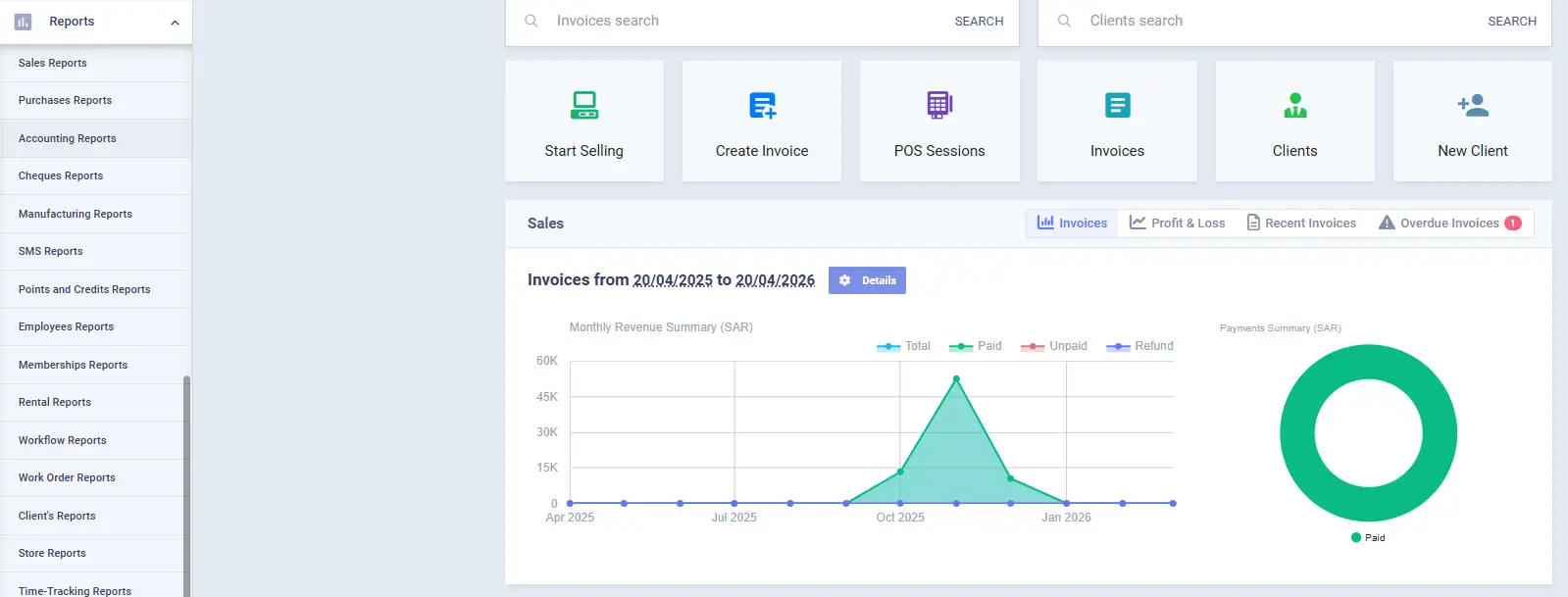
Since Daftra is primarily directed at Arab and Islamic countries, you will undoubtedly find features that help you implement Islamic accounting software through Daftra Accounting Software, with sufficient knowledge of the differences between conventional software and Islamic accounting software. So don't worry about this matter; choose the software you want, and don't forget that our technical support helps you with customization and configuration to get services that match what you want 100%.
In conclusion, Islamic accounting, with its flexibility and continuous development, has been able to address the financial and accounting challenges in Islamic financial institutions while upholding the principles of justice and transparency in financial transactions.
By adopting the Islamic accounting approach, Islamic financial institutions can strengthen their position and credibility by meeting the needs of clients and stakeholders in balanced, fair ways that align with noble Islamic values.
Frequently Asked Questions
What is the function of Islamic banks?
Islamic banks work on all financial and investment transactions, but in accordance with Islamic Sharia and its specific standards.
Why Islamic banks?
Because Islamic banks do not engage in prohibited transactions, they provide a sense of safety in the financial transactions you conduct. In addition, Islamic banks are real investment entities, free from speculation, and they share losses with the client.
What are the types of financial contracts in Islam?
- Ijarah contracts.
- Sale contracts.
- Partnership contracts.
- Exchange contracts.
What are Islamic institutions?
Islamic institutions are institutions and companies that work in ways that serve Islam and its specific teachings, such as Islamic scholarly institutions, charitable institutions that help the needy and poor, or institutions responsible for serving the Islamic religion in all ways.
What are the prohibited financial transactions?
- Usury (riba).
- Gambling or games of chance.
- Taking money unlawfully.
- Deception and fraud in buying and selling.
What are the financial acts of worship?
- Charity.
- Hajj or Umrah.
- Spending in the way of Allah.
- Zakat.
- Participating with money in charitable works.
- Paying money to develop and improve society.
What Is the 30% Rule in Islamic Finance?
The 30% rule is a key financial screening criterion (mainly from AAOIFI Shari'ah Standard No. 21) used to determine whether a stock is Shariah-compliant. It states that a company's interest-bearing debt must not exceed 30% of its market capitalization, and interest-bearing cash/securities must also stay under 30%, with impermissible income capped at 5% of total income. The goal is to exclude companies heavily reliant on interest-based financing, while allowing a practical margin since almost no large public company is entirely debt-free. Other indexes (like Dow Jones Islamic Market) use a 33% threshold instead of 30%.
Is a Credit Card Haram or Halal in Islam?
Scholars are divided. The stricter view holds that credit cards are haram outright, since the contract itself includes a commitment to pay interest if payment is delayed, and that commitment is considered impermissible even if interest is never actually charged. The more permissive view (e.g., Dr. Monzer Kahf) holds that credit cards are permissible as long as the balance is paid in full before the due date, so the interest clause is never actually triggered. Shariah-compliant credit card alternatives now exist (e.g., in Malaysia and the UAE), built on fixed service fees or a Murabaha structure instead of interest.









 Invoicing
 POS
 Offers
 Installments
 Sales Commission
 KSA E-Invoice Software
 EGY E-Invoice Software
 JO E-Invoice Software
 E-Invoice Software
 Chart of Accounts
 Asset Management
 Cost Centers
 Expenses
 Cheque Cycle
 UAE VAT-Tax
 Product Management
 Purchases
 Purchase Cycle
 Suppliers
 Requisitions
 Stocktaking
 Organizational Structure
 Personnel Management
 Attendance and Leave
 Contracts
 Payroll
 Requests
 Work Orders
 Booking Management
 Rental and Unit Management
 Time Tracking
 Work Flow
 Lease Contracts
 Manufacturing Management
 Client Follow-Up
 Loyalty Points
 Points and Credits
 Memberships
 Insurance Management
 Daftra ERP Full App
 Point of Sales App
 Point of Sales for Desktop – Support Offline Mode
 AI Expenses Scanner App
 Employee Attendance, Sign & ESS App
 E-invoice Reader App
 Inventory Stocktaking App