





Table of contents:
- Quick Takeaways
- What Are International Accounting Standards?
- Key International Accounting Standards
- What Is IFRS?
- What Is the Difference Between IAS and IFRS?
- What Is the Difference Between Accounting Standards and Accounting Principles (GAAP)?
- When Did International Accounting Standards Emerge?
- How Are the Standards Issued?
- Why Do International Accounting Standards Matter?
- What Are the Objectives of the Standards?
- Who Uses Accounting Information?
- What Is the Impact of the Standards?
- Daftra Helps You Comply with International or Local Standards
- Frequently Asked Questions
As businesses and investment activity have grown, the need for financial reports and statements that give investors reliable information has increased. This led to a push for international standards, a shared, cross-border "language of business" that supports the global economy and improves the efficiency of international markets. It also prompted many comparisons between national accounting systems to support the growth of local and international companies and multinational investment.
If you work in accounting, finance, or business, or you have investment plans or commercial activities, International Accounting Standards deserve your attention. This article covers what they are, why they matter, how they affect financial reporting, and the most important standards.
What Are International Accounting Standards?
International Accounting Standards (IAS) are rules and guidelines used to measure the elements of financial statements in light of the circumstances, events, and changes that may affect a company's financial position.
They are relied on to reduce differences of opinion among experts about situations a business may face, and to gauge how efficiently the business is operating.
According to the commonly cited definition, these are accounting standards developed by international standard-setting bodies headquartered in London that later became the basis for preparing financial statements. Today the standard-setter is the International Accounting Standards Board (IASB), which has 14 members drawn from different countries.
Key International Accounting Standards
Companies and organizations should know these standards before carrying out their accounting work, so they follow globally accepted practice and produce reports in a uniform format that makes company-to-company comparison easier.
Inventories (IAS 2)
This standard prescribes the accounting treatment of inventories: assets held for sale in the ordinary course of business, assets in the process of production for sale, and materials or supplies to be consumed in production or in providing services.
Inventory cost includes purchase costs, conversion costs, and other costs of bringing the inventory to its present location and condition, such as transport and import duties. Selling costs and general administrative overheads are excluded. Inventories are measured at the lower of cost and net realizable value.
Property, Plant and Equipment (IAS 16)
These are assets expected to provide future economic benefits, such as production equipment and supplies, assets held for rental to others, or assets used for administrative purposes over more than one accounting period.
They are initially measured at cost, such as purchase or import cost and costs of assembly and preparation for use.
Effects of Changes in Foreign Exchange Rates (IAS 21)
This standard covers the consequences of exchange-rate movements between the transaction date and the settlement date, and how foreign-currency transactions are reflected in the financial statements. It requires a high level of transparency in disclosures.
Earnings per Share (IAS 33)
This standard measures earnings attributable to ordinary shares, assesses how well an entity performs over different reporting periods, and compares performance across entities.
Impairment of Assets (IAS 36)
This standard sets out the procedures to ensure assets are not carried at more than their recoverable amount. Entities must perform impairment tests and disclose impairment losses at the end of each reporting period.
Government Grants (IAS 20)
This standard covers accounting for and disclosure of government assistance to qualifying entities. Grants take different forms, and an entity must disclose their nature and the accounting policy applied.
Business Combinations (IFRS 3)
This standard clarifies the accounting for acquisitions and mergers of businesses, whether vertical, horizontal, or conglomerate in nature.
Leases (IFRS 16, which replaced IAS 17)
This standard covers the recognition, measurement, presentation, and disclosure of leases of property and equipment, so both lessees and lessors provide faithful, consistent information.
Agriculture (IAS 41)
This standard covers the financial reporting of agricultural activity, including the measurement of biological assets, generally at fair value less costs to sell, up to the point of harvest and their conversion into agricultural produce.
Investment Property (IAS 40)
This covers property held to earn rentals or for capital appreciation, such as buildings leased out to others. It is measured using either the cost model or the fair value model.
Events After the Reporting Period (IAS 10)
Entities may need to adjust financial statements already prepared to reflect events that occurred after the reporting period.
Accounting Policies, Changes in Accounting Estimates and Errors (IAS 8)
This standard governs changes to accounting policies and the correction of prior-period errors to provide more reliable information.
What Is IFRS?
IFRS stands for International Financial Reporting Standards (now officially branded IFRS Accounting Standards). It is a set of accounting standards providing guidance on how to prepare and present financial statements, developed and published by the International Accounting Standards Board (IASB).
The aim of IFRS is to harmonize accounting standards worldwide, making it easier for companies to operate across borders and helping investors and analysts understand and compare the financial performance of companies from different countries.
What Is the Difference Between IAS and IFRS?
IAS and IFRS are not rival frameworks: IAS is the older set of standards, IFRS is the newer one, and many IAS remain in force alongside IFRS. The main differences are:
- Issuer and timing: The International Accounting Standards Committee (IASC) issued IAS, established in 1973. In 2001, the IASB took over and adopted the existing IAS, and has since issued new standards under the IFRS name (the first, IFRS 1, in 2003).
- Scope: IFRS are the more recent standards and cover newer and more detailed areas, such as insurance contracts, revenue, and financial instruments.
- Approach: IAS tend to set general principles not tied to a specific industry, while several IFRS address particular transactions or industries and guide practitioners on the right accounting treatment.
- Consistency: Clear and comprehensive standards produce more consistent information in financial reports, while gaps or ambiguity can lead to differences in application and analysis.
- Adoption: IFRS Standards, including the IAS that remain in force, are required or permitted in more than 140 jurisdictions.
What Is the Difference Between Accounting Standards and Accounting Principles (GAAP)?
Accounting standards regulate how reports are prepared and how final financial statements are arranged. Each addresses a specific item or group of items to be presented to management and investors.
Accounting principles are the set of rules applied to every accounting transaction. They are fixed conventions agreed among the parties concerned.
In short, standards define how to recognize, measure, present, and disclose the elements of financial statements, while principles provide a broad framework for accounting; without them, accounting would have no direction. Put differently: if principles are the theory of managing financial resources and obligations, standards are the concepts and guidance that put those principles into practice.
When Did International Accounting Standards Emerge?
The idea isn't new. The need arose in the 1950s, driven by post-World War II economic conditions and growing cross-border capital flows.
Early efforts focused on reducing differences among experts over the accounting practices in use in the capital markets. The 1960s brought calls for unified standards; the 1970s and 1980s saw the creation of an international committee to set them; the 1990s saw that committee restructured; and the 2000s focused on developing a rigorous set of standards applicable in all capital markets.
How Are the Standards Issued?
Issuing standards is a complex, structured process involving several steps and stakeholders, designed to ensure the standards reflect the needs and expectations of the global accounting community. The IASB develops and issues IFRS. The steps are:
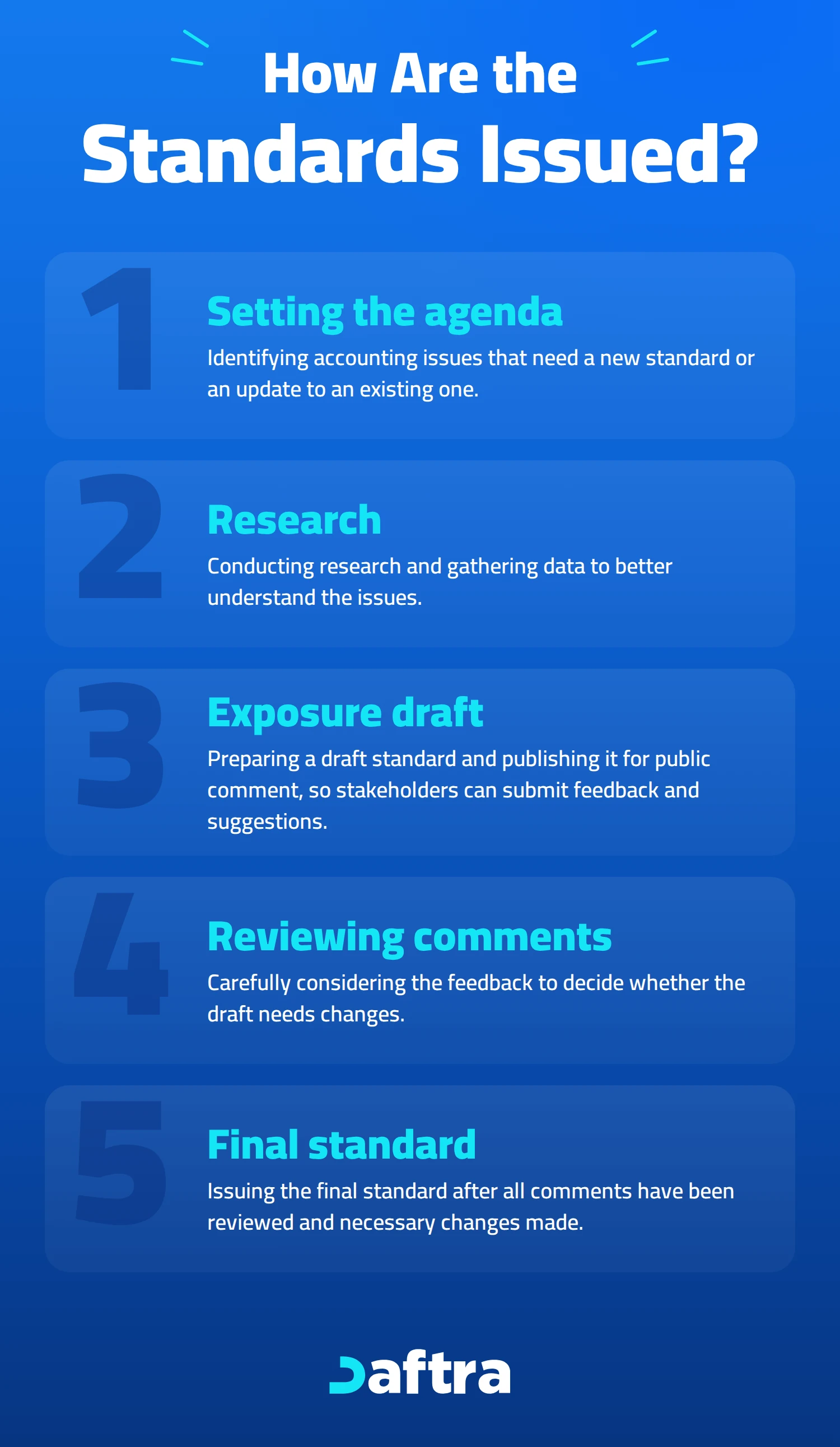
- Setting the agenda: identifying accounting issues that need a new standard or an update to an existing one.
- Research: conducting research and gathering data to better understand the issues.
- Exposure draft: preparing a draft standard and publishing it for public comment, so stakeholders can submit feedback and suggestions.
- Reviewing comments: carefully considering the feedback to decide whether the draft needs changes.
- Final standard: issuing the final standard after all comments have been reviewed and necessary changes made.
You may also like: The Importance and Types of Accounting Books
Why Do International Accounting Standards Matter?
Investment and trade between organizations and across countries have multiplied, alongside currency fluctuations, exchange rates, and inflation. All of this has highlighted the importance of the standards, which:
- Produce credible, neutral financial statements free of personal interests.
- Support sound decisions and settle differences in viewpoint, since decisions rest on shared standards.
- Define appropriate ways of measuring information.
- Give investors and users of financial statements honest analytical results.
- Standardize how transactions are recorded and presented, making it easier for investors and analysts to compare companies.
- Increase investor and creditor confidence in a company's financial statements, making it easier to raise capital and expand.
- Improve financial market efficiency through greater transparency and comparability.
- Help companies comply with local and international laws and regulations, reducing the risk of penalties and fines.
- Give companies a framework for organizing their financial transactions more effectively, supporting informed management decisions.
What Are the Objectives of the Standards?
Accounting is often described as the language of business, showing an organization's financial position. Like any language, it has rules that govern it, and the main objectives of the standards are to:
- Ensure the credibility of the data used to prepare financial reports and statements; non-compliance can have serious consequences.
- Enable comparisons between companies and organizations, showing a company's internal position and standing.
- Apply a consistent set of accounting policies, including disclosure of how different transactions are accounted for.
Who Uses Accounting Information?
Under IFRS, users of accounting information are either internal or external:
- Investors: use financial statements to decide whether to buy, sell, or hold securities.
- Creditors and lenders: assess credit risk and make lending decisions.
- Employees: gauge their employer's stability and profitability, and use the data in wage and benefits negotiations.
- Management: makes strategic and operational decisions.
- Suppliers and customers: want to understand the financial stability and ability to pay of the companies they deal with.
- Governments and regulators: determine taxes and fees and monitor economic activity.
- The public: consumers and communities affected by a company's activities and financial performance.
What Is the Impact of the Standards?
The standards focus on accounting assumptions and foundations, and some governments have issued rules requiring compliance. Each standard applies from a specified effective date, and its transition provisions determine whether and how it applies to prior periods. Key outcomes include:
- Transparency and efficiency: they provide financial information that promotes transparency and efficiency in financial markets worldwide, and help regulators everywhere obtain comparable financial statements.
- Better international investment: a single accounting language and standard lowers the cost of capital and avoids unnecessary preparation of multiple sets of statements and reports.
- Flexibility: because they rest on general, applicable principles, they can accommodate the full range of expected and unexpected market conditions.
- Wider recognition: statements prepared under them are recognized in countries that apply the standards, without needing separate reports and financial studies for foreign markets.
- Fraud prevention: they discourage misstatement and fraud in the data used to prepare financial statements, helping auditors verify the data and improving reliability.
- Performance measurement: they help measure the ability of an organization's different divisions to increase profitability and meet financial obligations.
- Comparability across borders: Before IFRS, each country relied on its own set of standards, which made cross-border comparison difficult. IFRS improves transparency and comparability, helping investors and analysts understand company performance and make informed decisions.
- Market confidence: By providing a unified and reliable reporting framework, IFRS has increased confidence in global financial markets.
- Continuous evolution: IFRS continues to evolve to reflect changes in the global economic and financial environment, so the standards remain relevant and effective.
- Challenges: Despite the benefits, adopting IFRS can be difficult, especially for small and medium-sized enterprises and for countries whose accounting standards differ significantly from IFRS.
Daftra Helps You Comply with International or Local Standards
Daftra's accounting software is flexible enough to be configured to the accounting standards you follow. Whether you use international, US, or local standards, you can easily set up the system to align with them.
All you need to do is adapt your usage and run your calculations so they apply to your setup.
Frequently Asked Questions
How many international accounting standards are there for the public sector?
The International Public Sector Accounting Standards Board (IPSASB) issues public-sector standards under the name IPSAS. As of January 2022, there were 42 accrual-based IPSAS, but the board has issued further standards since, so the number has grown. The standards are continually updated to meet the changing needs of public-sector accounting, so the count changes over time.
What is IAS 18?
IAS 18 sets out when and how to recognize revenue from the sale of goods or the provision of services. It was replaced by IFRS 15 from 2018.
What is IFRS 16?
IFRS 16 sets out the principles for recognizing, measuring, presenting, and disclosing leases so that lessees and lessors provide faithful information about lease contracts. It replaced IAS 17. (Not to be confused with IAS 16, which covers property, plant and equipment.)
What is IFRS 15?
IFRS 15 deals with revenue from contracts with customers. It aims to give users of financial statements useful information about the nature, amount, timing, and uncertainty of revenue and cash flows arising from contracts with customers.
What is IFRS 9?
IFRS 9 covers financial instruments, including financial assets and liabilities, which are classified and measured at:
- Amortized cost (e.g., payables, notes payable, bonds)
- Fair value through other comprehensive income
- Fair value through profit or loss
It also includes distinct rules for particular instruments, such as derivatives (futures, forwards, interest rate swaps).
What is IAS 8?
IAS 8 serves three main purposes: ensuring accounting treatment is based on sound estimates; improving reliability so comparisons across periods are fair; and, when accounting policies change, making the basis for the change clear so statements are prepared properly.
What is IAS 2?
IAS 2 deals with inventories. It determines the cost to be recognized as an asset and guides accountants on rules for valuing inventory cost in line with accounting principles.
What is IAS 1?
IAS 1 sets the basis for presenting general-purpose financial statements. Applying it ensures all statements are prepared consistently across reporting periods, making them easy to compare and the business's position easier to assess accurately.
When was IFRS first applied?
The IASB, the body responsible for developing and issuing IFRS, was established in 2001, and the first IFRS followed in 2003. Since then, many countries have adopted IFRS as a main accounting framework, especially for companies listed on financial markets.
What are examples of IFRS standards?
- IFRS 1: First-time Adoption of IFRS
- IFRS 2: Share-based Payment
- IFRS 3: Business Combinations
- IFRS 9: Financial Instruments
- IFRS 15: Revenue from Contracts with Customers
- IFRS 16: Leases
- IFRS 17: Insurance Contracts
(This is a selection, not the full list.)
Which accounting standards does Saudi Arabia adopt?
Saudi Arabia applies IFRS as issued by the IASB and endorsed by SOCPA, with amendments for the accounting treatment of zakat and income tax.
When were IFRS adopted in Saudi Arabia?
In 2012, SOCPA adopted the project to transition to IFRS. From 2017, the standards began to apply to listed companies' financial statements.
What is IAS 10?
IAS 10 covers events after the reporting period. It specifies how to treat events that occur between the end of the reporting period and the date the financial statements are authorized for issue.
What are the objectives of the standards?
To unify accounting practices worldwide and enhance transparency and comparability across companies' financial reports.
What is IAS 24?
IAS 24 covers related party disclosures. It promotes transparency by clarifying how relationships and transactions with related parties affect the entity's financial position.
What are the International Public Sector Accounting Standards?
IPSAS are a set of accounting standards that provide consistent, harmonized reporting for governments and other public-sector entities.
How do IFRS and US GAAP differ on revenue recognition?
Historically, IFRS took a principles-based approach focused on transferring goods and services to the customer at the transaction price, while US GAAP provided detailed, industry-specific guidance. Since IFRS 15 and ASC 606 were issued, the two have largely converged, though some differences remain.
What role do the standards play in limiting creative accounting?
This is one of their most important roles. First, they provide a unified framework for preparing all financial reports, which strengthens transparency and credibility. Second, they help prevent data manipulation.
What have the standards added to local accounting practice?
They have brought many improvements, such as standardized reporting, greater transparency, and more efficient management of operations.








 Invoicing
 POS
 Offers
 Installments
 Sales Commission
 KSA E-Invoice Software
 EGY E-Invoice Software
 JO E-Invoice Software
 E-Invoice Software
 Chart of Accounts
 Asset Management
 Cost Centers
 Expenses
 Cheque Cycle
 UAE VAT-Tax
 Product Management
 Purchases
 Purchase Cycle
 Suppliers
 Requisitions
 Stocktaking
 Organizational Structure
 Personnel Management
 Attendance and Leave
 Contracts
 Payroll
 Requests
 Work Orders
 Booking Management
 Rental and Unit Management
 Time Tracking
 Work Flow
 Lease Contracts
 Manufacturing Management
 Client Follow-Up
 Loyalty Points
 Points and Credits
 Memberships
 Insurance Management
 Daftra ERP Full App
 Point of Sales App
 Point of Sales for Desktop – Support Offline Mode
 AI Expenses Scanner App
 Employee Attendance, Sign & ESS App
 E-invoice Reader App
 Inventory Stocktaking App