



Table of contents:
- What is Contribution Margin?
- How to Calculate Contribution Margin?
- What is the Contribution Margin Ratio?
- How to Calculate Contribution Margin Ratio?
- What is the Contribution Margin at the Break-Even Point?
- What is the Difference Between Profit Margin and Contribution Margin?
- What is the Difference Between Gross Margin and Contribution Margin?
- What is the Importance of Contribution Margin?
- How to Improve Contribution Margin
- What is a good contribution margin ratio?
- How Daftra Can Help You Calculate Contribution Margin
- Frequently Asked Questions
- Conclusion
How Can Contribution Margin Affect a Company's Overall Financial Performance? The answer lies in using the contribution margin as a strategic indicator for making pricing decisions, financial planning, and allocating resources efficiently and effectively.
In this article, we provide a comprehensive guide to the concept of contribution margin, its importance, how to calculate it, the meaning of the contribution margin ratio, and the difference between contribution margin and other key concepts related to understanding the basics of profit and costs.
What is Contribution Margin?
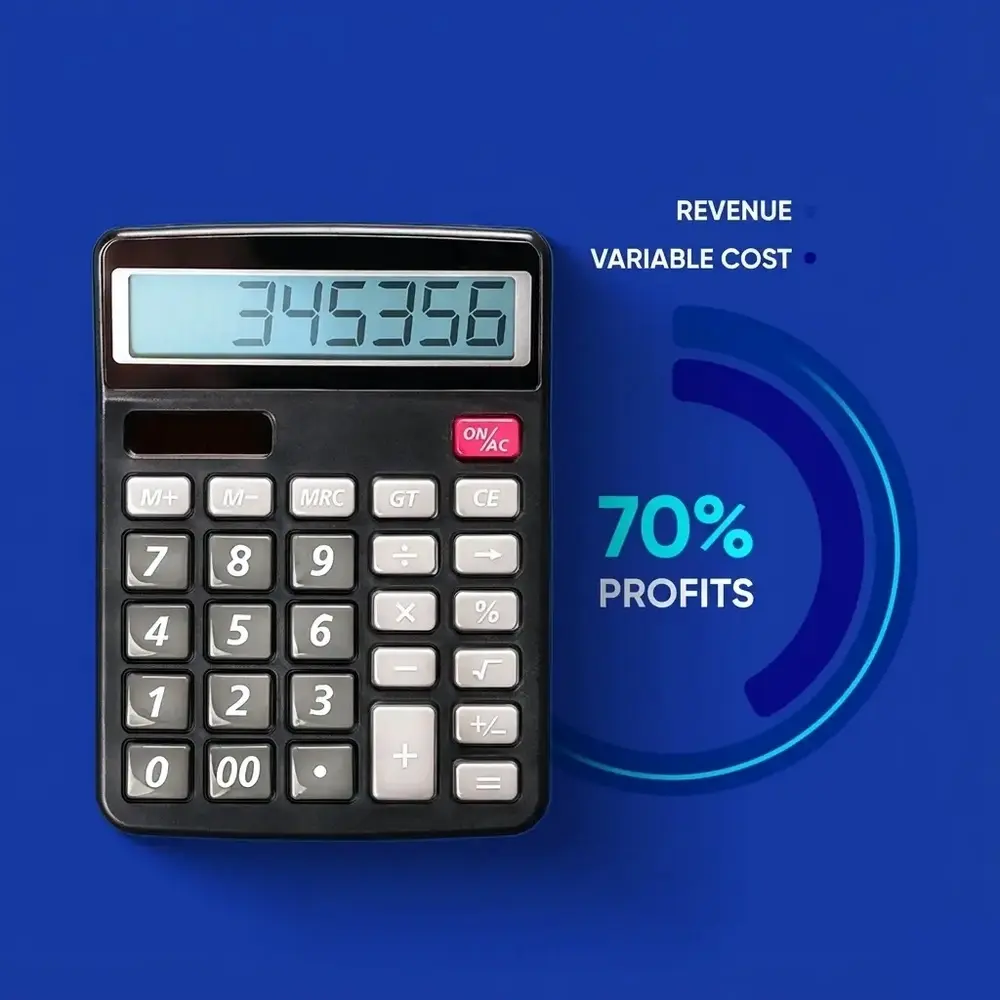
Contribution margin is the difference between revenue from selling a product or service and its variable costs; it covers the entity's fixed costs, and whatever remains after covering them represents profit.
How to Calculate Contribution Margin?
You can calculate contribution margin using two key formulas: total contribution margin and contribution margin per unit. Each equation offers a different perspective on how sales cover variable and fixed costs and generate profit.
What is the Contribution Margin Ratio?
The contribution margin ratio (CMR) represents the percentage of revenue remaining after deducting variable costs; it indicates the portion of each riyal of sales available to cover fixed costs and generate profit.
Companies use this metric to evaluate financial performance over time, such as year-over-year or quarterly comparisons, and to benchmark performance against similar companies in the same sector.
How to Calculate Contribution Margin Ratio?
The contribution margin ratio expresses the contribution margin as a percentage of total revenue and can be calculated using the following formula:
What is the Contribution Margin at the Break-Even Point?
The contribution margin at the break-even point is what remains after deducting variable costs from total sales at the sales level where revenue equals total costs. At this point, the total contribution margin equals fixed costs; consequently, the business neither generates a profit nor incurs a loss.
The contribution margin at the break-even point helps determine the minimum sales volume or number of units required to cover fixed costs. Once sales exceed the break-even point, the contribution margin from additional units contributes to profit after fixed costs are covered.
Therefore, understanding the relationship between contribution margin and the break-even point is crucial when analyzing pricing, sales volume, costs, and how changes in these factors affect the business's profitability.
The break-even point for contribution margin is calculated using the following accounting formula:
What is the Difference Between Profit Margin and Contribution Margin?
The following table clearly and simply presents the differences between the profit margin and the contribution margin.
| Basis of Comparison | Contribution Margin | Profit Margin |
| Definition | The difference between revenue and variable costs only | The difference between revenue and total variable and fixed costs |
| Equation | Revenue – Variable Costs | Revenue – Total Costs |
| Fixed Costs | Not deducted | Fully deducted |
| Primary Objective | Determines the extent to which each unit contributes to covering fixed costs and generating profit | Determines the actual final profitability of the company or product |
| Level of Usage | Internal analysis of each product or product line | Provides a comprehensive analysis of the company or individual product after accounting for all costs |
| Uses | Used in break-even analysis, product pricing, and decision-making regarding the discontinuation or continuation of a specific product line | Assesses overall financial performance, facilitates company comparisons, and aids in investor reporting |
| When it appears in financial statements | Does not appear as a line item in financial statements | Appears on the income statement |
| Relationship to Profit | Does not necessarily indicate that the entity is generating a profit | Reflects actual profit after all obligations |
What is the Difference Between Gross Margin and Contribution Margin?
Below, we present the key differences between the contribution margin and gross margin:
| Basis of Comparison | Contribution Margin | Gross Profit Margin |
| Definition | The difference between revenue and variable costs only | The difference between revenue and the cost of goods sold only |
| Equation | Revenue – Variable Costs | Revenue – Cost of Goods Sold |
| Basis of Classification | Based on cost behavior | Based on cost function |
| What is Deducted | All variable costs (production + variable selling and administrative) | Direct production costs only |
| Fixed Costs | Not deducted | Deducted |
| Variable Costs | Deducted | Not deducted (as they are not part of production costs) |
| Goal | Internal management analysis, break-even point calculation, pricing, and production decisions | Evaluating production process efficiency and setting base product prices |
| Presentation in Financial Statements | Does not appear as a formal line item | Officially appears on the income statement under financial accounting |
What is the Importance of Contribution Margin?
The importance of contribution margin becomes even more evident when companies and business entities make pricing and cost-management decisions.
A restaurant in Riyadh launched a promotion to boost order volume by selling a meal for 35 SAR instead of the original price. After the launch, orders rose significantly and total sales improved, suggesting the promotion achieved its intended goal.
However, when management reviewed the period's results, they noticed that the sales increase did not translate into a proportional increase in profitability. To identify the cause, our team at Daftra compared the contribution margin per meal before and after the promotion, rather than relying solely on total sales.
The review also factored in variable costs per order, including ingredients, packaging materials, delivery platform fees, and payment processing charges. The comparison showed that lowering the meal price from 45 SAR to 35 SAR reduced the contribution margin per order, and the increase in order volume did not offset this decline.
Consequently, this analysis helped restaurant management understand how selling price, sales volume, and variable costs interact, moving beyond evaluating the promotion's success based on sales figures alone. This highlights the importance of calculating contribution margin when evaluating promotions and pricing strategies, and when making decisions about sales and profitability.
Here are the reasons that highlight the importance of contribution margin:
Measuring Profitability
Total and marginal contribution margin, and the contribution margin ratio, measure the profit the company earns from each additional unit sold and help determine the break-even point through cost-volume-profit analysis.
Determining the Break-Even Point
It shows the minimum required sales to cover variable costs. It shows whether selling prices cover variable costs that change with activity level, which affects pricing decisions and budget planning.
Setting the Product or Service Price
Calculating the contribution margin is important for pricing by analyzing different price levels and volumes, which supports effective budget planning.
Budget Planning
By calculating the contribution margin, you can find ways to increase revenue or reduce variable costs by using cheaper alternatives or options, raising product prices, and estimating expected revenues and potential profits.
Making Investment Decisions
Calculating the contribution margin helps you add a new production line, determine distribution areas, design products, and make other decisions.
Improving Profitability and Controlling Costs
Once you know the total contribution margin and each product's margin, you can analyze profit trends and control costs.
Assessing Operating Leverage
A high contribution margin indicates that the company is highly sensitive to sales fluctuations; sales drive profit growth, while a decline in sales amplifies losses. This helps investors assess risk.
Assessing Business Model Quality
A strong, stable contribution margin shows the entity's ability to withstand shocks and cover fixed costs, helping investors make informed investment or financing decisions.
How to Improve Contribution Margin
Some of the most effective ways to improve contribution margin are:
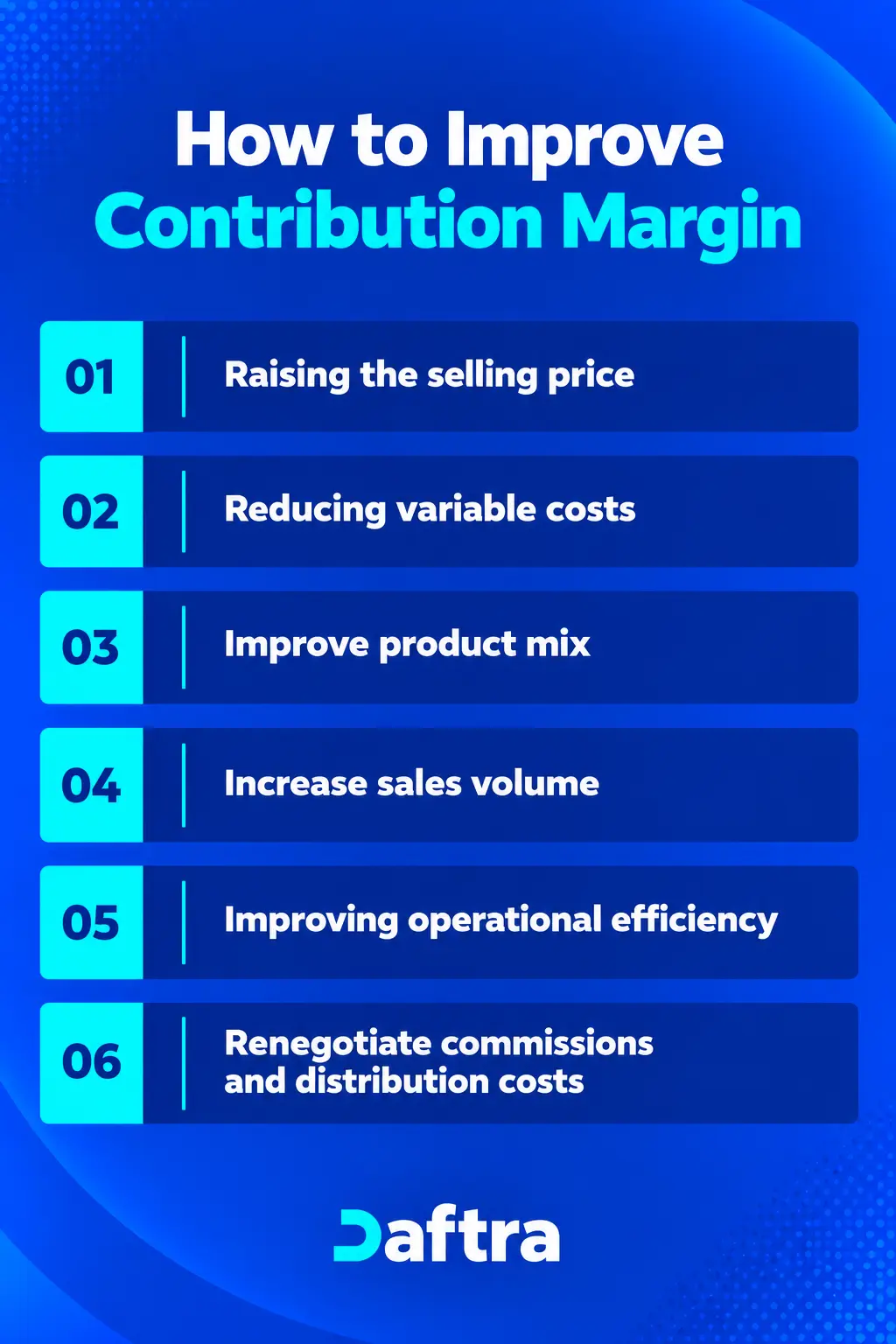
1- Raising the selling price
You can increase contribution margin by raising the selling price of products or services, provided it does not significantly reduce sales volume; gradually raise prices, offer different pricing levels, or test price increases and monitor their impact on sales volume and contribution margin. In other words, when implementing this strategy in Saudi Arabia, Value Added Tax (VAT) must be taken into account when calculating the net contribution margin to ensure that the price increase reflects a genuine improvement in the margin.
2- Reducing variable costs
This can be achieved through:
- Negotiating with suppliers to obtain better prices for raw materials or discounts when purchasing in large quantities. Saudi companies can also leverage local sourcing instead of importing to reduce shipping costs and customs duties, in alignment with Vision 2030 objectives to support local content.
- Searching for other alternatives at a lower cost for the materials used while maintaining the level of quality
- Improving production efficiency to reduce waste and material consumption per unit
- Automate labor-intensive processes. In the Saudi market, this point gains added significance given the costs of recruiting expatriate labor and the fees associated with the Nitaqat system; this makes automation an effective option for reducing variable unit costs while remaining compliant with Saudization requirements.
- Optimize shipping and packaging processes and leverage bulk shipping to reduce unit costs
3- Improve product mix
Analysis of the contribution margin for each product helps determine which products make a greater contribution to covering fixed costs and achieving profit through:
- Directing sales and marketing efforts towards products with a higher contribution margin
- Review low-margin products and re-price or adjust their costs
- Using contribution margin analysis to determine which products deserve priority in promotions, offers and packages
4- Increase sales volume
It is possible or possible to increase sales volume to improve the gross contribution margin, provided that the additional units are profitable and the variable costs are stable, and one of the most important methods for achieving this is:
- Take advantage of the abundance of volume by purchasing raw materials in large quantities
- Expanding into new markets or adding sales channels to help increase sales. For Saudi companies, expanding into neighboring Gulf markets is a strategic move, given the sales volume involved and the opportunity to benefit from economies of scale.
5- Improving operational efficiency
Improving operational processes helps reduce variable costs and reduce waste through:
- Reducing production downtime and defective products for the purpose of reducing waste
- Investing in technologies or equipment that increases production efficiency and reduces the variable cost per unit
6- Renegotiate commissions and distribution costs
If sales commissions or distribution costs are calculated per sale, renegotiating them may improve the contribution margin by reviewing distributor agreements and restructuring commissions.
What is a good contribution margin ratio?
No single, universal contribution margin ratio suits all companies; the right ratio depends on the nature of the business, the structure of fixed and variable costs, and the business model.
However, general guidelines can assist in evaluating the contribution margin:
Consequently, the higher the contribution margin ratio, the more the company can cover fixed costs from revenue—assuming all other factors remain constant. However, a high ratio does not necessarily mean the company is profitable; profitability also depends on the magnitude of fixed costs and the level of sales.
How Daftra Can Help You Calculate Contribution Margin
Daftra accounting software is considered one of the best programs for providing accurate data through automated applications in sales management, profit ratios, purchasing management, and issuing the necessary reports that help rationalize costs and increase sales profits.
The Daftra system helps distribute production and human resources effectively through the inventory and warehouse management program, as well as the employee and human resources management program. All these solutions and more are offered by Daftra across more than 50 business fields in an integrated manner through an easy-to-use control interface.
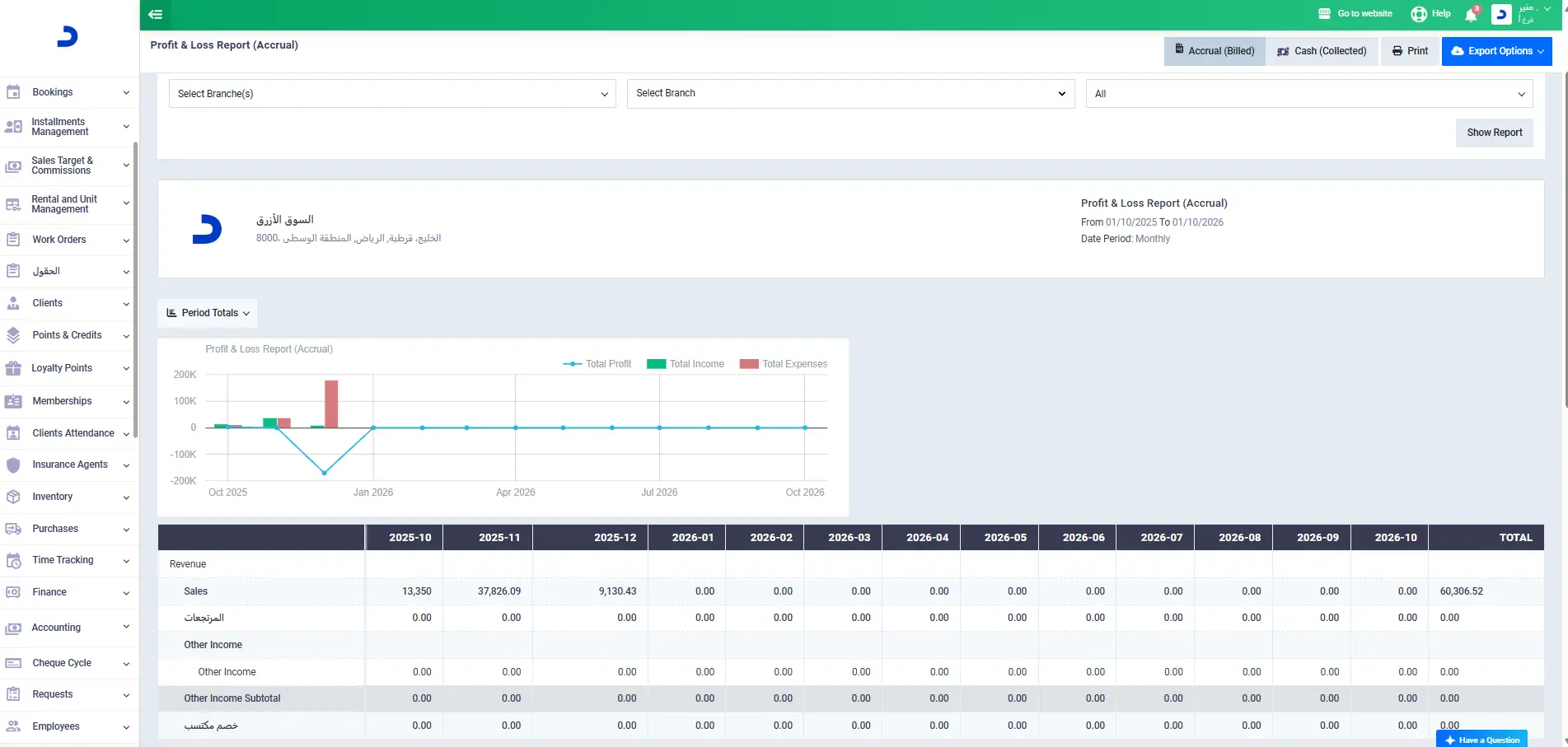
Technological solutions provided by Daftra software for calculating contribution margin:
- Daftra’s enterprise resource planning software performs accurate, fast, automatic calculations to determine total contribution margin, helping evaluate production performance.
- The Daftra system helps collect profit and cost data to analyze it, study product trends, and determine how to control variable costs.
- Using past and current results to forecast future contribution margins, plan budgets, and price products.
- Tracking contribution margin indicators and changes for each period and production line is essential for preparing reports on the performance of the company’s production operations.
- Integrating programs within the Daftra system ensures comprehensive, accurate results by using inputs for expense calculations and cost of goods sold, along with achieved revenues, to calculate total contribution margin and marginal contribution margin.
Frequently Asked Questions
How can I calculate the margin on variable cost?
Margin on variable cost = (Variable costs − Unit selling price) / Total selling price.
What is the marginal contribution margin?
The marginal contribution margin is the monetary amount used to produce one unit of a product. Use the following formula to calculate the marginal contribution margin:
Marginal contribution margin = Unit selling price − Variable cost to produce the unit.
Calculating the contribution margin per unit helps determine how many units must be sold to cover fixed costs and reach the break-even point. The break-even point means that sales cover the costs incurred. It is also used in analyzing product profitability and pricing decisions.
What are the forms of the contribution margin?
- Total contribution margin: The difference between the total selling price of units and the total cost of goods sold.
- Contribution margin per product: The difference between the selling price of one product and the cost of manufacturing the product.
- Contribution margin ratio: The percentage that expresses the difference between the selling price and the product cost.
What are the levels of the contribution margin?
- Negative contribution margin: When the selling price does not cover the product's manufacturing cost.
- Positive contribution margin:When the product price covers the variable manufacturing cost; the higher the ratio, the better.
How to find contribution margin income?
- Determine revenue balances resulting from sales.
- Determine variable costs such as raw materials, distribution, and others.
- Subtract variable costs from revenues.
- Find the percentage by dividing the contribution margin by revenues and multiplying the result by 100.
Is the contribution margin the same as profit?
No, the contribution margin is not the same as profit; rather, it is the amount remaining after deducting variable costs from revenue. It covers fixed costs, and whatever remains after that is profit.
Why is it called a contribution margin?
Because it shows how much sales contribute to covering fixed costs and generating profit after deducting variable costs.
What does a 40% contribution margin mean?
This means 40% of sales revenue remains after deducting variable costs, available to cover fixed costs and generate profit.
How to calculate contribution margin per unit?
The contribution margin per unit is calculated by subtracting the variable cost per unit from its selling price.
Contribution Margin per Unit = Selling Price per Unit - Variable Cost per Unit.
Conclusion
In conclusion, having explored contribution margin, the break-even point, its distinctions from profit margin and gross margin, and the formulas and practical improvement methods, it becomes clear that contribution margin is more than a figure for financial reports. It serves as a strategic indicator, showing each product or service's ability to cover fixed costs and generate actual profit.
Consequently, successful companies don't calculate contribution margin once; they monitor it regularly, benchmark it against industry standards, and strive for continuous improvement. They do this by adjusting pricing strategies, reducing variable costs, and reallocating resources to the most profitable products
This makes contribution margin an essential tool for financial planning and for decisions about pricing, investment, and expanding product lines.











 Invoicing
 POS
 Offers
 Installments
 Sales Commission
 KSA E-Invoice Software
 EGY E-Invoice Software
 JO E-Invoice Software
 E-Invoice Software
 Chart of Accounts
 Asset Management
 Cost Centers
 Expenses
 Cheque Cycle
 UAE VAT-Tax
 Product Management
 Purchases
 Purchase Cycle
 Suppliers
 Requisitions
 Stocktaking
 Organizational Structure
 Personnel Management
 Attendance and Leave
 Contracts
 Payroll
 Requests
 Work Orders
 Booking Management
 Rental and Unit Management
 Time Tracking
 Work Flow
 Lease Contracts
 Manufacturing Management
 Client Follow-Up
 Loyalty Points
 Points and Credits
 Memberships
 Insurance Management
 Daftra ERP Full App
 Point of Sales App
 Point of Sales for Desktop – Support Offline Mode
 AI Expenses Scanner App
 Employee Attendance, Sign & ESS App
 E-invoice Reader App
 Inventory Stocktaking App