


What Is the XBRL Financial Reporting System in Kuwait?


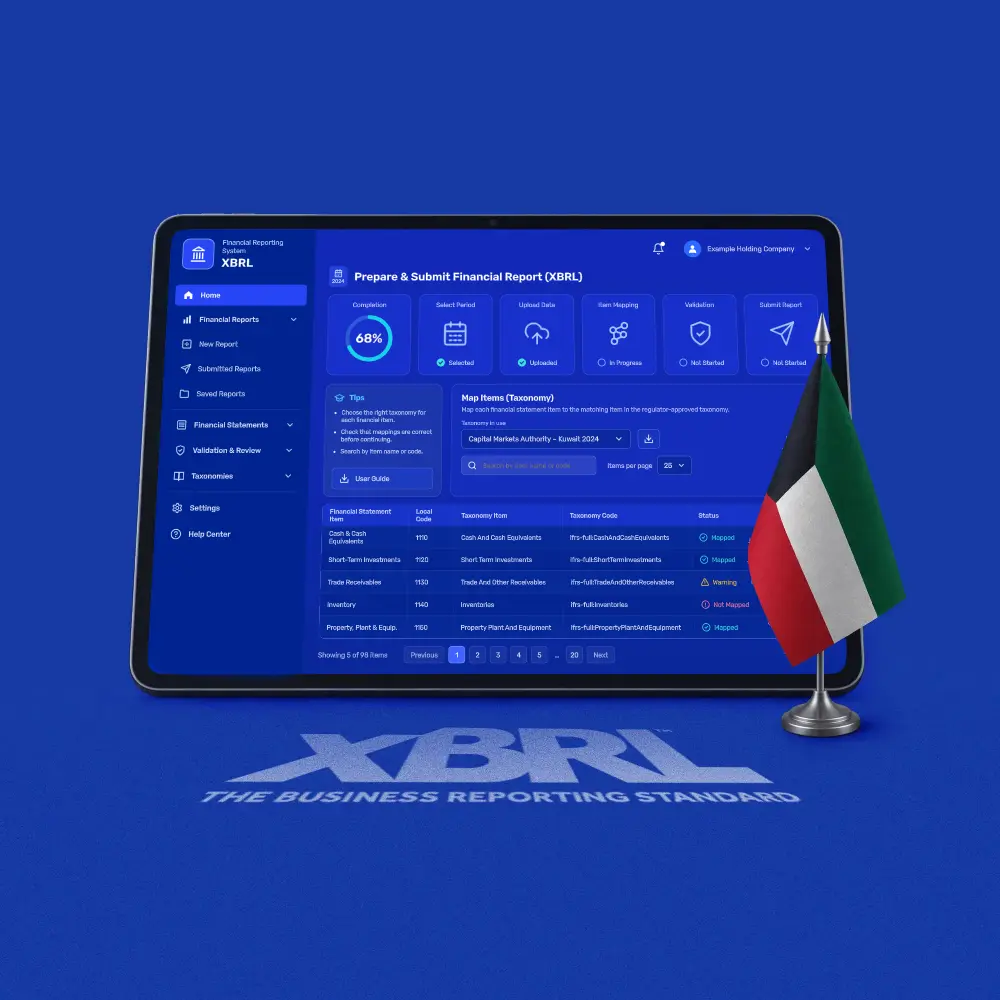
Table of contents:
- Key Summary
- What Is XBRL?
- Why Has XBRL Become Important in Financial Reporting?
- How Does XBRL Work in Simple Terms?
- What Is iXBRL?
- What Is Changing in Kuwait With XBRL?
- Which Entities Are Most Affected by XBRL Implementation in Kuwait?
- What Is the Difference Between Traditional Reports and XBRL?
- What Are the Benefits of XBRL for Companies and Finance Teams?
- What Challenges May Companies Face When Preparing for XBRL?
- How Can Your Company Prepare for XBRL Implementation in Practice?
- Are Accounting Systems Alone Enough for XBRL Compliance?
- Common Mistakes to Avoid When Preparing for XBRL
- Frequently Asked Questions About XBRL in Kuwait
- Conclusion
Traditional methods of preparing financial reports are no longer sufficient to keep pace with a business environment that is rapidly moving toward digitalization and smarter compliance. From the growing need for transparency and accuracy to faster access to financial information, businesses and regulatory authorities need more efficient ways to prepare, exchange, and analyze financial data.
This is where XBRL represents a major shift in how financial reports are prepared, understood, analyzed, and processed.
The adoption of XBRL in Kuwait is more than a technical upgrade; it represents a fundamental transformation in financial reporting. Data is transformed from static documents into structured digital information that can be read and analyzed automatically. This transformation improves efficiency, reduces human error, and enhances the reliability of financial data for regulatory authorities.
In this article, we explore the role of XBRL in developing financial reporting and submission mechanisms in Kuwait, along with its key benefits and the challenges it presents for companies and regulatory authorities.
What Is XBRL?
XBRL, or eXtensible Business Reporting Language, is a standardized digital language designed to prepare and exchange accounting reports in a machine-readable format. It uses structured tags to identify and define each element within a financial report, allowing systems to process, analyze, and exchange financial information automatically without relying on manual data entry.
XBRL is widely used by regulatory authorities, stock exchanges, and large organizations to improve the quality of financial disclosure, enhance transparency, and accelerate access to financial information.
Why Has XBRL Become Important in Financial Reporting?
XBRL has become increasingly important in financial reporting because it addresses several challenges associated with traditional reporting methods, including slow processing, repeated manual data entry, and human errors. Its key benefits include:
- Improving data accuracy: Each financial element is tagged in a standardized, machine-readable format, reducing errors associated with manual data entry.
- Enhancing transparency: Reports are structured according to standardized classifications, making it easier to compare financial information across different entities.
- Accelerating reporting and analysis: Structured data can be extracted, processed, and analyzed more efficiently.
- Supporting digital transformation: XBRL reduces reliance on paper-based processes and supports a more connected and intelligent data environment.
How Does XBRL Work in Simple Terms?
Financial data is transformed into structured digital information through several key components that work together to create an XBRL report:
What Is iXBRL?
iXBRL (Inline XBRL) is an extension of XBRL that combines human-readable presentation with machine-readable data in the same document. This allows users to view the report in a familiar format while enabling software systems to extract and process the underlying structured data.
What Is Changing in Kuwait With XBRL?
The adoption of XBRL is significantly changing the financial reporting landscape in Kuwait. The transition goes beyond a technical update to reshape how financial disclosures are prepared, submitted, processed, and accessed within the regulatory environment.
iFSAH 2 at the Capital Markets Authority
The Capital Markets Authority (CMA) in Kuwait launched the mandatory phase of its XBRL-based electronic disclosure system, iFSAH 2, on January 5, 2025. The system covers the submission of financial statements, capital adequacy reports, exchange disclosure forms, and general assembly requests.
Under the mandatory phase, entities subject to CMA supervision were required to use the XBRL-based iFSAH system for submitting the relevant disclosures and reports, while traditional submission methods to the CMA were discontinued.
The system is designed to digitize financial disclosure and provide structured, machine-readable information, helping improve data accuracy and reliability while making the disclosure process more efficient.
It is also important to distinguish between the CMA's iFSAH system and the separate disclosure platform operated by Boursa Kuwait. The CMA subsequently extended the use of Boursa Kuwait's CIP system during the transition period. As of July 1, 2026, the CMA stated that the XBRL-based iFSAH system would become the sole approved mechanism for submitting disclosures on the Boursa Kuwait website, with CIP available as an alternative only in cases of technical problems preventing use of iFSAH.
Digital Filing of Financial Statements
Kuwait is also moving toward broader digital use of structured financial data and XBRL-based reporting. The CMA's XBRL system already includes a dedicated domain for submitting financial statements, alongside other regulatory disclosures. The implementation has been supported by transitional periods, testing, technical support, and training to help relevant entities adapt to the new reporting requirements.
Accordingly, companies should view the transition to XBRL not simply as the adoption of new reporting software, but as a broader process that requires accurate accounting data, standardized reporting structures, appropriate internal processes, testing, and employee training.
Which Entities Are Most Affected by XBRL Implementation in Kuwait?
Several entities are affected by the implementation of XBRL in Kuwait. The most significantly affected include:
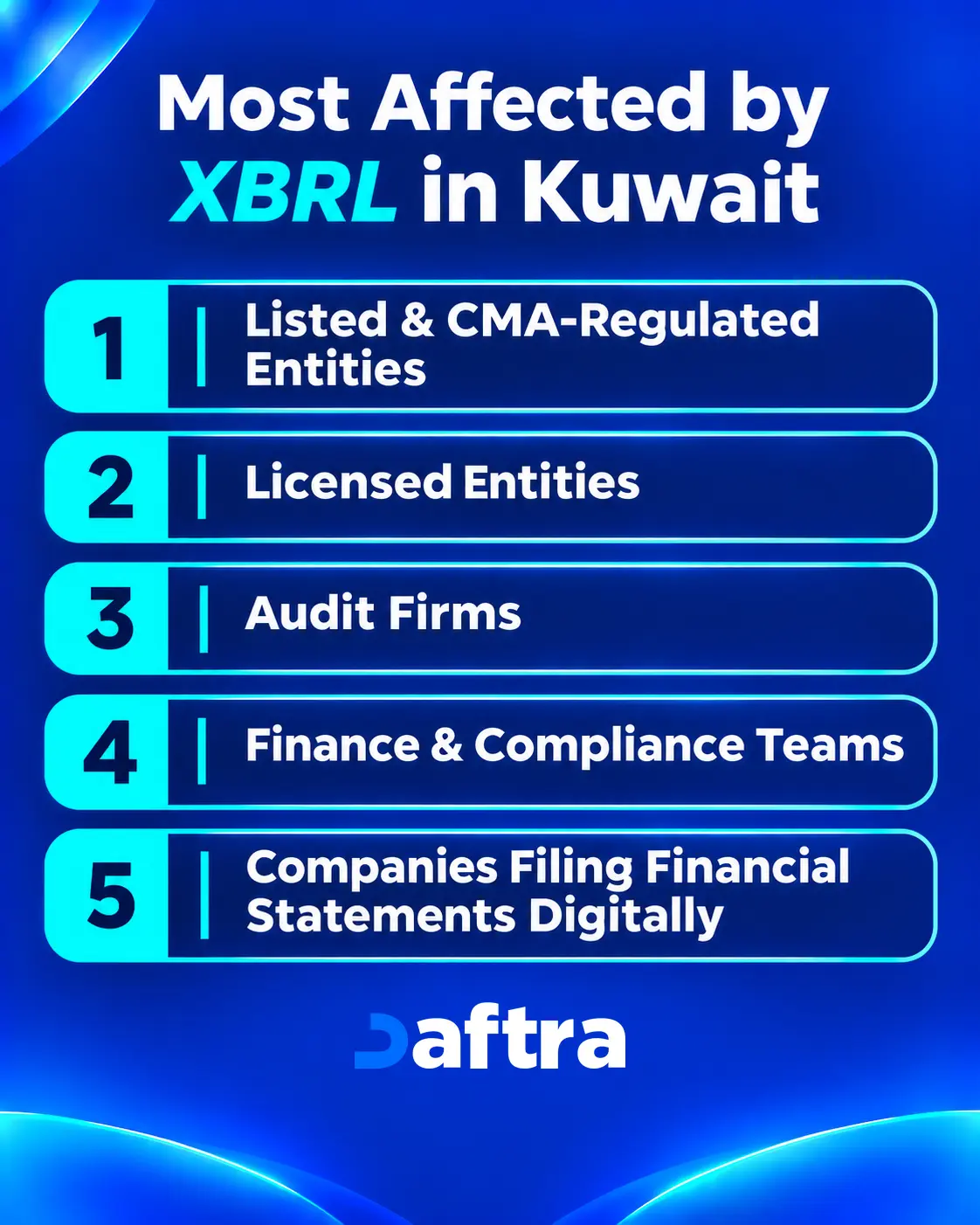
1- Listed Companies and Entities Subject to the Capital Markets Authority
Listed companies on Boursa Kuwait and entities subject to the supervision of the Capital Markets Authority (CMA) are among the groups most affected by XBRL implementation. They are required to submit relevant disclosures and financial reports in a structured digital format rather than relying on traditional reporting formats.
2- Licensed Entities
This category includes entities licensed by the relevant regulatory authorities, such as investment and financial services companies. These entities are required to standardize the presentation of financial data in line with XBRL requirements, supporting regulatory compliance and facilitating supervisory review.
3- Audit Firms
Audit firms are also experiencing significant changes in their workflows. Instead of working primarily with unstructured or non-standardized files, auditors can work with structured digital financial data, which can help streamline audit procedures and reduce the time required to review financial information.
4- Finance and Compliance Teams Within Companies
Finance and compliance teams are among the parties most directly affected by the operational changes introduced by XBRL. They need to reorganize reporting processes and ensure that financial data is accurately mapped to the relevant XBRL taxonomy and reporting requirements.
5- Companies That Will Submit Financial Statements Through Digital Regulatory Channels
As XBRL implementation expands, its impact will also extend to companies that submit their financial statements through government and regulatory digital channels associated with the system. This represents a gradual transition toward a more standardized environment for preparing and submitting financial reports.
What Is the Difference Between Traditional Reports and XBRL?
The following table highlights the key differences between traditional financial reports and reports based on XBRL:
| Comparison Criteria | Traditional Reports | XBRL |
| Readability | Human-readable only | Human- and machine-readable |
| Data Transferability | Limited and often requires data to be re-entered | Enables immediate analysis and provides data ready for processing |
| Comparison Across Companies | Difficult due to differences in reporting formats | Easier due to standardized taxonomies |
| Risk of Errors | Higher due to manual data entry | Lower due to automation |
| Review and Regulatory Oversight | Slower | Faster |
| System Integration | Limited | High |
What Are the Benefits of XBRL for Companies and Finance Teams?
Implementing XBRL is more than a technical improvement to the format of financial reports. It has a direct impact on the performance of finance teams and the quality of accounting processes within companies. Key benefits include:
- Accelerating the reporting cycle: XBRL reduces the time required to prepare financial reports by minimizing the need for repeated formatting and manual data entry.
- Reducing errors: Data is standardized and processed automatically, significantly reducing errors and improving the accuracy of financial reports.
- Supporting compliance: XBRL helps companies meet regulatory requirements by submitting data in the required structure and format.
- Improving data quality: It organizes financial information in a structured and accurate manner, making it more reliable for analysis and decision-making.
- Improving communication with regulators, auditors, and investors: XBRL facilitates the exchange of data between companies and relevant stakeholders, making financial information clearer and easier to understand and review while enhancing transparency and trust.
What Challenges May Companies Face When Preparing for XBRL?
Despite its many benefits, implementing XBRL presents several challenges for companies. The most common include:
- Mismatch between the chart of accounts and required taxonomies: A company’s existing chart of accounts may not directly correspond to XBRL taxonomies, requiring certain accounts to be restructured or accurately mapped to standardized concepts.
- Reliance on PDF or Excel reports: These formats are not inherently designed for tagging, which can make the transition to XBRL more difficult.
- Limited expertise in tagging and taxonomies: Selecting the appropriate tags and taxonomies requires a sound understanding of XBRL concepts and the relevant accounting standards.
- Need to test files before submission: Preparing an XBRL report is not sufficient on its own. The file must be validated and tested to identify and resolve technical errors before submission.
- Need to train finance teams: Finance and compliance teams need practical training to understand how to prepare reports under XBRL, which requires time and resources to develop the necessary skills.
- Initial and technical setup costs: The transition to XBRL may require updates to accounting systems or the addition of supporting tools, creating an additional cost for some businesses.
How Can Your Company Prepare for XBRL Implementation in Practice?
Implementing XBRL is not limited to the technical side. Several practical steps can help companies make the transition more smoothly:
1- Review the Regulatory Authority and Filing Requirements
First, determine whether the company falls within the scope of the relevant requirements. For example, identify whether it is subject to iFSAH 2 under the Capital Markets Authority or falls under a broader digital filing pathway for financial statements. This helps determine the required reports and the appropriate submission process.
2- Assess Financial Data Readiness
Ensure that financial statements are up to date and complete, accounts are properly classified within the chart of accounts, and disclosures are clear and well organized.
3- Map the Chart of Accounts to the Required Taxonomies
This is one of the most important preparation steps. Each account in the chart of accounts should be mapped to the appropriate XBRL concept. This may require:
- Restructuring certain accounts.
- Combining or separating certain financial statement items.
- Ensuring that each item has been assigned an accurate accounting classification.
4- Prepare the Export, Conversion, and Testing Process
Successful XBRL implementation depends not only on the accuracy of the figures but also on the integrity of the report itself. Companies should:
- Use tools that support exporting data in XBRL format.
- Test files before submission.
- Verify that the reports comply with the relevant regulatory requirements.
5- Train Finance and Audit Teams
Finance and audit teams should receive training on:
- XBRL concepts and the tagging process.
- Working with taxonomies.
- Reviewing reports carefully before submission.
Are Accounting Systems Alone Enough for XBRL Compliance?
It may seem that having an accounting system means a company is ready to implement XBRL. In practice, however, XBRL goes beyond simply recording financial transactions. It also concerns how financial data is structured and mapped to precise standardized taxonomies.
Companies may face challenges related to:
- How the chart of accounts is organized.
- How financial statement items are classified.
- The level of detail provided in reports.
- Whether the underlying data is ready to be mapped to XBRL tags.
Common Mistakes to Avoid When Preparing for XBRL
Companies may encounter several challenges when transitioning to XBRL. The most common mistakes include:
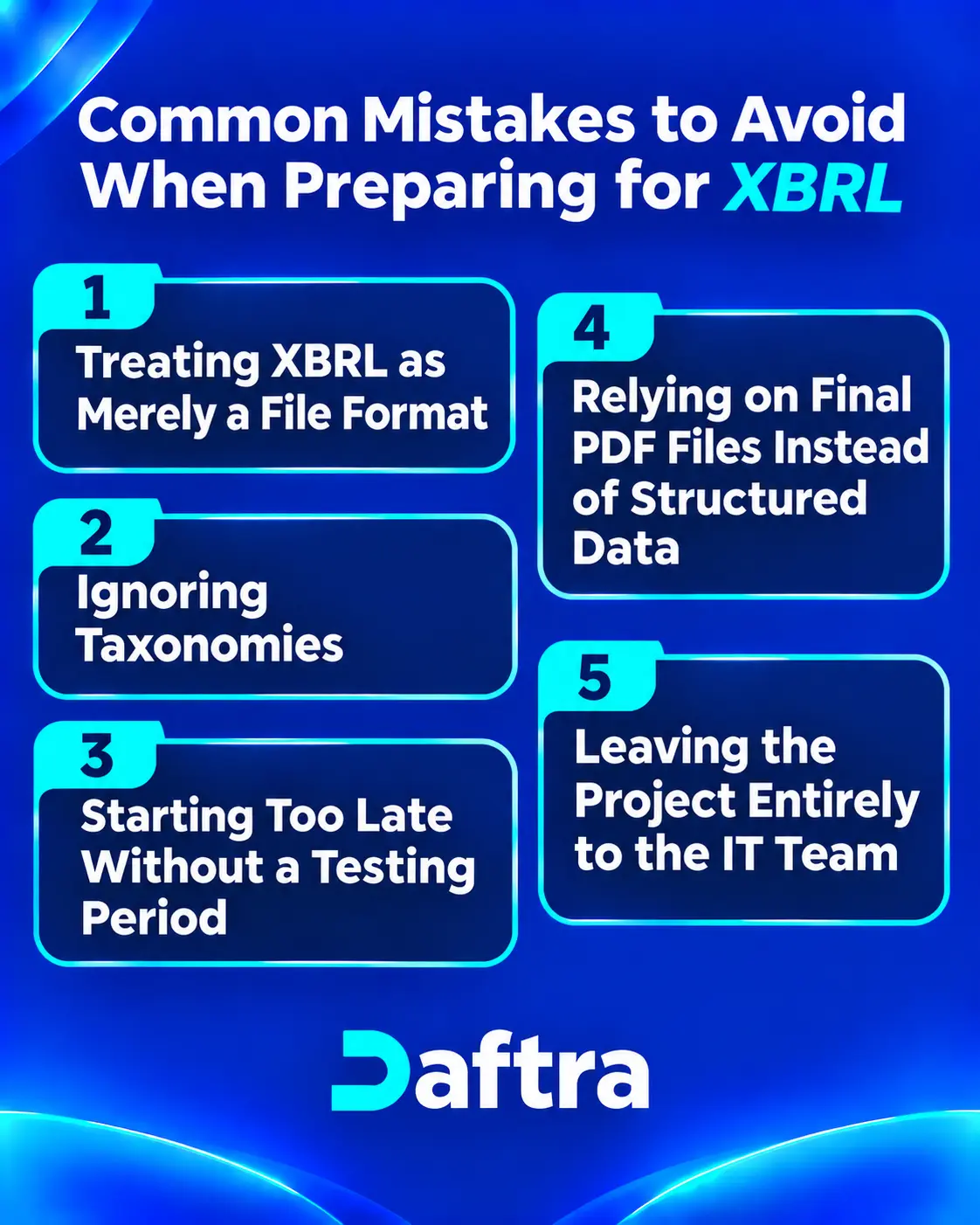
Treating XBRL as Merely a File Format
XBRL should not be viewed simply as another reporting format. It is a structured reporting framework that involves organizing data and mapping it to specific concepts and taxonomies.
Ignoring Taxonomies
A superficial approach to taxonomies may result in reports that do not comply with regulatory requirements or are difficult for regulatory systems to validate and process.
Starting Too Late Without a Testing Period
XBRL implementation requires sufficient time to test files, verify compliance, and correct errors before official submission. Starting late increases the risk of submission problems.
Relying on Final PDF Files Instead of Structured Data
PDF files can make the transition to XBRL more difficult because XBRL requires structured data that can be processed and tagged, rather than simply a final, non-editable presentation of the report.
Leaving the Project Entirely to the IT Team
Successful XBRL implementation requires collaboration among finance, accounting, audit, and IT teams. This helps prevent gaps in understanding taxonomies and ensures the quality and accuracy of the underlying financial data.
Frequently Asked Questions About XBRL in Kuwait
What Is a Taxonomy?
A taxonomy is the digital dictionary used within XBRL. It defines financial concepts, their meanings, and the relationships between them, helping standardize how financial information is structured and presented across companies.
Has Mandatory XBRL Implementation Started in Kuwait?
Yes. Mandatory implementation began partially through the iFSAH 2 system of the Capital Markets Authority on January 5, 2025, for relevant disclosures. The use of XBRL-based digital reporting is also being expanded to other financial reporting and filing requirements in stages.
What Is the Difference Between XBRL and PDF?
- PDF: Primarily designed to present information in a human-readable format.
- XBRL: Provides structured financial data that can be read and analyzed by software systems while also supporting human-readable reporting.
Conclusion
XBRL is no longer simply a technical update; it represents a fundamental transformation in financial disclosure. Instead of relying on traditional reports that depend heavily on manual presentation and limited data processing, XBRL makes financial information more structured, machine-readable, and easier to access and analyze.
As Kuwait continues to expand the use of systems such as iFSAH 2, the future of financial reporting is moving toward a more standardized, data-driven environment rather than one based primarily on static documents.
Accounting systems such as Daftra can help companies build an organized accounting foundation by structuring their chart of accounts and facilitating the preparation of financial statements and reports, making the transition toward XBRL more manageable.









 Invoicing
 POS
 Offers
 Installments
 Sales Commission
 KSA E-Invoice Software
 EGY E-Invoice Software
 JO E-Invoice Software
 E-Invoice Software
 Chart of Accounts
 Asset Management
 Cost Centers
 Expenses
 Cheque Cycle
 VAT & Tax Compliance
 Product Management
 Purchases
 Purchase Cycle
 Suppliers
 Requisitions
 Stocktaking
 Organizational Structure
 Personnel Management
 Attendance and Leave
 Contracts
 Payroll
 Requests
 Work Orders
 Booking Management
 Rental and Unit Management
 Time Tracking
 Work Flow
 Lease Contracts
 Manufacturing Management
 Client Follow-Up
 Loyalty Points
 Points and Credits
 Memberships
 Insurance Management
 Daftra ERP Full App
 Point of Sales App
 Point of Sales for Desktop – Support Offline Mode
 AI Expenses Scanner App
 Employee Attendance, Sign & ESS App
 E-invoice Reader App
 Inventory Stocktaking App