


What Are Cost Centers and the Cost Center Hierarchy?


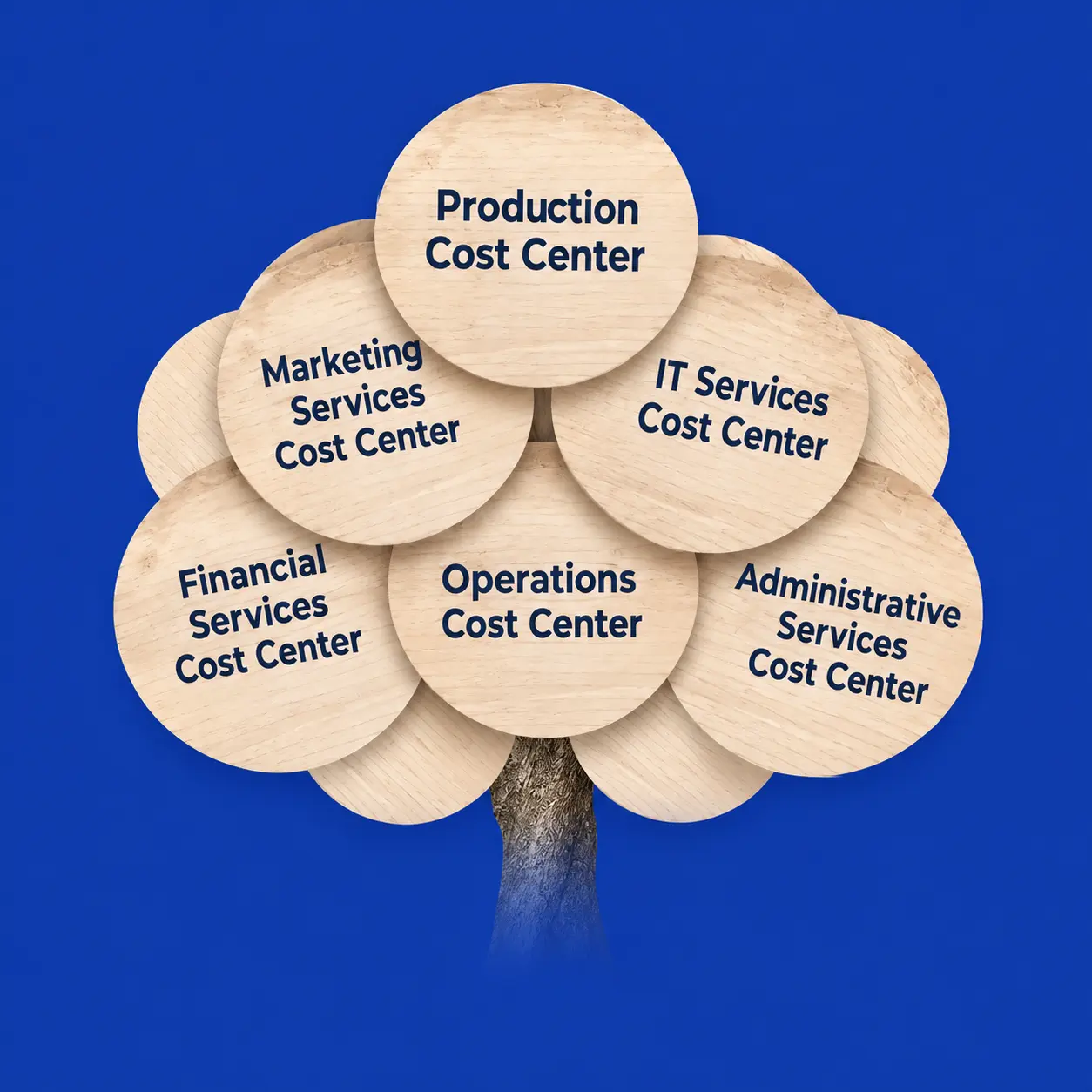
Table of contents:
- Key Summary
- What Are Cost Centers?
- What Are the Main Types of Cost Centers?
- First Direct Cost Centers
- Second Indirect Cost Centers
- How to Implement Cost Centers A Step-by-Step Guide
- Practical Examples of Cost Centers
- What Are Cost Center Journal Entries?
- What Is a Cost Center Hierarchy?
- Where Did the Marketing Budget Go?
- What Is the Importance of Cost Centers?
- Methods of Allocating Costs to Cost Centers
- Methods of Allocating Service Costs to Production Cost Centers
- What Challenges Can You Face When Setting Up Cost Centers?
- Managing Cost Centers and Linking Them to Accounts in Daftra
- Frequently Asked Questions
Cost centers are among the most important tools in cost accounting. Accurate cost indicators help improve management performance and accounting decisions. A cost center is a unit where a company or organization can collect and monitor all department-related costs and profits.
This comprehensive guide explains cost centers, their types, importance, how to structure a cost center hierarchy, and the steps involved in setting them up, with more details throughout the article.
What Are Cost Centers?
Cost centers are specific units or departments within a company that are used to collect and track costs independently. They help determine the costs incurred by each department or unit and evaluate its spending efficiency. A cost center may be an entire department, such as accounting or human resources, or a smaller organizational unit.
A cost center is not directly responsible for generating revenue or profit. Instead, it focuses on monitoring costs within its area of responsibility. Therefore, managers usually evaluate a cost center's efficiency by comparing actual costs with planned costs or the approved budget. This helps management identify variances, understand the reasons behind increased costs, and take appropriate action.
You can also read our article about Cash Flows and their role in cost centers.
What Are the Main Types of Cost Centers?
Cost centers are classified by their relationship to business activity or the organization into two main types: direct cost centers and indirect cost centers. Below, we explain the main types of cost centers and the sub-cost centers that fall under each category.
First: Direct Cost Centers
Direct cost centers perform the organization's core activities. In other words, they are directly related to the products or services provided by the company. Their costs can therefore be charged directly to products or operations without allocating them to other cost centers.
The main types include:
Production Cost Center
A production cost center represents the organization's core purpose. It includes departments that typically perform manufacturing, conversion, or contract-execution activities.
Example: The cutting and assembly department in a clothing factory.
Second: Indirect Cost Centers
Indirect cost centers support the organization's core activities but do not work directly on the product. The organization first collects their costs and then allocates them to direct cost centers based on appropriate allocation bases, such as hours, area, or consumption.
They include the following:
Service Machinery Cost Center
These centers support production cost centers by providing the tools, resources, energy, and maintenance they require.
Examples: Power stations and warehouses.
Marketing Services Cost Center
These centers conduct market studies and research and handle the marketing of the organization's products or services.
Examples: Advertising and sales.
Administrative and Financial Services Cost Center
These centers perform the organization's general administrative and financial functions.
Examples: Human Resources, accounting, and legal affairs.
Capital Activities Cost Center
These centers perform capital activities that benefit the organization over an extended period. Unlike other cost centers, their costs are not charged as expenses in the current period; instead, they are included in the asset's cost.
Example: Establishing production service workshops.
Other Supporting Service Centers
An organization may create additional cost centers according to the nature of its activities.
Examples: Transportation and information technology.
It should be noted that classifying a center as direct or indirect does not necessarily mean that all costs within that center are direct or indirect. The classification depends on whether the cost can be traced to the center or to the activity benefiting from it.
How to Implement Cost Centers: A Step-by-Step Guide
To implement cost centers in a company or organization, first establish a clear structure to collect costs and link them to the departments, activities, or projects where they were incurred. Then monitor actual costs and compare them with planned costs.
The following steps should be followed when implementing cost centers:
Identifying Cost Centers and Building Their Structure
The company begins by identifying the units, departments, or projects whose costs it wants to track independently, based on its activities. Cost centers may include departments such as production, accounting, and marketing, as well as projects, branches, or geographical locations. These centers are then organized into a hierarchical structure showing the relationship between main and sub-cost centers.
Assigning Costs to Cost Centers
Once you identify cost centers, record costs under the cost center where they were incurred. For example, you can assign accounting department employees' salaries to the accounting cost center, while assigning the cost of materials used for a specific project to that project's cost center.
It is not necessary to use Activity-Based Costing (ABC) in every case. ABC is one method for allocating indirect costs, and companies can choose the appropriate allocation method based on the nature of the business and the required accuracy for cost analysis.
Comparing Actual Costs with Planned Costs and Analyzing Variances
The performance of each cost center is monitored by comparing actual costs with planned costs or the approved budget. Differences are then identified, and their causes are analyzed.
Taking Appropriate Actions and Decisions
Cost centers are not limited to recording expenses. The analysis results also inform actions that improve spending efficiency and resource utilization.
For example, if management identifies an unjustified increase in a particular center's costs, it can review operating methods, resource usage, or cost allocation bases and take appropriate corrective action.
Daftra's Cost Center Management Software also simplifies these steps by letting you assign one or more cost centers to journal entries and organize accounts in a hierarchical structure.
Practical Examples of Cost Centers
Below are some examples of cost centers:
Cost Centers in Hospitals
Cost centers in hospitals include departments that provide medical services, along with supporting and administrative departments, such as:
| Emergency Department | Operating Rooms | Outpatient Clinics |
| Inpatient and Care Departments | Laboratory and Radiology | Pharmacy |
| Maintenance and Cleaning | Accounting and Human Resources |
For example, the Radiology Department can be treated as an independent cost center where it collects the costs of employees, equipment, supplies, and expenses associated with radiology services. This helps management analyze the cost of the department's services.
Cost Centers in Restaurants
Cost centers in restaurants can be organized by the stages of food preparation and service. The main cost centers in restaurants include:
| Kitchen | Restaurant Floor and Customer Service | Delivery |
| Purchasing | Marketing | Administration and Accounting |
For example, the kitchen can be treated as a cost center where costs for raw materials, labor, and expenses required to prepare meals are collected. These costs can then be compared with activity levels to evaluate operational efficiency.
Cost Centers in Manufacturing Companies
Cost centers in manufacturing companies can generally be identified according to production stages and departments that provide support services to the production process, such as:
| Raw Material Preparation | Production Lines | Assembly |
| Finishing | Packaging | Quality Control |
| Machinery and Equipment Maintenance | Warehouses | Administration and Accounting |
Create an independent cost center for each production line, and charge the labor, materials, and expenses associated with that line to it. The costs of service departments, such as maintenance, can then be allocated to the production centers that benefit from them.
| Main Center | Cost Center | Examples of Costs Charged to It |
| Production | Raw Material Preparation | Cost of preparing and processing materials before production |
| Production | Production Lines | Labor, materials, and expenses associated with each production line |
| Production | Assembly | Employee wages and assembly supplies |
| Production | Finishing | Finishing materials and expenses |
| Production | Packaging | Packaging materials and employee wages |
| Production Services | Quality Control | Inspection costs |
| Production Services | Machinery and Equipment Maintenance | Spare parts and maintenance wages |
| Supporting Services | Warehouses | Storage costs |
| Administrative Services | Administration and Accounting | Salaries and expenses |
Cost Centers in Construction Companies
In construction companies, a project itself can be treated as a main cost center. Its costs can then be divided according to the stages or activities involved in execution, such as:
| Administrative Building Construction Project | Residential Complex Construction Project | Excavation and Foundation Works |
| Concrete Works | Electrical Works | Plumbing Works |
| Finishing Works |
For example, a company can create a cost center for an administrative building construction project, allowing it to track excavation and foundation, concrete, electrical, and finishing costs within that center. This makes it possible to determine the cost of each stage and compare it with the planned cost.
Cost Centers in Trading Companies
Trading companies can create cost centers based on branches, operating activities, and supporting functions, such as:
| Sales Branches | Warehouses | Purchasing |
| Sales | Distribution and Transportation | Marketing |
| Customer Service | Information Technology |
If a company has several branches, it can create an independent cost center for each branch to track its operating expenses. It can also create cost centers for warehouses, distribution, administration, and marketing. This helps management compare costs across branches and identify where expenses are increasing.
If you own a multi-branch retail business, you can now use Daftra's Retail Accounting Software to help organize expenses and link them to branches instead of relying on scattered records.
What Are Cost Center Journal Entries?
Cost center journal entries link expenses and costs to the center that benefited from them. This helps determine each department's or activity's cost and analyze its performance.
Cost centers do not represent separate accounts within an accounting entry. Instead, they are data associated with the financial accounts.
Suppose a company paid SAR 5,000 for an advertising campaign and assigned the amount to the Marketing Cost Center. The journal entry would be as follows:
| Description | Debit | Credit |
| Marketing Expenses | SAR 5,000 | - |
| Bank | - | SAR 5,000 |
What Is a Cost Center Hierarchy?
A cost center hierarchy is similar to a chart of accounts. It branches from the main level to sub-levels and can be modified by adding or deleting cost centers according to the nature and type of the organization's activities.
Cost Center Hierarchy Example
Below is an illustrative example of a cost center hierarchy for a contracting project. You can modify it according to the nature and field of your business:
| Main Type | Cost Center | Sub-Cost Centers |
| Direct Cost Centers | Production Cost Center | Cutting and Assembly Department |
| Sewing Department | ||
| Finishing Department | ||
| Indirect Cost Centers | Operational Services Cost Center | Machinery Maintenance |
| Utilities and Power Station | ||
| Warehouses | ||
| Marketing Services Cost Center | Advertising | |
| Marketing | ||
| Market Research | ||
| Administrative and Financial Services Cost Center | Accounting | |
| Human Resources | ||
| Legal Affairs | ||
| Supporting Services Cost Center | Transportation | |
| Information Technology |
Where Did the Marketing Budget Go?
Based on the Daftra team's experience with one of the companies they worked with, management struggled to determine the actual amount spent on marketing activities, particularly because expenses were spread across digital advertising, content design, and social media campaigns.
The company therefore created an independent cost center called "Marketing" to collect and monitor all department-related expenses.
The company spent SAR 20,000 during one month on an advertising campaign that included digital advertising, content design, and social media promotion. By assigning these expenses to the Marketing Cost Center, management could easily determine the total amount spent on marketing activities during the period and compare it with the allocated budget and the sales generated by the campaigns.
| Main Center | Sub-Cost Center | Expense Amount |
| Marketing | Digital Advertising | SAR 10,000 |
| Marketing | Content Design | SAR 5,000 |
| Marketing | Social Media Promotion | SAR 5,000 |
| Total | Marketing Cost Center | SAR 20,000 |
In this way, the cost center was no longer simply a tool for recording expenses. Instead, it became a tool to monitor spending, analyze variances, and make more efficient decisions about the marketing budget.
What Is the Importance of Cost Centers?
Cost centers play an important role in Business Management within an organization, improving efficiency and indirectly increasing profitability. The following are some of the key factors that demonstrate the importance of cost centers in an accounting system:
1. Cost Analysis and Improved Cost Management
Cost centers are primarily used to analyze costs separately, helping management understand how expenses are distributed across different production activities and processes.
Based on this analysis, management can identify areas or functions with excessive spending or waste, ultimately reducing costs and increasing profits.
2. Enhancing Accountability and Transparency
Accurately structuring the cost center hierarchy defines cost responsibilities and improves individual accountability by assigning a responsible person to each cost center.
When managers know that they are accountable for costs, they are more likely to use and allocate resources efficiently. Clearly defining the roles of cost-center managers also helps evaluate performance periodically.
3. Making Important Strategic Decisions
Accurate cost analysis information from cost centers helps determine appropriate prices for products and services, improving profitability.
It also supports budget planning, better resource allocation, and financial and investment decisions related to expanding or reducing a particular activity or product.
4. Identifying the Causes of Variances from Expected Costs
Cost centers are tools for monitoring financial and operational performance. Analyzing and assigning costs within the accounting system makes it easier to identify the reasons for variances from the budget or estimated costs, which contributes to improving operations and future planning.
Methods of Allocating Costs to Cost Centers
Cost allocation assigns each cost center its share of the costs it benefits from, providing a more accurate picture of each department's cost.
Cost allocation is especially important for indirect costs or service center costs that support more than one center. In such cases, the company needs to use an appropriate allocation basis that reflects the relationship between the cost and the party benefiting from it as accurately as possible.
1. Identify the Cost Centers and the Costs to Be Allocated
The allocation process begins by identifying the cost centers where costs are collected, whether production or service centers. Then identify the costs that need to be allocated.
A cost can be charged directly to a specific center when it is easy to trace it to that center. However, shared costs that benefit more than one center require an appropriate allocation basis.
2. Determine the Appropriate Allocation Basis
Select the allocation basis based on the nature of the cost and its relationship to the cost centers benefiting from it.
Common examples of allocation bases include the number of employees, department area, and machine operating hours. The more closely the allocation basis is related to the cause of the cost or the level of benefit received, the more appropriate the cost allocation will be.
3. Allocate Service Center Costs
Once the costs of service centers and the allocation bases are identified, the organization charges service center costs to the benefiting centers according to the method it adopts.
Three common methods for allocating service center costs are the direct method, step-down method, and reciprocal method.
- Direct Method
Under this method, the cost of each service center is allocated directly to the production centers that benefit from its services, while it ignores services provided between service centers.
One main advantage of this method is its simplicity. However, it does not reflect the costs resulting from reciprocal services exchanged between service centers. - Step-Down Method
This method allocates service center costs in a predetermined sequence. Allocation begins with the center that provides the greatest amount of services to other centers based on an appropriate criterion, then proceeds to the next center.
This method recognizes some of the reciprocal services between service centers, but it does not fully reflect them. - Reciprocal Method
This method accounts for reciprocal services between service centers. For example, if the Maintenance Center benefits from Information Technology services while the Information Technology Center simultaneously benefits from maintenance services, this reciprocal exchange is considered when determining the final cost of each center.
This method requires simultaneous equations and is therefore more complex.
4. Charge the Allocated Costs to the Benefiting Centers
After allocating service center costs, add the allocated share to the cost of the benefiting centers. As a result, the total cost of each center is presented more comprehensively.
This data can then be used to calculate product or service costs, analyze each activity's cost, and compare actual costs with planned costs.
Methods of Allocating Service Costs to Production Cost Centers
There are five methods for allocating service costs to production cost centers. Companies select one method based on their policies and the financial manager's approach. The following is an explanation of these methods:
1. Total Allocation Method
Under this method, the costs of all service centers are combined into a single total and then allocated only to the production centers. For example, if there are four service centers, combine their costs and add them to the production centers' total cost.
2. Individual Allocation Method
Under this method, each service center's costs are allocated separately to only the production centers that benefit from its services.
3. Step-Down Allocation Method
This method allocates the costs of lower-cost service centers to all higher-level departments that benefit from their services, whether production or service centers, in a step-down sequence.
4. Reciprocal Allocation Method
One disadvantage of this method is that it is relatively complex. However, it provides a fairer allocation than the previous methods because it accounts for the reciprocal services exchanged between centers.
Under this method, a service center is charged for the cost of services it receives from other service centers.
5. Determining Cost Allocation Rates for Cost Centers
As previously mentioned, it is necessary to determine the cost unit. The final step is to determine the amount allocated to each product unit in each production center, based on the nature of the activity and the operating process.
Allocation rates vary by production cost center.
What Challenges Can You Face When Setting Up Cost Centers?
There are several challenges that may arise when using cost centers. Therefore, it is important to understand these challenges, whether they relate to employees, difficulty identifying costs, or other factors. The following are the main challenges and how they can be addressed:
1. Difficulty in Allocating Cost Centers
Allocating cost centers in industrial or commercial companies can be difficult when it doesn't align with the organizational structure and business activities. This usually occurs when cost-related data is not collected comprehensively and accurately, particularly in large organizations operating across multiple and diverse activities. This can ultimately lead to inaccurate cost analysis results.
2. Challenges in Allocating Indirect Costs
Allocating indirect costs across multiple cost centers can be challenging because selecting an inappropriate allocation basis, such as labor hours or units produced, can distort results.
Inaccurate or unfair indirect-cost allocation can lead to misleading results about cost centers' financial performance, which in turn affects decisions on cost management and resource allocation.
3. Lack of Experience Among Those Responsible for Managing Cost Centers
A lack of expertise among those responsible for managing cost centers can make it difficult to allocate costs efficiently. It can also make it more difficult to understand the cumulative interactions within the cost center hierarchy and their impact on overall performance.
4. Changes in Production and Operational Processes
Cost centers need periodic evaluation and may need reallocation and reorganization due to ongoing changes in operational and production processes.
Another way to avoid problems and errors when setting up cost centers is to use the Daftra Accounting System, which helps you allocate costs and accurately monitor expenses and revenues.
Managing Cost Centers and Linking Them to Accounts in Daftra
Daftra provides Cost Center Accounting as part of the General Ledger, recognizing its importance in cost accounting. It also offers related features that make it an effective tool for supporting financial and managerial decision-making.
In the following sections, we will provide a clear explanation of how to use cost centers in Daftra and link them to accounts.
Creating and Assigning Cost Centers
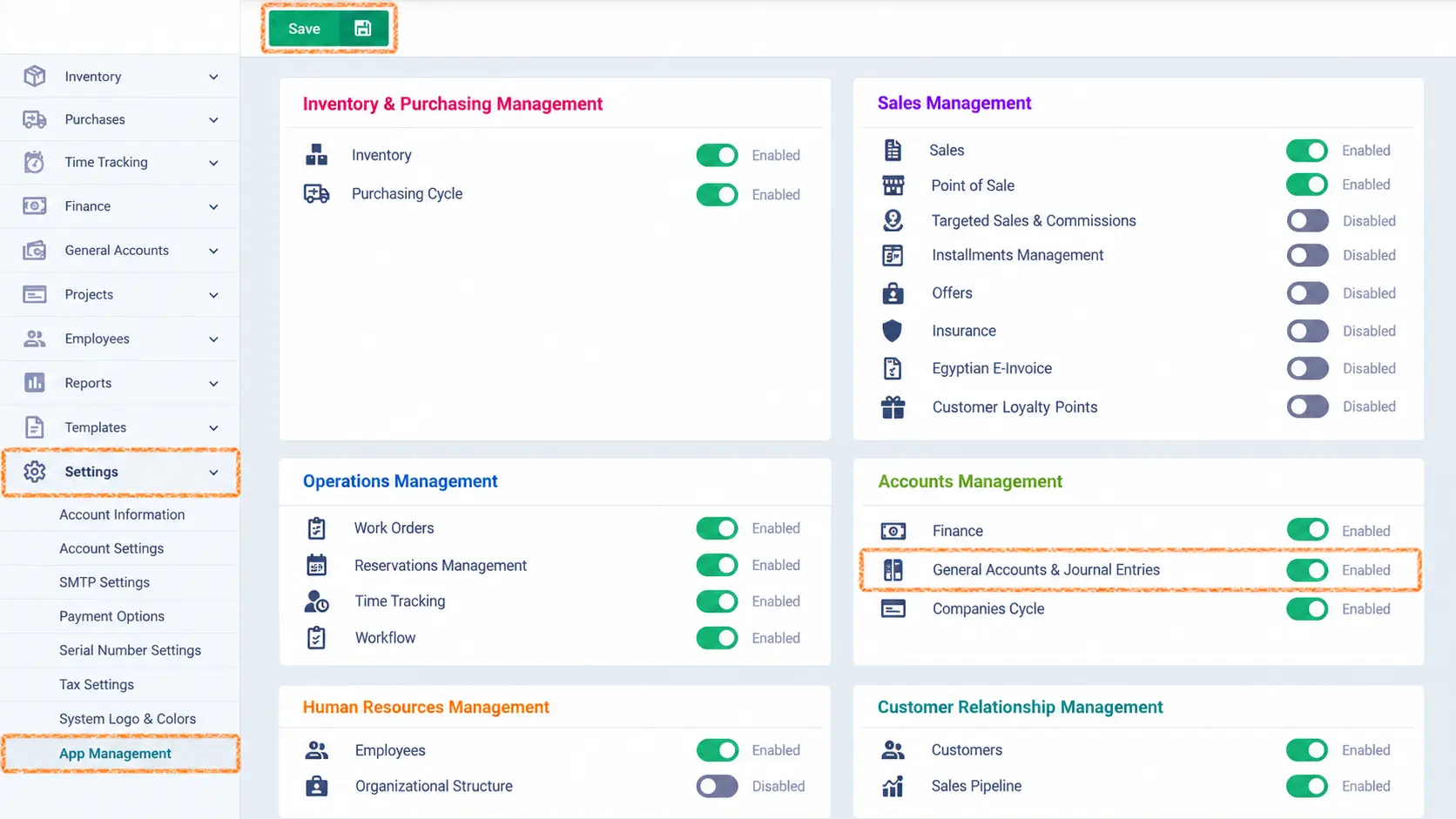
First, make sure that the General Ledger is enabled from the "Account Management" application by clicking "Settings" from the main menu and selecting "App Management."
Then, enable the "General Ledger and Journal Entries" option, as shown in the image, and click "Save."
To start creating cost centers, you must first have a main cost center under which a number of sub-cost centers can be created. First, create a main cost center, then add sub-cost centers under it. After that, you can assign expenses to these cost centers.
To create a main cost center, go to “General Accounts” from the main menu, then click “Cost Centers.” Next, click the “Add Cost Center” button at the top left of the page to display the pop-up window shown in the image. Enter the “Name” of the new main cost center and enable the “Main Cost Center” option.
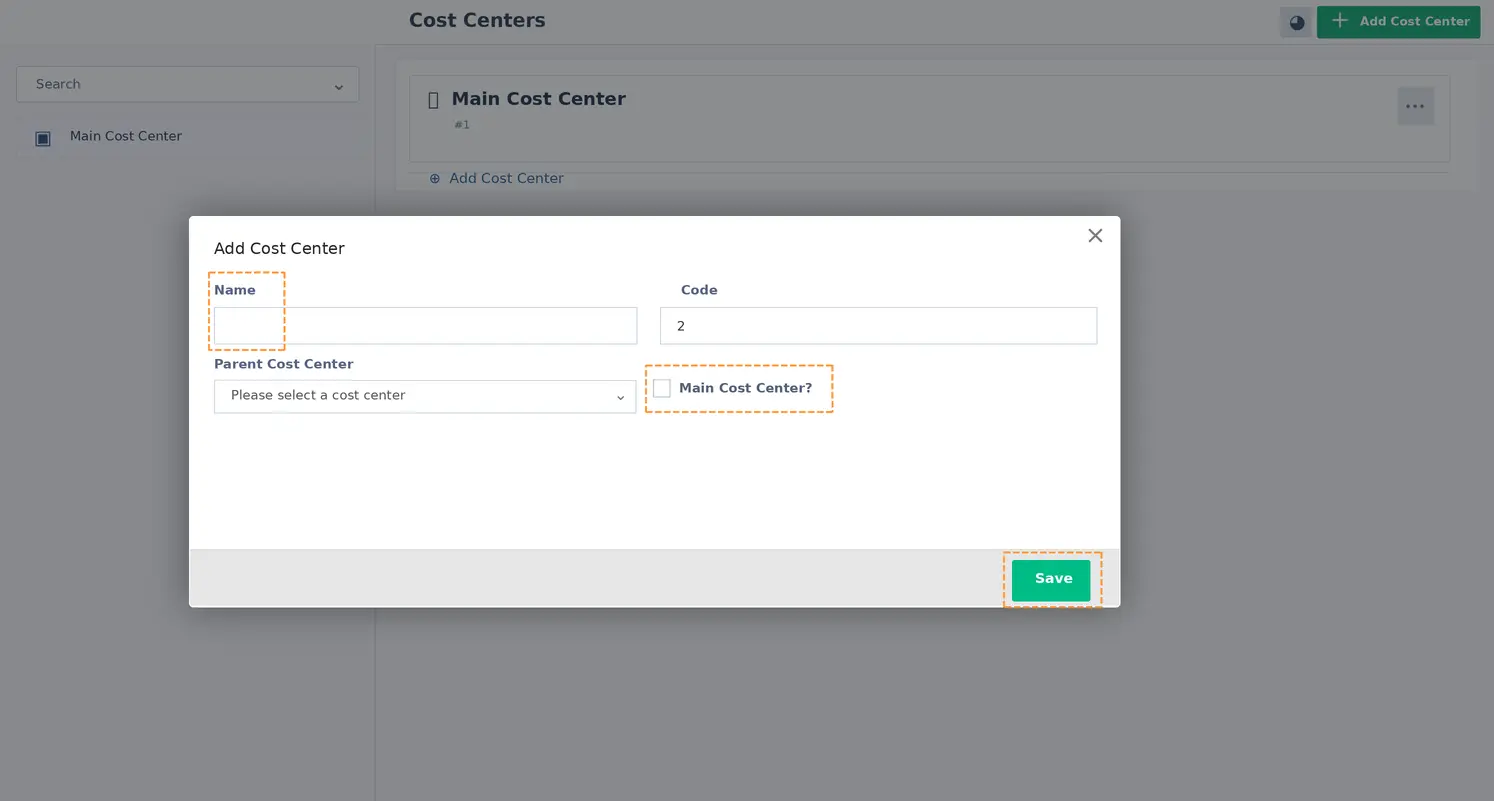
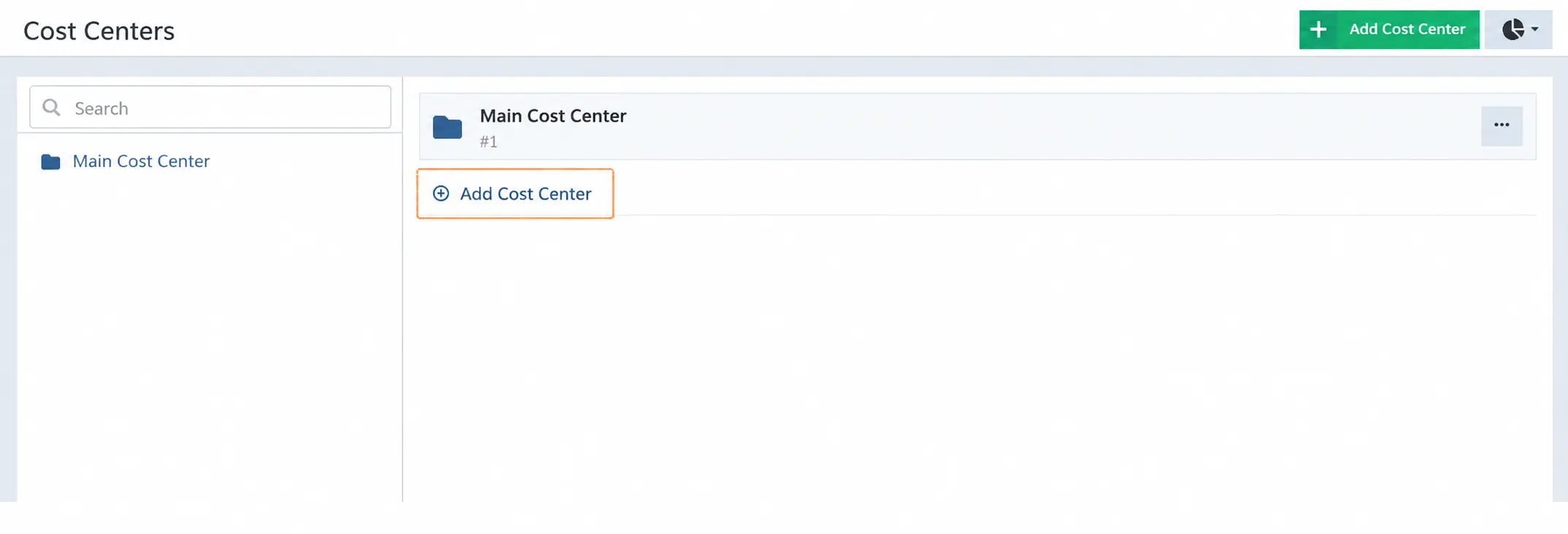
This creates a main cost center, which will appear on the Cost Center Management page. The next step is to create a sub-cost center under it. Below the main cost center, click “Add Cost Center.”
Enter the name of the sub-cost center, then select the main cost center in the field below the name field.
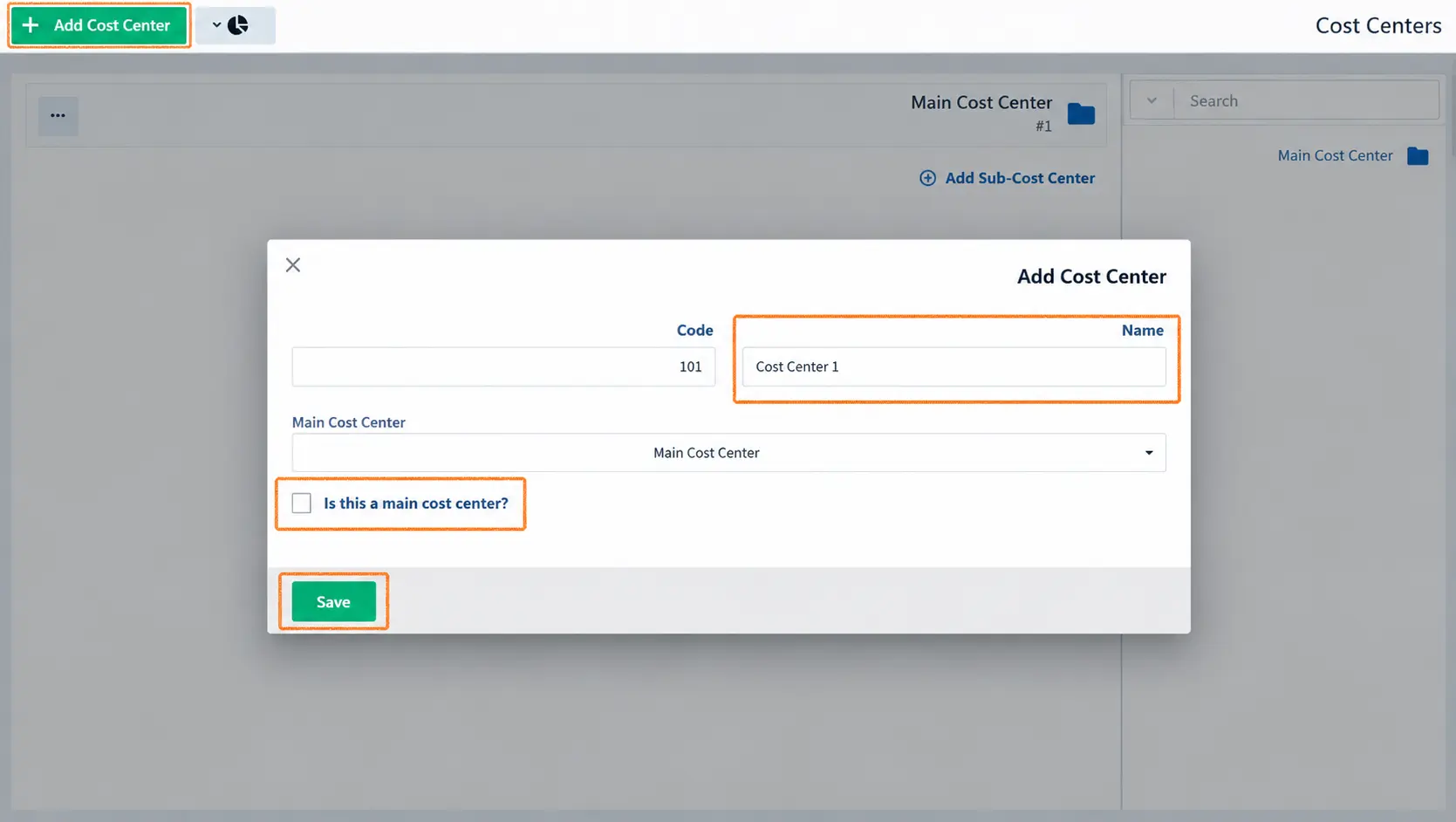
You can add more than one sub-cost center under a single main cost center. You can also create multiple main cost centers, each with its own sub-cost centers. This gives you full flexibility to structure your Cost Center Hierarchy according to the nature of your business.
Next, we can add an expense and assign cost centers to it. First, go to the expense voucher creation page by clicking “Finance” from the main menu, then selecting “Expenses,” and clicking the “Payment Voucher” button.
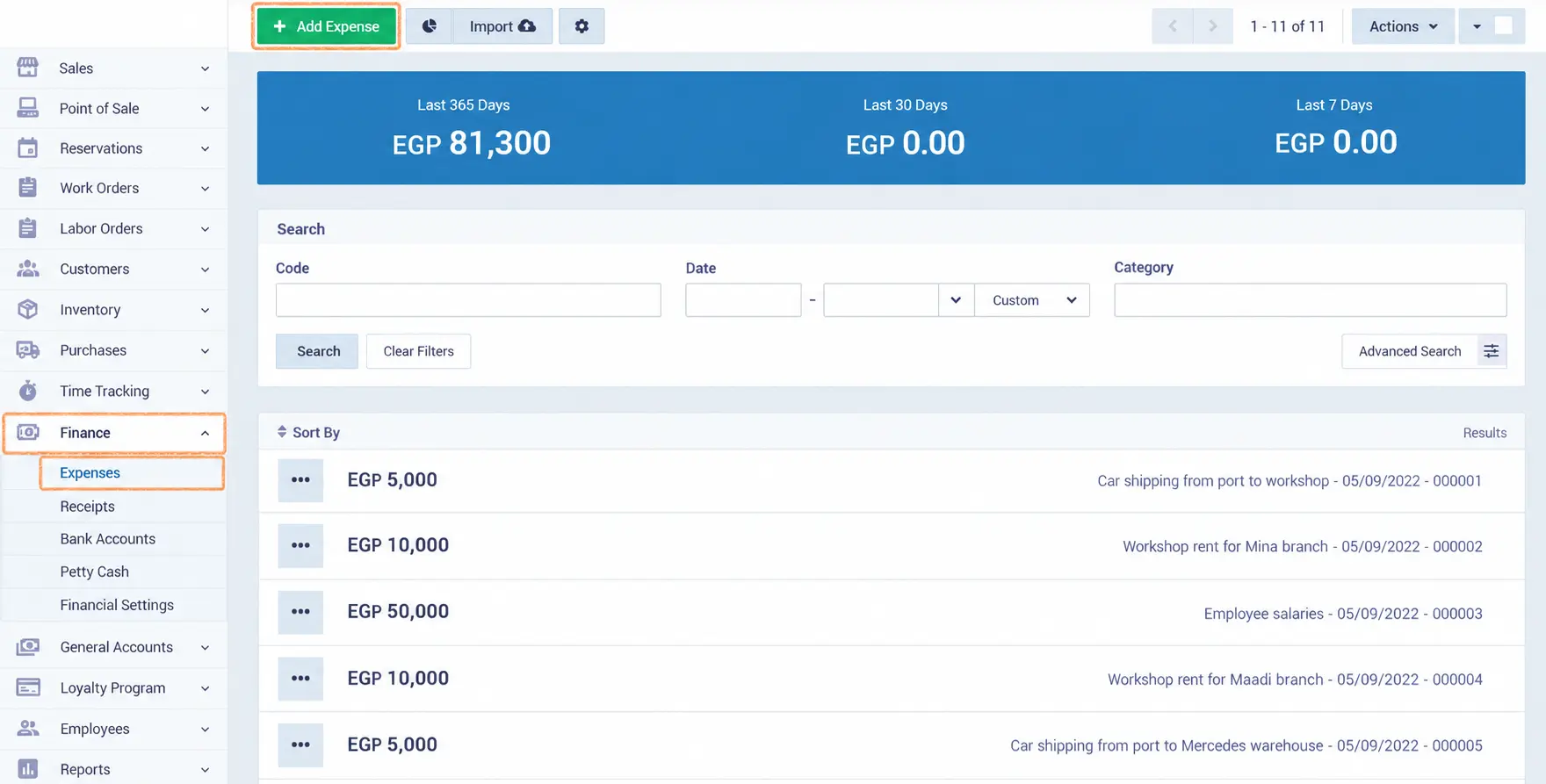
After entering all the basic expense details, such as the amount and description, you can enable the “Assign Cost Centers” option. This displays the fields used to configure the cost centers that will bear all or part of the expense and specify their respective percentages.
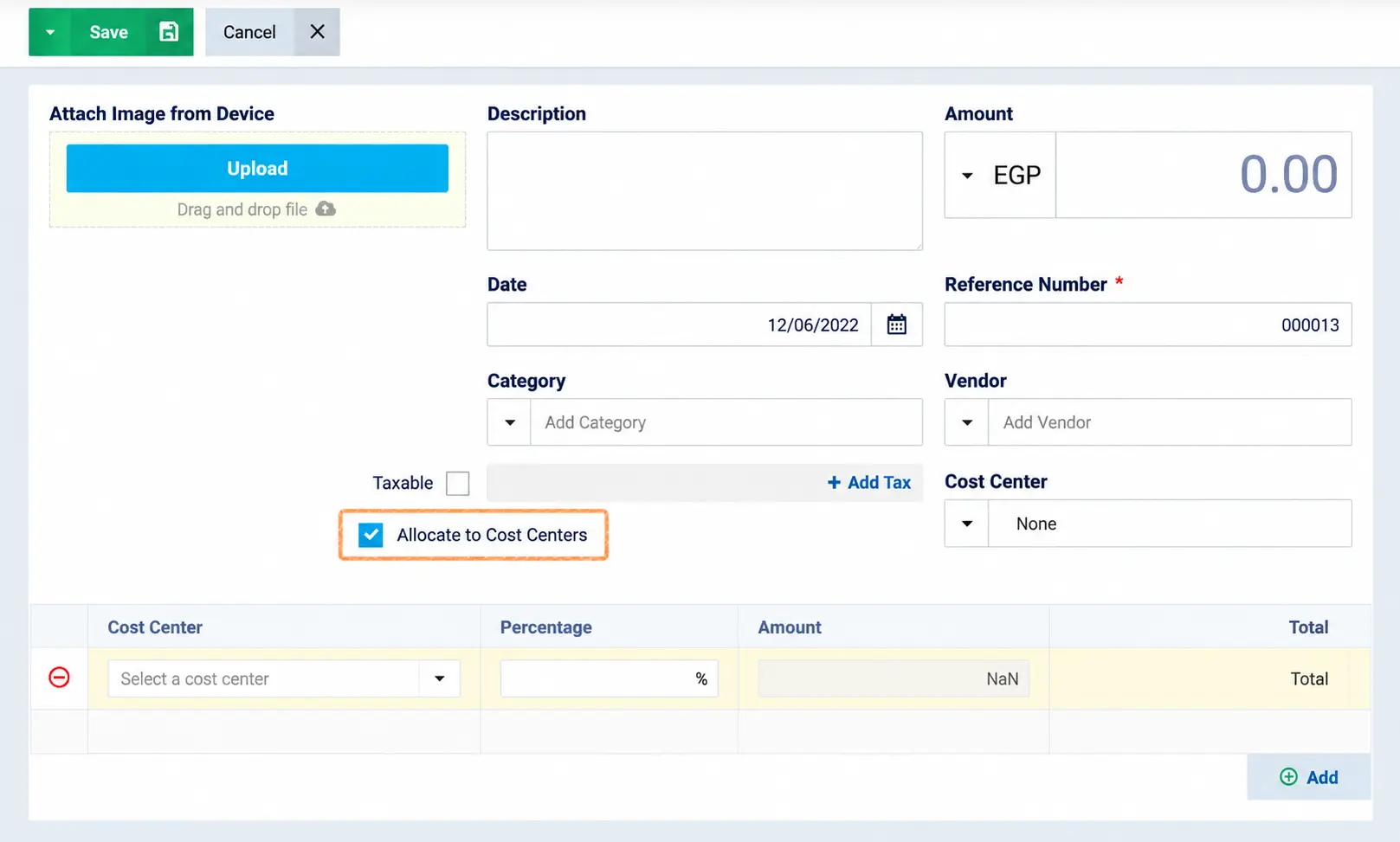
Select the required cost center, then choose whether to enter the allocation as a percentage or a fixed amount.
The system will automatically calculate the other field regardless of which option you select. If you enter a percentage, the system will calculate the corresponding amount based on the total expense and the percentage entered. Conversely, if you enter a fixed amount, the system will calculate the corresponding percentage.
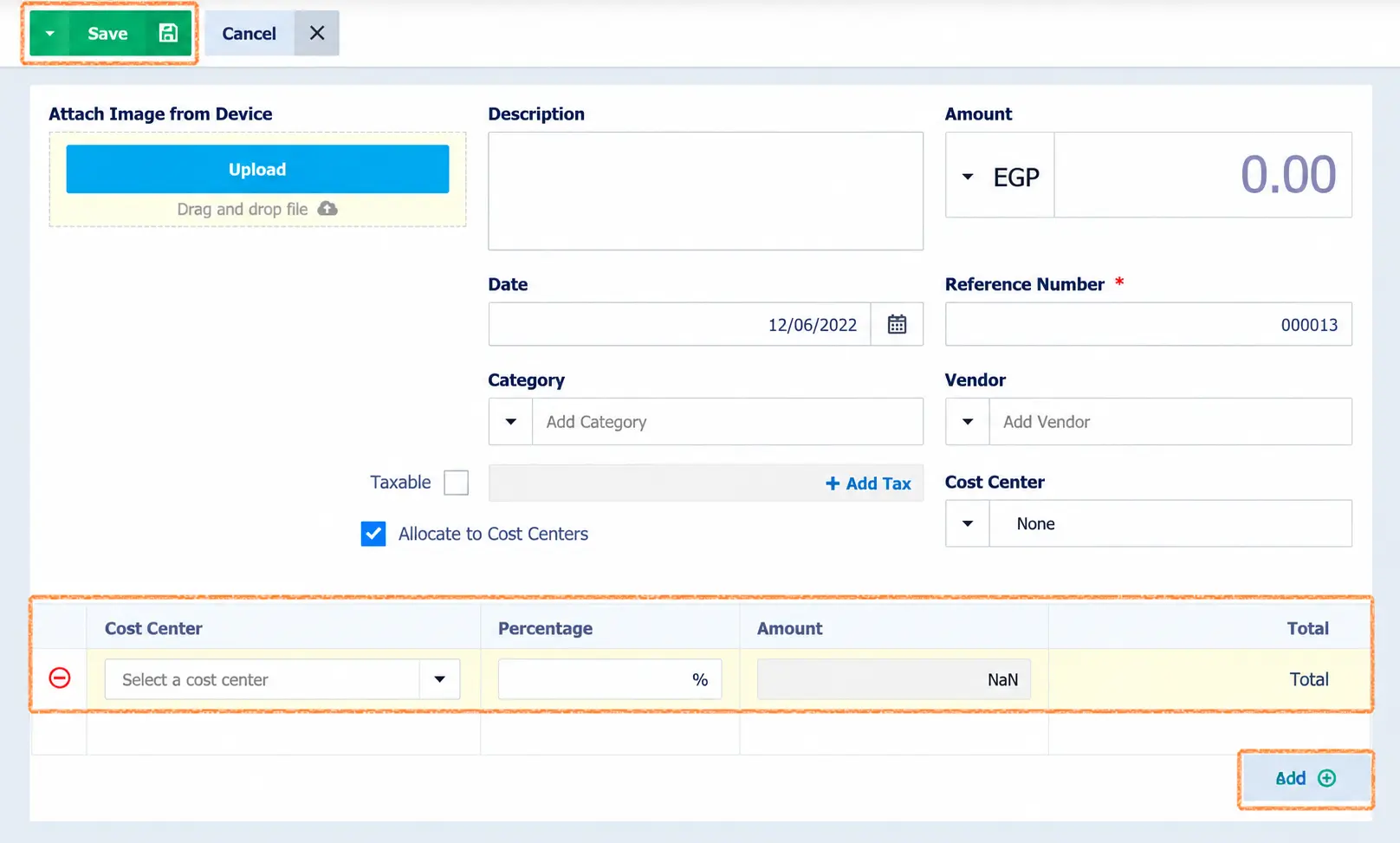
You can assign more than one cost center to the same expense by clicking “Add.”
Linking Cost Centers to Accounts
You can link the company’s accounts to cost centers. For example, you can create a sub-account under expenses or revenues in the Chart of Accounts and link that account to one or more specific cost centers.
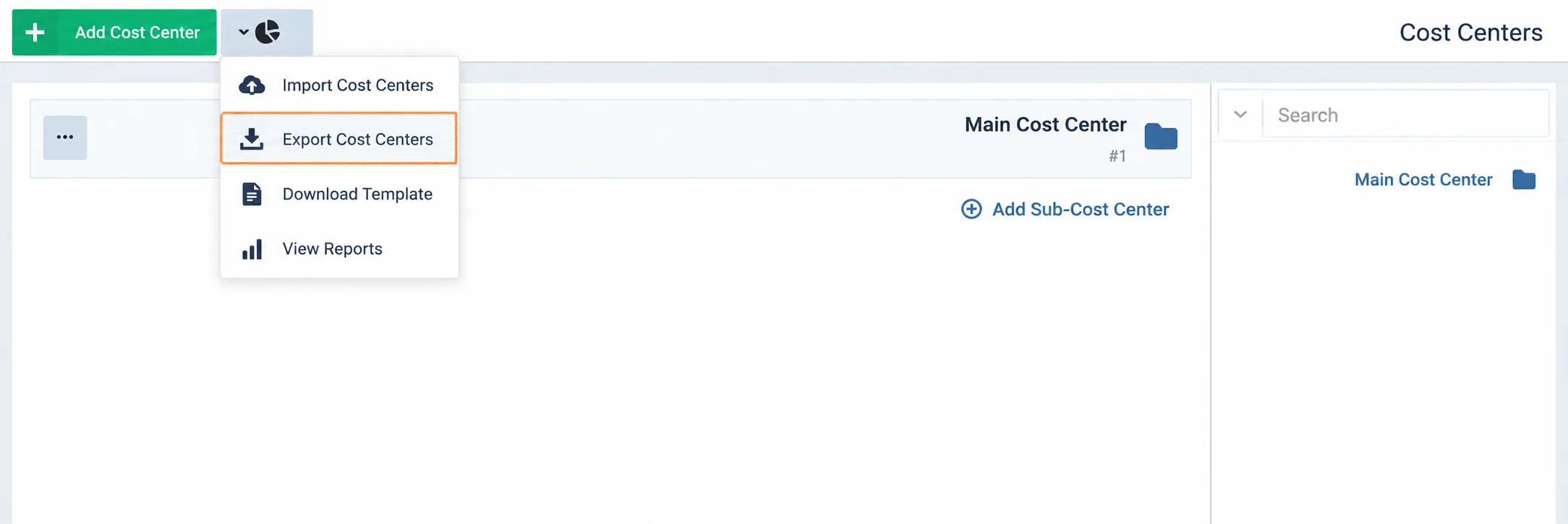
To do so, click “Finance” from the main menu, then click “Cost Centers,” and select “Accounts Without Cost Centers,” as shown in the image.
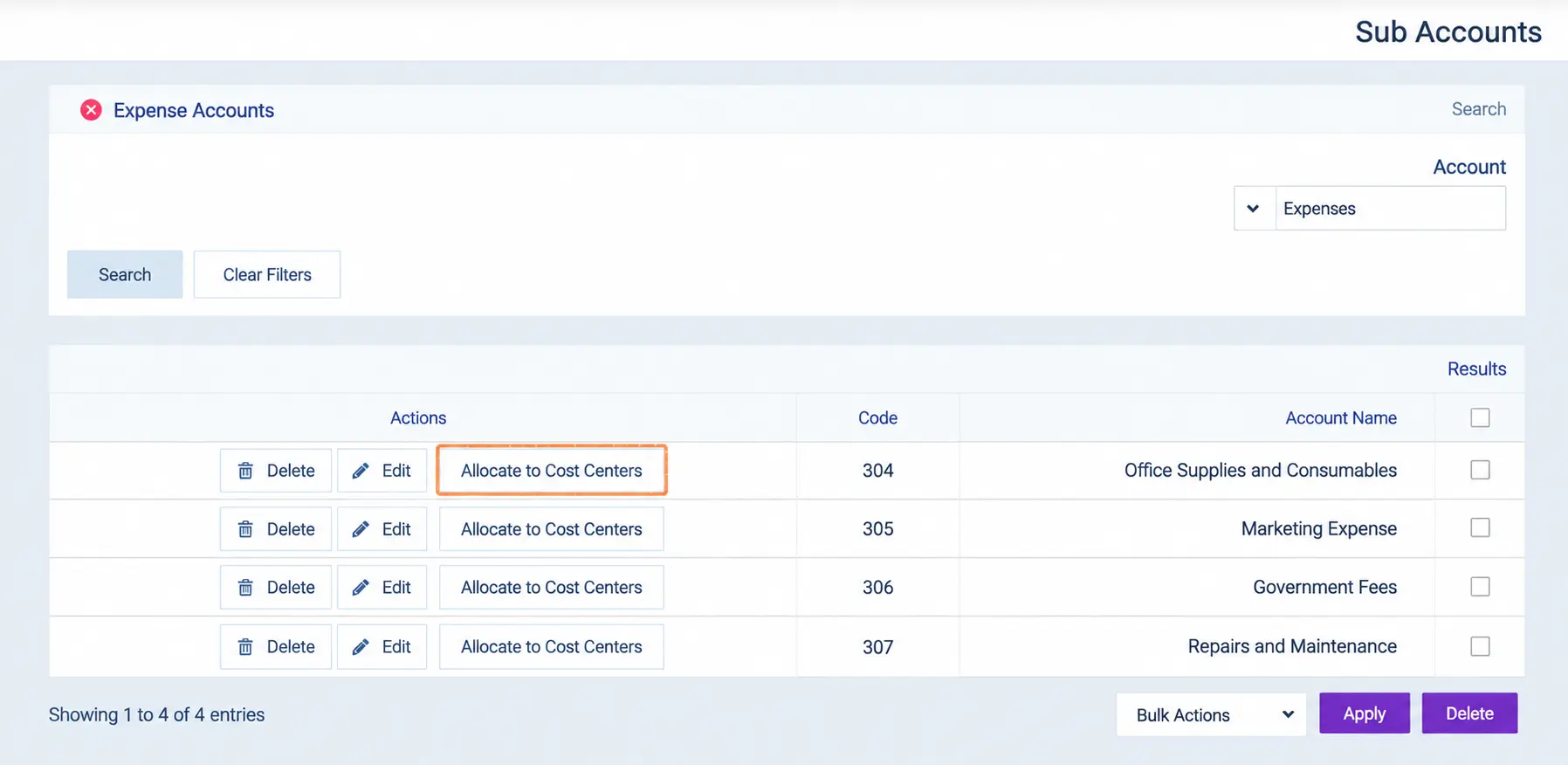
From the list of available accounts, click “Assign Cost Centers” to the left of the account to which you want to assign a cost center.
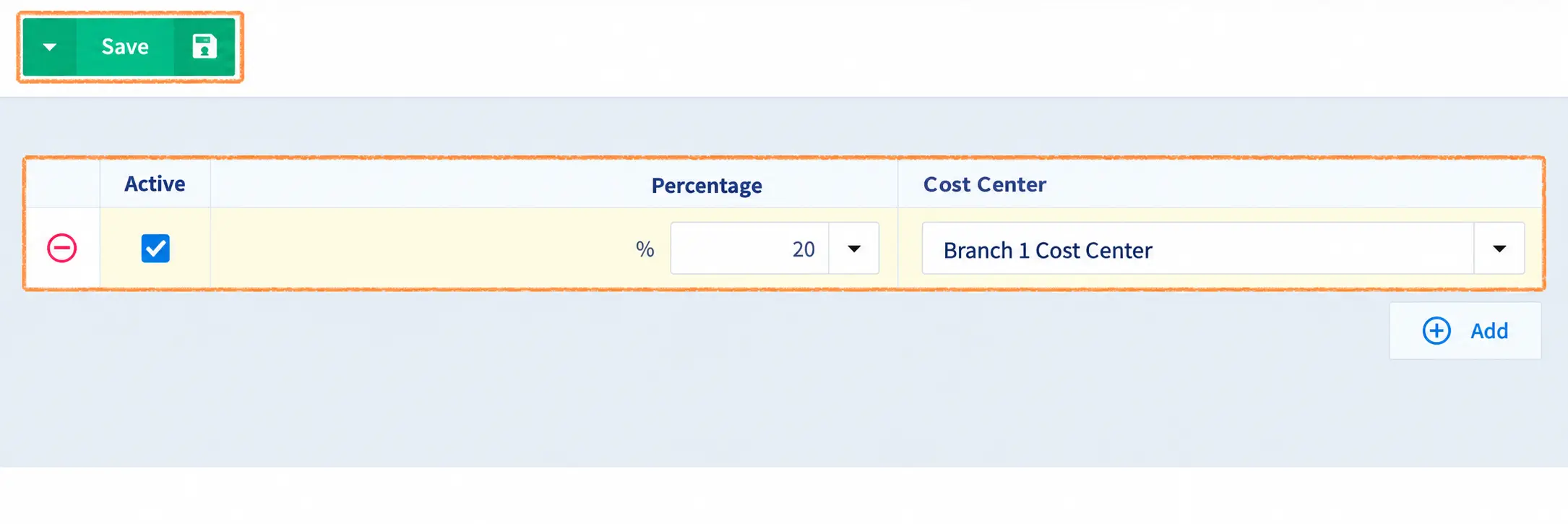
Clicking this option takes you to the page where you can specify the cost centers to be linked to the account, along with the percentage or amount assigned to each cost center. As mentioned earlier, you can add multiple cost centers by clicking “Add” and assigning another cost center, then clicking “Save.”
The only step remaining is to review the cost center reporting feature. Daftra provides a range of reports that display all main and sub-cost centers, as well as reports for cost centers linked to the company’s accounts. It also provides filtering tools that make viewing and extracting data more accurate and convenient.
You can access the reports by clicking “General Accounts” from the main menu, then clicking “Cost Centers.” Next, click the Cost Center Management icon and select “Cost Center Report,” as shown in the image.
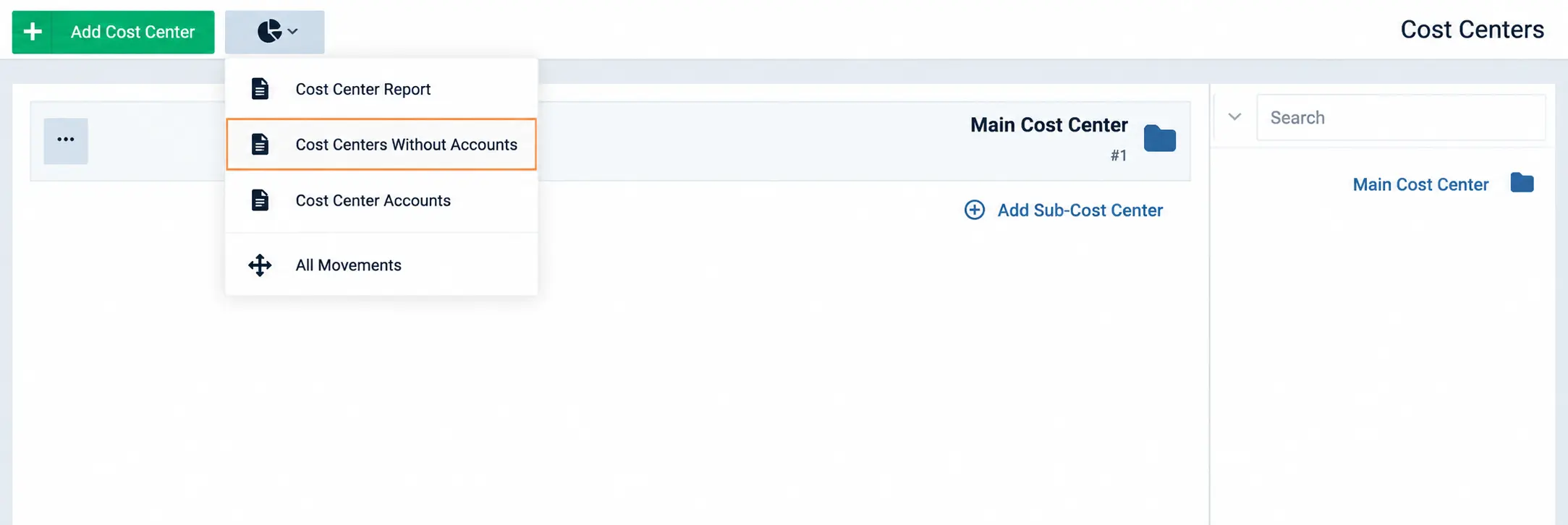
The report can display main and sub-cost centers, along with the balance of each cost center, including debit and credit balances. It also provides details of the expense and revenue transactions recorded in the account.
Frequently Asked Questions
What Is the Difference Between a Cost Center and a Profit Center?
The main difference between a cost center and a profit center is their focus. Cost centers focus on tracking the company’s costs, while profit centers track revenues, costs, and profits together over a specific accounting period.
Is There a Specific Number of Cost Centers a Company Should Have?
There is no specific number of cost centers that a company should have. The number and structure of cost centers depend on the nature of the company’s business. If production or operational processes change unexpectedly, reassign cost centers to ensure the resulting data is accurate.
How Is Cost Center Accounting Classified?
Cost center accounting falls under management accounting rather than tax or financial accounting because cost centers provide detailed information that helps internal management make decisions about product pricing, efficiency improvements, and resource allocation. Cost centers do not have a direct impact on taxes.
Does a Company Need a Cost Center?
Yes, companies generally need cost centers to monitor costs, revenues, and net profits. Although cost centers are not responsible for revenue and investment decisions, they remain an important management tool even when they do not generate income.
What Is the Accounting Difference Between Cost Centers and Branches?
The main difference is that branches are internal divisions of a company that appear as detailed organizational units. They may be financially independent or operate under the company’s main accounting system, and their accounting data can be recorded separately or as part of the overall accounting system.
Cost centers, on the other hand, are connected to one another to measure financial performance and support decisions aimed at improving profitability.
What Are Cost Center Journal Entries?
Cost center journal entries are accounting transactions that record and assign costs to the cost centers associated with specific activities, departments, or projects within a company. Costs are assigned based on the organization’s structure and internal processes, making it easier to track costs, analyze performance accurately, and identify which cost centers are performing well and which need improvement in cost management and resource allocation.
What Is the Difference Between a Cost Center and a Cost Unit?
The main difference is that a cost unit is a component of a cost center. A cost center tracks the costs of a specific department or function within a company, while a cost unit measures the cost of a specific product unit produced by the department associated with the cost center.
Is a Cost Center a Responsibility Center?
Yes. A cost center is a type of responsibility center that is accountable for costs but does not directly generate revenue. For internal management purposes, any revenue or income associated with cost centers is disregarded because the primary objective of cost centers is to analyze costs rather than evaluate revenues.
In addition, separating and disregarding revenues makes it easier to track cost center costs accurately and identify ways to control expenses. This enables management to analyze internal performance and improve the efficiency of operational and production processes.
What Is the Process of Allocating Costs to Cost Centers?
Cost allocation to cost centers is the process of allocating indirect costs among departments within a cost center to determine each center's cost separately. This helps ensure accurate data and supports better pricing decisions.
What Is a Cost Center Directory?
A cost center directory lists the classifications of cost centers within a company, allowing you to track and analyze each department’s costs separately to support informed decision-making.
What Are Cost Centers in Trading Companies?
Cost centers in trading companies are classifications of the company’s departments used to track and analyze costs associated with each department, enabling the team to evaluate the company’s financial performance.
What Are Cost Centers in Contracting Companies?
Cost centers in contracting companies are groups of cost centers divided according to the different activities within the company. They help track and analyze the company’s financial performance and support informed decision-making.
With that, we have reached the end of our journey together. We have explained the concept of cost centers with practical examples, discussed a sample Cost Center Hierarchy, and concluded by explaining how to use cost centers in Daftra’s accounting cost center management software, along with its key features that make managing your accounts easier and more accurate. Daftra also provides a technical support team ready to answer your inquiries around the clock.









 Invoicing
 POS
 Offers
 Installments
 Sales Commission
 KSA E-Invoice Software
 EGY E-Invoice Software
 JO E-Invoice Software
 E-Invoice Software
 Chart of Accounts
 Asset Management
 Cost Centers
 Expenses
 Cheque Cycle
 UAE VAT-Tax
 Product Management
 Purchases
 Purchase Cycle
 Suppliers
 Requisitions
 Stocktaking
 Organizational Structure
 Personnel Management
 Attendance and Leave
 Contracts
 Payroll
 Requests
 Work Orders
 Booking Management
 Rental and Unit Management
 Time Tracking
 Work Flow
 Lease Contracts
 Manufacturing Management
 Client Follow-Up
 Loyalty Points
 Points and Credits
 Memberships
 Insurance Management
 Daftra ERP Full App
 Point of Sales App
 Point of Sales for Desktop – Support Offline Mode
 AI Expenses Scanner App
 Employee Attendance, Sign & ESS App
 E-invoice Reader App
 Inventory Stocktaking App