




Table of contents:
- Key Summary
- What Is an Offshore Company in the UAE?
- Key Advantages of Offshore Company Formation in The UAE
- Offshore Company Formation Process
- Offshore vs Free Zone vs Mainland Which One Should You Choose?
- UAE Offshore Jurisdictions You Can Choose From
- Best Offshore in UAE How to Decide
- Offshore Bank Account in Dubai What to Expect
- What Offshore Company Formation Cost Depends On?
- When Offshore Is the Wrong Choice (Quick Warnings)
- Operations & Systems for Offshore Company Formation
- FAQs about Offshore Company Formation
An offshore company in the UAE is a legal entity designed mainly for international business and efficient asset holding, rather than for day-to-day operations within the UAE.
However, offshore companies are restricted from operating in the UAE market, which makes them attractive for investors who focus on international trade and holding activities.
If your goal is active business operations, you can understand more about Free Zones in UAE to select the right free zone that suits your business needs.
In this guide, you will understand:
- What an offshore company is and how it works in the UAE.
- Offshore vs Free Zone vs Mainland to know which one fits your goals.
- The main UAE offshore jurisdictions and their advantages.
- What affects offshore setup costs.
- When offshore is not the right choice.
What Is an Offshore Company in the UAE?
An offshore company is a legal entity registered through a specific jurisdiction, such as JAFZA and RAK ICC. It allows 100% foreign ownership with no physical office or employees required, making it an ideal opportunity for investors involved in international trading, holding investments, and corporate structuring to start the offshore company formation process.
Unlike Free Zone and Mainland companies, the offshore company can’t conduct commercial activity with clients or entities within the UAE because it only receives a certificate of incorporation, not a business license.
Key Advantages of Offshore Company Formation in The UAE:
100% foreign ownership
Offshore companies allow investors to own the company outright without a local sponsor.
International market scope
An offshore structure is mainly used for activities outside the UAE, which makes it suitable for businesses that want to operate internationally without needing a physical presence.
Tax advantages
Offshore companies can benefit from 0% corporate tax if they are recognized as QFZP and meet FTA rules, which will allow them to maximize their profitability.
Lower operating costs
Offshore companies don’t need to lease office space or hire employees in the UAE, which keeps operating costs competitive compared to other setups, such as a Dubai mainland company setup.
Asset protection
It provides a safe way to protect personal and corporate assets by creating a legal separation between the owner and the business assets, reducing risk and improving financial planning.
Offshore Company Formation Process
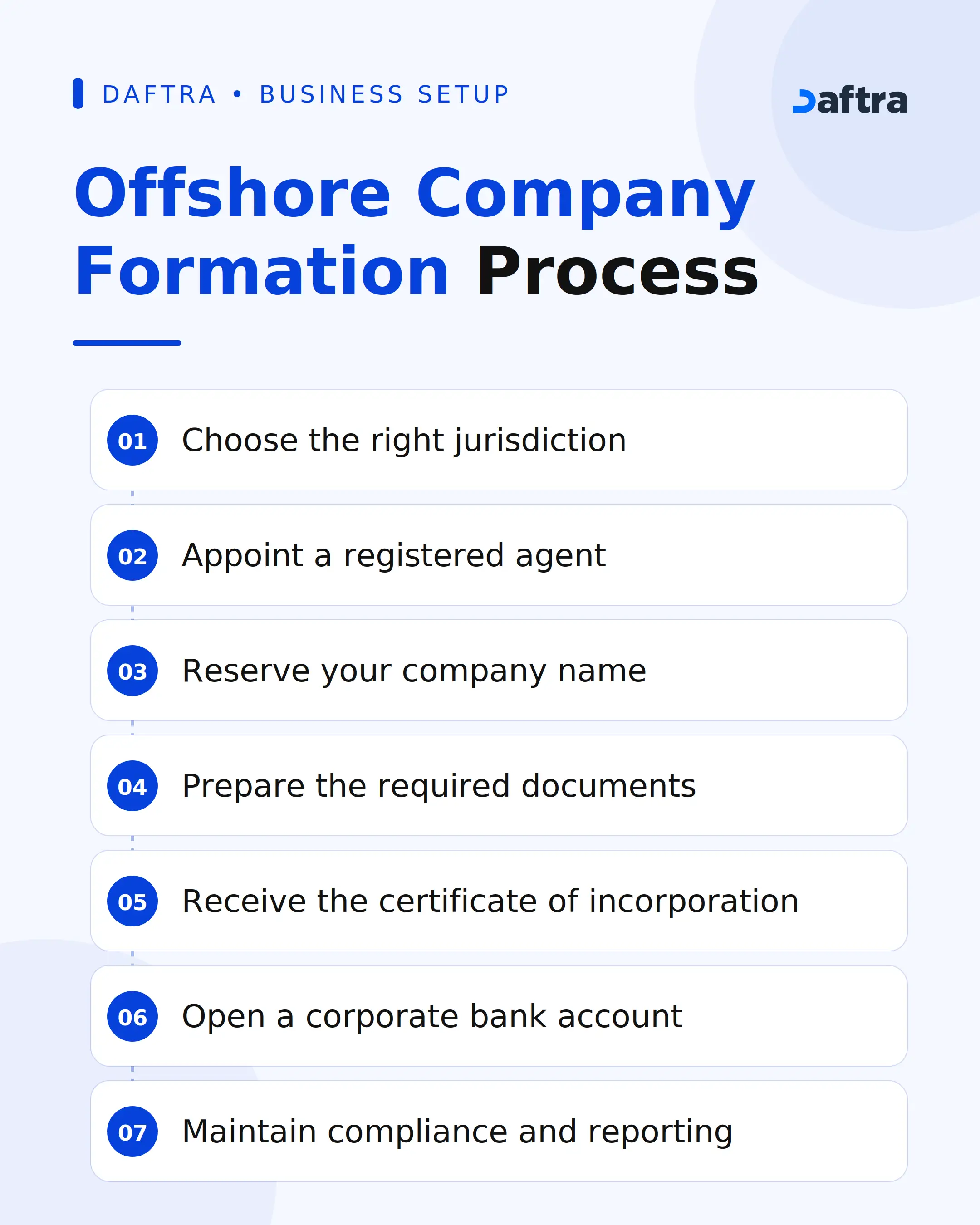
Step 1: Choose the right jurisdiction
Before starting the offshore company formation in the UAE, you need to select a specific jurisdiction to operate in. This step defines the advantages and limitations that your company will deal with from the different options you can choose from, such as JAFZA, RAK ICC, or Ajman.
Step 2: Appoint a registered agent
In offshore company formation, you can’t set up the business directly without having an authorized registered agent. Many offshore jurisdictions provide you with an authorized agent you can deal with during the UAE offshore company formation.
The agent acts as:
- Your legal representative with the offshore authority.
- The one who’s responsible for submitting your documents and managing compliance.
Step 3: Reserve your company name
You need to choose a company name that follows the UAE’s naming rules so you can get the authority's approval for that name. The business name needs to comply with the following rules:
- Unique and not registered by another company.
- Must reflect your business activities.
- Doesn’t contain any restricted or offensive words.
- The trade name must end with a clear offshore suffix, such as Ltd or Inc.
Step 4: Prepare the required documents
You’ll need to prepare all documents required by the authority so it can review your application and proceed with the company formation process.
Common required documents:
- Passport copies of shareholders.
- Memorandum and articles of association.
- Letter of appointment of registered agent.
- Certificate of good standing.
- Board resolution document.
- Power of attorney (POA).
Step 5: Receive the certificate of incorporation
After the offshore authority reviews your application, you will receive the certificate of incorporation, which helps your offshore company in many ways because it acts as:
- The official document confirms that your company exists.
- It’s the replacement of the business license for offshore companies.
- It allows you to start operating internationally.
All offshore companies in the UAE operate only internationally by using this certificate, but if you want to open a branch and operate within the UAE market, you can start the registration of a foreign company in Dubai.
Step 6: Open a corporate bank account
Opening a corporate bank account is important for offshore companies because it helps you receive international payments and manage the company's finances. Banks usually require these documents:
- Certificate of Incorporation.
- Shareholders passports.
- Proof of residential address.
- Source of funds.
- Memorandum and Articles of Association.
- Board resolution certificate.
- Certificate of Good Standing.
- Brief business profile
Step 7: Maintain Compliance and Reporting
After finishing the Dubai offshore company formation, you will need to maintain compliance to keep your business legally active and meet the FTA’s regulations. To maintain compliance, you will need:
- Keep an active agent to act as the official contact with the offshore authority.
- Register for corporate tax and meet the FTA’s rules.
- Keep proper financial records.
- Pay all annual renewals required for the company.
Offshore vs Free Zone vs Mainland: Which One Should You Choose?
| Factor | Offshore | Freezone | Mainland |
| Ownership | 100% foreign ownership. | Business setup in a Dubai free zone offers 100% foreign ownership. | Dubai mainland company setup allows 100% foreign ownership in most activities. |
| Market Access | It has no access to the UAE’s market, but it can only operate internationally. | It can operate within the free zone and internationally, but can’t sell directly in the UAE market unless it has approval. | It has full access to the UAE market, which allows it to sell directly to local clients, companies, and governments. |
| Visa eligibility | It’s not eligible to have visas, because there is no office space or employees. | It has limited eligibility, as the number of visas you can obtain depends on the package and office type. | You can upgrade your visa eligibility by upgrading the office size your company operates in. |
| Office requirement | Not required. | Required, and it offers flexible options. | Physical office required. |
| Tax treatment | 0% if it meets the QFZP criteria. | 0% if it meets the QFZP criteria. | 9% corporate tax above the UAE’s threshold. |
| Setup complexity | Low | Medium | High |
| Best for | Holding and corporate structuring companies | Startups and international trade businesses | Trading and logistics businesses |
UAE Offshore Jurisdictions You Can Choose From
Before starting the offshore company formation, you must understand the key advantages of each jurisdiction. There are different options, such as JAFZA, RAK ICC, and Ajman, and each one has different features.
What to consider before choosing a jurisdiction:
- Setup flexibility: If the jurisdictions ask for fewer requirements, it will make the setup process faster.
- Reputation and credibility: A jurisdiction with stronger international recognition will improve your company’s trust.
- Banking requirements: Jurisdictions that have stronger banking relationships will make it easier for you to get approvals.
- Cost effectiveness: Some jurisdictions offer competitive prices and flexible setup, while others offer an international reputation with higher prices.
JAFZA Offshore (Dubai)
JAFZA Offshore is an established offshore jurisdiction in Dubai, and it has a strong international image because it is located in Dubai. First, before you start the JAFZA company formation process, you need to check its advantages and limitations to evaluate if it suits your company.
Key advantages:
- Strong reputation and credibility because it's recognized by international companies, which can make business relationships smoother.
- Strong reputation and credibility because it's recognized as a well-established offshore in Dubai.
- Better banking relationships as JAFZA structures are more accepted by UAE banks.
- JAFZA offshore companies can own properties in Dubai under their corporate structure.
Main limitation:
- It doesn’t obtain a business license, so it will not have access to the UAE market.
- Higher cost compared to other jurisdictions, such as RAK ICC and Ajman.
- It usually involves a more formal setup process, which takes longer compared to other jurisdictions.
Best for: Businesses that need a premium and well-established offshore structure.
RAK International Corporate Center (RAK ICC) (Ras Al Khaimah)
RAK ICC is known for its flexible regulations and cost-efficient structure. Companies in RAK can only operate internationally, unlike free zone companies that are allowed to operate within the free zones and also outside the UAE.
Key advantages:
- It’s built on a modern legal framework that makes it easier for investors to work with.
- It offers a faster and more flexible setup process.
- RAK ICC offers affordable setup prices, which make it a suitable option for a startup.
- There are no complicated compliance requirements, such as audited financial statements.
- There is no requirement for minimum share capital, which provides flexibility for small businesses.
Main limitation:
- RAK ICC companies only receive a certificate of incorporation and can’t operate within the UAE.
- Bank account approval can take more time, especially if the company structure and documents are not clear.
Best for: Companies looking for a flexible and affordable offshore structure.
Ajman Free Zone Offshore (Ajman)
Ajman Offshore is a practical and cost-effective offshore option. It is designed for businesses that want a simple structure without complexity or higher costs. However, it’s not allowed to operate within the UAE like other jurisdictions, so if you want to operate internationally and also within specific free zones, you can start a business setup in Dubai Free Zone process.
Key advantages:
- Ajman Offshore offers a low-cost setup, which is suitable for startup businesses.
- It provides a smooth setup process with minimal documents and administrative requirements.
- You don’t need a minimum capital to get started, which can make the setup more accessible.
Main limitation:
- It doesn’t provide a business license, so it can’t trade within the UAE’s local market.
- Lower recognition in terms of banking and international positioning compared to other jurisdictions.
Best for: Small businesses that want a simple and cost-efficient offshore setup.
Best Offshore in UAE: How to Decide
Offshore Bank Account in Dubai: What to Expect
Opening a bank account for an offshore company usually takes more time because offshore companies don’t have a real physical presence, which makes it more difficult for banks to verify ownership and the source of funds.
As a result, banks apply stricter compliance checks to offshore structures. Although some jurisdictions offer good banking relationships, such as JAFZA, the overall approval process goes through strict bank checks. Because of that, avoiding what causes bank delays will help you to get banking approvals faster.
What can cause delays:
- Incomplete or missing documents.
- Unclear business activity.
- Not clearly stating the source of funds.
- High-risk industries and business activities.
- Shareholders have a risk profile or nationality.
- Weak business profile, such as a poor business brief presentation.
If you want faster bank approvals and you’re eager to operate in the local market, you can start the Dubai mainland company setup. With this mainland setup, you can benefit from dealing with local clients and working with government entities.
What Offshore Company Formation Cost Depends On?
During offshore company formation, you will go through many steps, each with fees, and knowing the Dubai offshore company formation cost will help you plan your budget before you start.
If you are planning to set up your company in Dubai, you can read the “How much does it cost to set up a company in Dubai” guide to have a broader scope of company formation costs in Dubai specifically.
When Offshore Is the Wrong Choice (Quick Warnings)
Although offshore companies offer unique tax advantages and lower operating costs, before starting the offshore company formation, you must clearly state what your business actually needs. You will find below common scenarios that, if you find out that they don’t suit your business goal, will be a clear signal that the offshore company structure is the wrong choice.
Don’t choose an offshore company structure if:
- You want to sell to UAE customers because offshore companies are not allowed to trade within the UAE market.
- You need a UAE residence visa for investors or employees because it’s not allowed in this structure.
- You need a physical office to operate because offshore companies don’t run their operation locally; they’re designed for international activities only.
- Your business depends on local operations within the UAE market, such as logistics and retail businesses.
Operations & Systems for Offshore Company Formation
Operating in an offshore structure needs to be managed correctly, especially since it has strict compliance checks due to its operating nature. If you want to stay compliant with the FTA’s regulations, you need to keep in mind these considerations.
- Tax compliance: You must register for corporate tax requirements, so you can be compliant with the FTA’s regulations and avoid any financial penalties.
- Anti-Money laundering regulations: You must verify the shareholder's identity and provide clear information about the source of funds.
- Economic substance requirements: You need to prove that the business is operating in reality by showing that the company is properly managed and keeps clear financial records.
Offshore companies, as well as investors setting up a Dubai free zone or Dubai mainland company, must keep these considerations in mind, as they help maintain a clear record for any regulatory check.
FAQs about Offshore Company Formation
How to set up an offshore company in Dubai?
Setting up an offshore company in Dubai usually starts by choosing a specific jurisdiction and appointing a registered agent. After that, you will need to prepare the required documents to have the authority issue your certificate of incorporation, and finally, you can open a corporate bank account.
What is an offshore company in Dubai?
An offshore company in Dubai is a legal entity in a UAE jurisdiction for operating internationally. It’s usually used for holding assets, managing investments, and corporate structuring.
What is the cost of an offshore company?
The cost varies depending on the jurisdiction you choose, because it ranges from affordable to premium jurisdictions. The costs also include registered agent fees, renewal fees, and banking requirements.
What are the benefits of offshore companies in the UAE?
Offshore companies provide lower operational costs compared to free zones and the mainland because they don’t require a physical office or hiring employees. They also offer tax advantages that companies can benefit from if they meet the QFZP requirements, as they can pay 0% corporate tax.
What are the risks of offshore companies?
The main risk is that offshore companies can’t operate directly inside the UAE market or obtain residency visas, which makes it harder for them to reach wider local clients. It also has more complex banking requirements due to stricter compliance checks.
Can offshore companies open a bank account in Dubai?
Yes, but banks usually require detailed documentation such as a company incorporation certificate, shareholder information, and source of the funds. The company can get bank approval based on the business profile and compliance review.
What do banks offer offshore accounts?
Banks offer offshore companies benefits such as multi-currency support, international transfers, and asset protection. They also offer online banking access, making it suitable for international business operations.
How do I register my offshore company with JAFZA?
To register with JAFZA, you need to work with an approved registered agent, and you will find a list of agents on the JAFZA website. The registration process includes choosing a company name and submitting the required documents. Once it’s approved, you will receive a certificate of incorporation to start operating legally.












 Invoicing
 POS
POS Offers
 Installments
 Sales Commission
 KSA E-Invoice Software
 EGY E-Invoice Software
 JO E-Invoice Software
 E-Invoice Software
 Chart of Accounts
 Asset Management
 Cost Centers
 Expenses
 Cheque Cycle
 UAE VAT-Tax
 Product Management
 Purchases
 Purchase Cycle
 Suppliers
 Requisitions
 Stocktaking
 Organizational Structure
 Personnel Management
 Attendance and Leave
 Contracts
 Payroll
 Requests
 Work Orders
 Booking Management
 Rental and Unit Management
 Time Tracking
 Work Flow
 Lease Contracts
 Manufacturing Management
  Client Follow-Up
 Loyalty Points
 Points and Credits
 Memberships
 Insurance Management
 Daftra ERP Full App
 Point of Sales App
 Point of Sales for Desktop – Support Offline Mode
 AI Expenses Scanner App
 Employee Attendance, Sign & ESS App
 E-invoice Reader App
 Inventory Stocktaking App