



Table of contents:
- Key Summary
- What is Equity in Accounting?
- What is the Statement of Changes in Equity in Accounting?
- What is the purpose of a statement of changes in owner's equity?
- What are the Components of the Statement of Equity
- What are the Items of Equity in Accounting?
- How to Create a Statement of Equity?
- How to Distribute Profits Through the Statement of Equity?
- Examples of the Statement of Equity
- What is the Format of the Statement of Changes in Equity?
- Major Accounting Errors When Preparing the Statement of Equity and How to Avoid Them
- What Can Cause Equity to Change Besides Profit or Loss?
- How to Manage the Statement of Equity in Daftra Software
- Frequently Asked Questions
- Conclusion
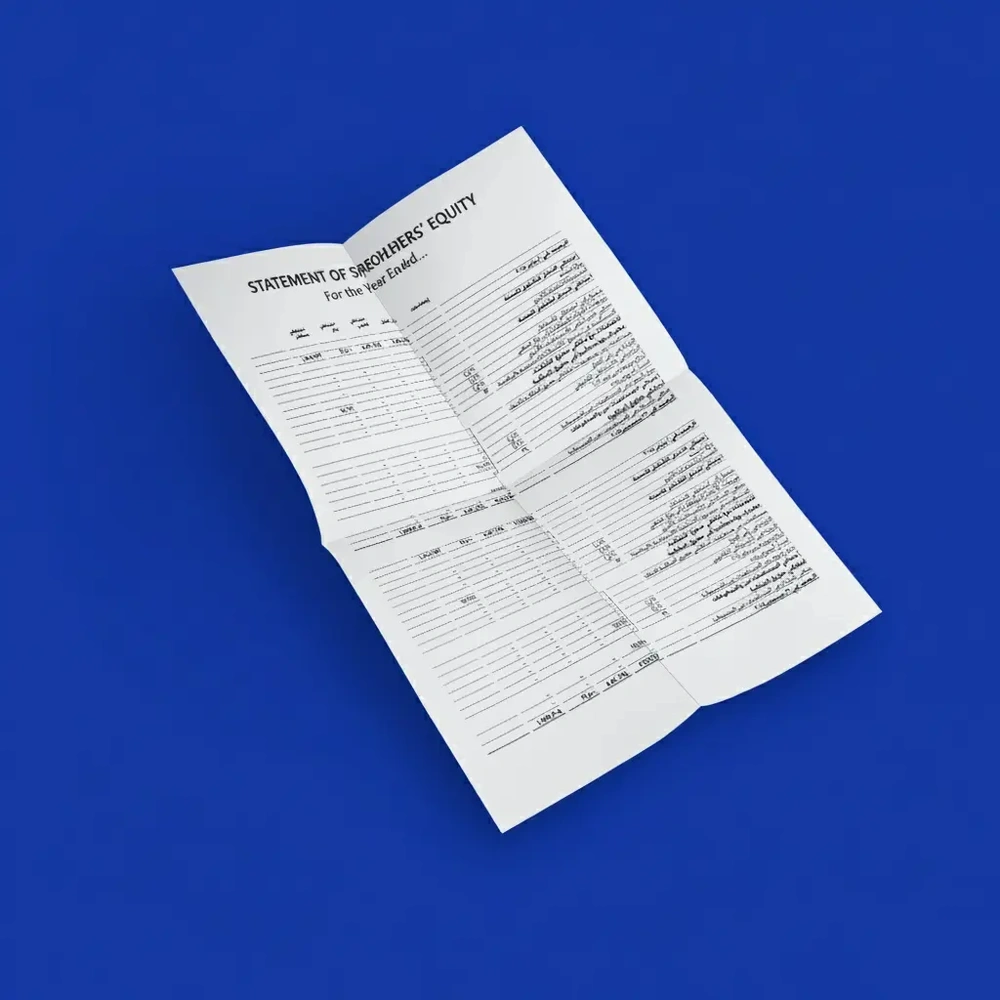
The statement of equity is one of the financial statements specific to business owners, providing a clear view of changes in the company’s equity.
How does the statement of equity connect owners' capital with distributed and retained earnings? And how can strategic decisions be made through the statement of equity?
This article will clarify the importance of the statement of equity, its components, and how to prepare it through practical steps.
What is Equity in Accounting?
Equity is the residual value of a business’s assets after deducting all its liabilities. In other words, it represents what the business owners or shareholders have in the company’s net assets after settling all liabilities.
It is also known as shareholders’ equity or owners’ equity and is equal to the company’s net assets.
While equity describes the owners’ residual interest in a business, the terms owners’ equity and shareholders’ equity depend on the business structure.
Owners’ equity is a general term that applies to sole proprietorships, partnerships, and corporations, while shareholders’ equity refers specifically to corporations, where owners hold shares in the company.
Both represent the owners’ claim on the business’s net assets and are calculated as assets minus liabilities.
For example, consider two businesses with the same financial position: SAR 200,000 in assets and SAR 80,000 in liabilities. If the first business is a sole proprietorship, the remaining SAR 120,000 is called owners’ equity.
If the second business is a corporation owned by shareholders, the same SAR 120,000 is called shareholders’ equity. The calculation is the same; only the terminology differs by business structure.
What is the Statement of Changes in Equity in Accounting?
The Statement of Changes in Equity is a financial statement that shows how a company’s equity changes during a specific reporting period. It reconciles the opening and closing balances of each equity component, helping explain how the company’s financial position changed over the period.
The statement typically shows changes resulting from net profit or loss, other comprehensive income, capital contributions from owners, share issuances or buybacks, dividends, and other changes in equity. It may also reflect adjustments resulting from changes in accounting policies or corrections of prior-period errors.
By linking changes in equity to the company’s financial performance and transactions with its owners, the statement provides a clearer view of how equity has increased or decreased during the reporting period. It also connects the closing equity balances with the amounts reported in the statement of financial position.
What is the purpose of a statement of changes in owner's equity?
The statement of owner’s equity shows the changes that occurred and determines profits or losses and other influential transactions. The objectives of preparing the statement of owner’s equity are represented in the following points:
1- Providing Important Data About Capital
The statement of owner’s equity provides important data for investors, lenders, creditors, and other stakeholders to understand how the entity's assets (capital) are managed, helping them evaluate the entity's performance and position, and make investment and financing decisions such as buying or selling shares, or requesting loans for expansion.
2- Foundation for Building the Balance Sheet
The balance sheet cannot be completed without changes in owner’s equity, as owner’s equity is an integral part of the balance sheet alongside the entity's assets and liabilities. Owner’s equity appears on the equity side of the balance sheet.
It links the income statement and the balance sheet.
3- Clarifying Owners' Rights
The statement of owner’s equity clarifies the percentages and shares of owners and shareholders in the entity through dividend distributions and participating shares, providing a comprehensive overview of the entity's structure.
4- Determining the Entity's Financial Health
It is used to determine share capital at year-end to establish net owner’s equity, as well as to understand the impact of profits or losses realized during the year on owner’s equity, helping assess the entity's ability to generate sustainable profits.
5- Evaluating the Institution's Performance and Financial Position
The statement of owner’s equity is used to determine share capital at year-end to establish net owner’s equity, as well as to understand the impact of profits or losses realized during the year on owner’s equity, helping evaluate the entity's financial position and performance through its ability to generate sustainable profits.
6- Compliance with Accounting Standards
The statement of owner’s equity is an essential part of compliance with accounting standards for financial statement preparation, reflecting the entity's financial health, credibility, transparency, and commitment to the principle of financial disclosure.
From my experience, I came across a case involving a Saudi company owned by several partners. The company started the year with SAR 500,000 in equity. During the year, it generated SAR 200,000 in net profit, distributed SAR 80,000 of the profit to the partners, and one partner made an additional SAR 100,000 capital contribution. By the end of the year, the company’s equity balance had reached SAR 720,000.
When the company owner looked at the income statement, he could see the SAR 200,000 net profit, but that alone did not explain why equity increased from SAR 500,000 to SAR 720,000 instead of SAR 700,000.
That is when we needed to look at the Statement of Changes in Equity. It helped us see exactly what caused the change: the SAR 200,000 net profit, the SAR 80,000 distributions to partners, and the SAR 100,000 additional capital contribution, which brought the closing equity balance to SAR 720,000.
Simply put, the income statement shows how the company performed during the year, while the Statement of Changes in Equity helps us understand how and why the equity balance changed from the beginning to the end of the period.
What are the Components of the Statement of Equity
Equity in the balance sheet for sole proprietorships, partnerships, and corporations consists of several elements that cannot be overlooked when preparing the balance sheet. The following are the elements of the statement of equity:
- Share capital at the beginning of the period.
- Additions or reductions to share capital during the financial period.
- Owner withdrawals.
- Net income or net loss.
- Cash reserves.
- Retained earnings.
- Dividend distributions.
- Prior period adjustments.
- Share capital at the end of the financial period (net equity), which represents the ending balance.
What are the Items of Equity in Accounting?
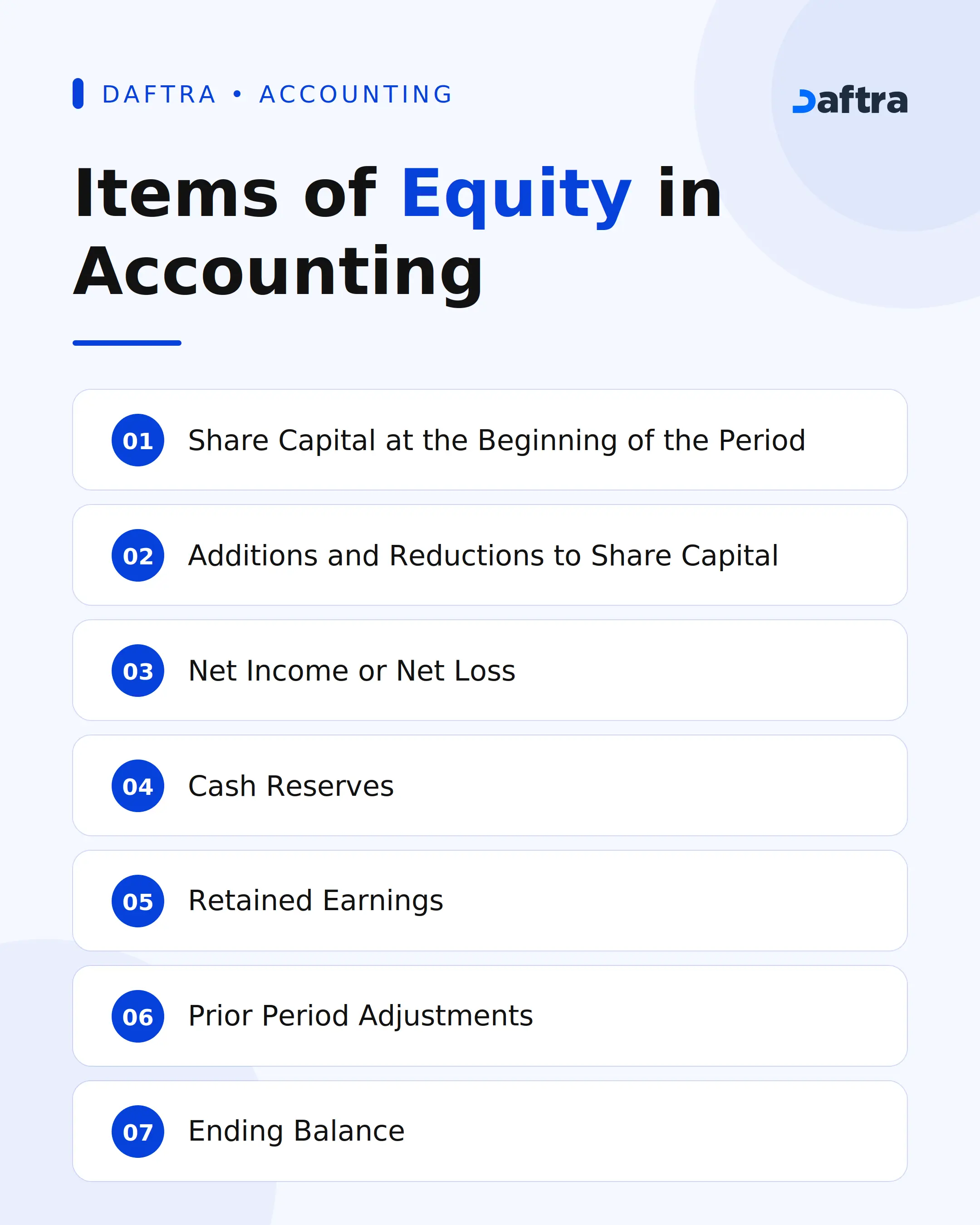
Explaining the statement of equity is important in clarifying the items and elements so they can be read correctly and accurately. The statement of equity includes paid-in capital, retained earnings, reserves, and others. Learn about the equity items in the following points:
1- Share Capital at the Beginning of the Period
Share capital at the beginning of the period represents the net share capital from the previous year and is recorded in the statement of equity at the beginning of the new year to identify the changes that occurred.
2- Additions and Reductions to Share Capital
Share capital additions during the financial period are any amounts added to increase share capital for the new year. For example, if the entity issued 100,000 shares at 3 riyals per share when the law states that the par value is 1 riyal per share, then 100,000 riyals is considered an increase to the original share capital, and 200,000 riyals is considered additional paid-in capital.
Share capital reductions represent amounts taken from the entity's share capital that decrease it, such as owner withdrawals, which are expenses taken from the entity for the benefit of the entity's owners.
3- Net Income or Net Loss
This is the positive cash balance (profit) or negative (loss) that occurred during the year, calculated through the income statement. The calculation formula for net income is as follows:
Net Income = Gross Profit - Total Other Direct Costs (taxes, interest, operating expenses, rent, equipment, and employee salaries).
4- Cash Reserves
Financial laws require institutions to maintain a specific percentage for cash reserves, calculated from the year's net income and appearing in the statement of equity twice: once as a positive value in the reserves column for the unused amount, and again as a negative under retained earnings because it wasn't used, thus reducing retained earnings.
Illustrative Example: If the year's net income equals 500,000 riyals and the reserve percentage equals 10%
Then reserves = 500,000 × 10% = 50,000 riyals.
Therefore, add this amount to the reserves column once as positive and again as negative in the retained earnings column.
5- Retained Earnings
These are the entity's annual profits that will be carried forward to the next year, so they appear in the retained earnings column under net income, listed under the credit side in equity. The company reinvests retained earnings in its business for expansion and growth.
6- Prior Period Adjustments
These are adjustments made in previous years that were deducted from profits, but in the new year, adjustments were made to add them to retained earnings in the new year. Therefore, the final total balance at the end of the period is the balance that appears in the balance sheet.
7- Ending Balance
Capital is calculated at the end of the financial period, or what is called net equity, which is the amount that expresses the owners' rights after additions and deductions.
How to Create a Statement of Equity?
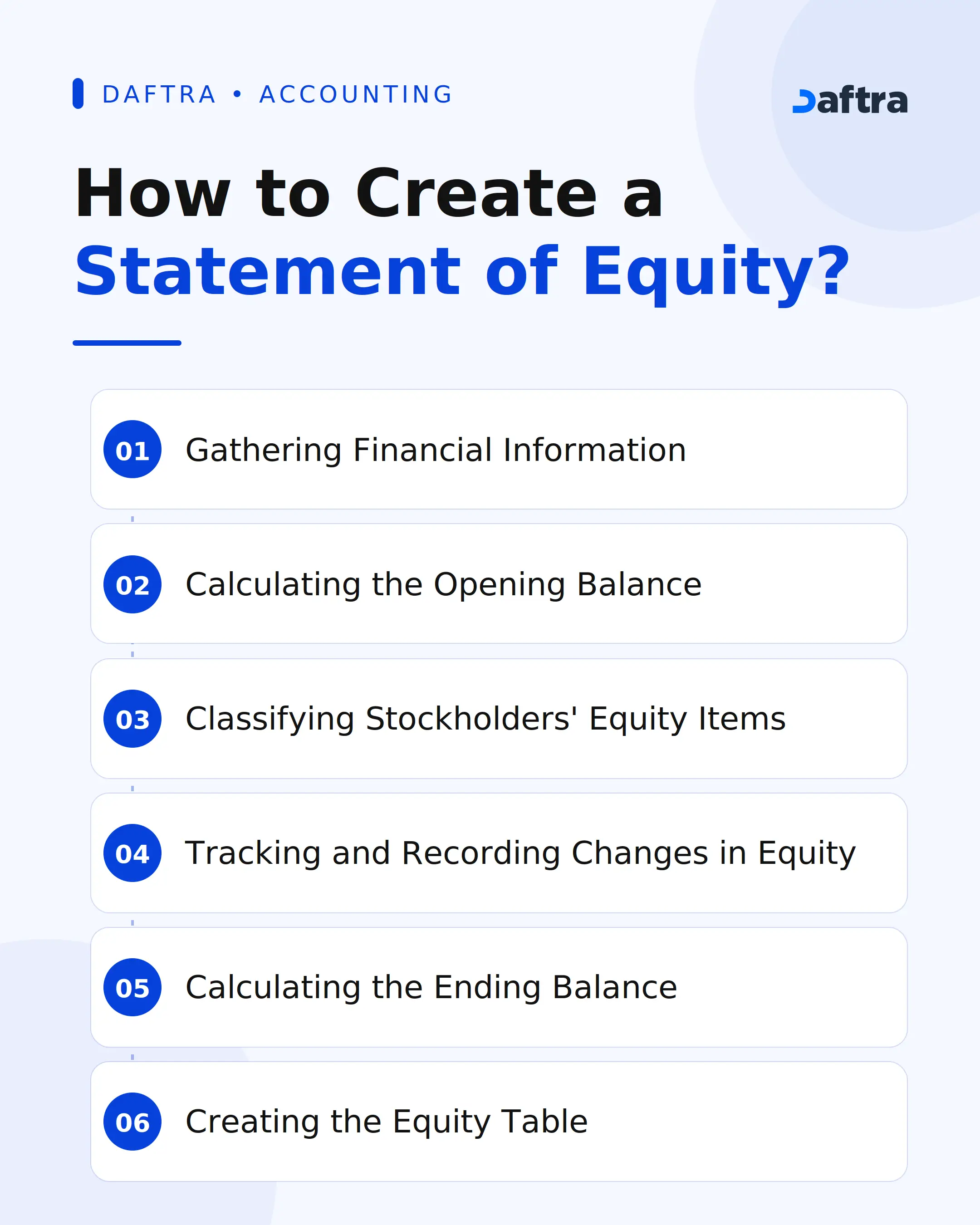
You can prepare a statement of equity by gathering the necessary data, preparing a detailed table of equity items, and then verifying the accuracy of the entered data. Learn in detail about the steps for creating a statement of equity in the following points:
1- Gathering Financial Information
Collecting basic financial information from accounting records to prepare the statement of changes in equity, such as net income, profits, and losses. This information helps calculate beginning and ending balances and identify changes that occurred during the financial period.
2- Calculating the Opening Balance
Determining the opening balance for the time period on which the statement of equity is prepared. The opening balance represents share capital at the end of the previous period.
Calculate the opening balance at the beginning of the period by adding share capital, retained earnings, and other comprehensive income from the previous period, then subtracting accumulated losses to obtain the beginning balance in the statement of equity.
3- Classifying Equity Items
Classifying equity items as shown in the equity statement template.
4- Tracking and Recording Changes in Equity
Tracking all changes to equity that occurred during the specified time period, such as additions or reductions to share capital and their impact on net income and loss, then recording these changes in an organized and detailed manner in chronological order (by date), with a description for each element, and clarifying whether it's an addition or reduction to equity through the use of either sign (+/-).
5- Calculating the Ending Balance
Calculating the ending balance, which represents net equity. The ending balance is calculated by adding the beginning balance to net income and other revenues, then subtracting losses, dividend distributions, and personal withdrawals from share capital to obtain the closing balance of equity in the balance sheet.
6- Creating the Equity Table
Prepare the equity statement table in an organized format, including the entity's name and the time period covered, then list the elements sequentially on the right side of the table and the amounts on the left.
How to Distribute Profits Through the Statement of Equity?
Profit distribution is carried out through the shareholders' or equity statement through a series of steps, which include:
1- Earning Profits
When a company earns profits during a certain period, the board of directors can make a decision to distribute part of these profits to shareholders.
2- Determining the Amount
A specific percentage or amount of profits is determined for distribution, and this amount may vary based on the company's financial policy and future needs.
3- Accounting Record
After making the decision to distribute profits, dividend distributions are recorded in the accounting records. These distributions appear as a reduction in retained earnings, meaning that funds have been transferred from retained earnings to shareholders.
They represent the financial amounts distributed to owners from the year's profits; therefore, dividend distributions appear as negative amounts under retained earnings because they have been distributed.
Examples of the Statement of Equity
1- Sole Proprietorships
On 1/1/2025, the capital account balance for entity (A) was 8,000 riyals, and during the year, some accounting transactions occurred in the entity:
On 12/31/2025, the business owner's personal withdrawals equaled 3,000 riyals.
Net income at year-end equaled 18,000 riyals.
Required: Prepare the statement of equity at year-end and calculate net capital.
In the statement of equity, we determined share capital at the beginning of the period, less personal withdrawals by owners, plus net income for the year, to arrive at net equity (share capital) at the end of the period.
2- Partnerships and Corporations:
On 1-1-2020, there was the following data:
- Share capital = 1,000,000 riyals
- Additional paid-in capital = 200,000 riyals
- Cash reserves = 100,000 riyals
- Retained earnings = 300,000 riyals
During the year, the following transactions occurred:
The entity issued 100,000 shares at 3 riyals each, and net income for the year was 500,000 riyals. The annual reserve percentage was 10%, and dividend distributions for the year were 400,000 riyals. Prior period adjustments equal 100,000.
Required: Prepare the statement of equity and determine the ending balance.
- First, record and total all beginning-balance data.
- Second, issuing 100,000 shares at 3 riyals each means the amount will be divided - part goes to original share capital and the other part to additional paid-in capital, i.e., 100,000 riyals to share capital and 200,000 riyals to additional paid-in capital.
- Third: The reserve percentage equals 10% and can be calculated from net income, i.e., 500,000 × 10% = 50,000 riyals. It appears once in the reserves column as positive, and again is deducted from retained earnings because it is being used.
- Fourth: Annual dividend distributions appear as negative because they have been distributed.
The statement is prepared as follows:
Therefore, the ending balance that appears in the balance sheet is 2,100,000.
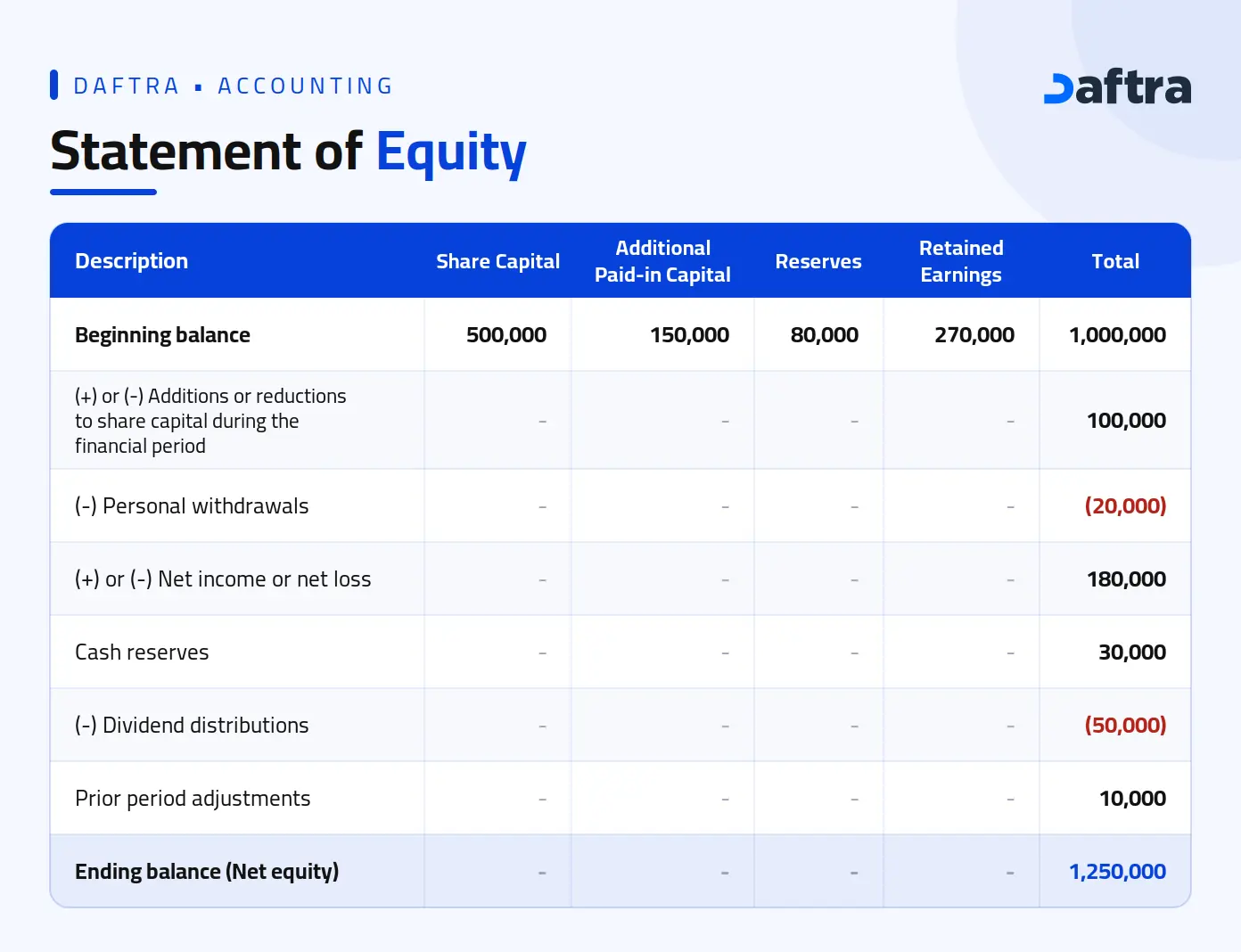
What is the Format of the Statement of Changes in Equity?
The statement of changes in equity consists of several items and elements, arranged in a specific order to enable decision-makers to read it easily. Learn about the format of the statement of changes in equity items through the following:
Major Accounting Errors When Preparing the Statement of Equity and How to Avoid Them
Accounting errors can occur when preparing the statement of equity, and these errors must be handled with precision and reviewed periodically. The following are the most prominent accounting errors related to preparing the statement of equity, along with the necessary solutions to control and avoid them, ensuring the preservation of financial information quality and increasing investor confidence:
1- Lack of Accuracy When Entering Numbers
Incorrect entry of numbers related to the statement of equity leads to misleading financial information, thus affecting the accuracy of financial statements such as the balance sheet and income statement. Therefore, conduct periodic audits of entered data and use comprehensive accounting software for business management to ensure reliable results and reduce human error.
2- Incorrect Calculation of Retained Earnings
Inaccurate retained earnings calculations or omissions can affect total equity. Therefore, update retained earnings periodically after dividend distributions and based on profits and losses for each accounting period.
3- Omitting Some Items of the Statement of Equity
Sometimes, some elements are omitted, such as designated reserves or issued shares, and some important transactions, such as share transfers or changes in ownership. Therefore, include all previously mentioned equity elements, and conduct periodic reviews to ensure all equity-related transactions are recorded.
What Can Cause Equity to Change Besides Profit or Loss?
Equity can change for several reasons other than the profit or loss generated during the accounting period. These changes may result from transactions with owners, changes in the value of certain assets, or the allocation of profits within equity. Common factors include:
These changes are reflected in the Statement of Changes in Equity, which helps explain how the company’s equity moved from its opening balance to its closing balance during the reporting period.
How to Manage the Statement of Equity in Daftra Software
Daftra accounting software provides a diverse range of account reports, such as personal withdrawals, buying or selling shares, revenues, profits, losses, and expenses, as well as clarifying sources and dates of transactions that led to capital increases from partners or external financiers.
These accounts are the foundation for preparing the shareholders' or equity statement. The system's dashboard lets you issue these reports flexibly, with an accurate and simple presentation method, and you can issue them in summary or detailed form for each report item separately.
Finally, you can keep the report digitally on your device or print it on paper.
Frequently Asked Questions
What is the difference between share capital and equity?
Share capital is the amount contributed by owners and shareholders for investment in the company, while equity includes share capital, retained earnings, accumulated reserves, and other comprehensive income elements.
What is non-controlling interest?
It represents the rights of shareholders who do not own a controlling interest in the company, also called minority interests. It is determined in the net assets of subsidiary companies and is presented in the balance sheet separately from liabilities and equity.
What is Average Equity?
Average equity reflects the time-weighted average of investments made by shareholders and owners in the company during a specific period, for analyzing financial performance and measuring the efficiency of using equity in investment and achieving profitable returns.
Average equity is calculated by adding equity values at the beginning and end of the period, then dividing the sum by the number of periods used.
For example, if equity at the beginning of the period = 50,000 Saudi riyals and at the end of the period equals 75,000 Saudi riyals, and the number of comparison periods is 2, then average equity will be calculated as follows:
Average Equity = (Beginning Equity + Ending Equity) / 2 = (50,000 + 75,000) / 2 = 62,500 riyals.
What does an increase in shareholders' equity mean?
An increase in shareholders' equity indicates an increase in the value of owners' and partners' investment in the institution, which indicates its growth, strength, and financial stability, and proves the institution's credibility and good reputation that attracts more shareholders and investors.
Are withdrawals part of equity?
Yes, personal withdrawals are considered basic components of equity as they represent financial or non-financial values deducted from share capital or asset values. Therefore, they are a fundamental form showing changes in equity, which naturally affects the rate of distributed and retained earnings.
What are the types of equity in accounting?
Types of equity in accounting are:
- Common Stock: Shares that allow voting rights and profit participation.
- Preferred Stock: Shares that give the holder special rights, such as preferred dividend distributions.
- Retained Earnings: Profits that are reinvested.
- Reserves: Cash amounts allocated as reserves for specific purposes, such as meeting obligations.
What is the relationship between the balance sheet and statement of equity?
The relationship between the statement of equity and the balance sheet is complementary, as equity is part of the structural composition of the balance sheet. The balance sheet also shows the relationship between assets, liabilities, and equity through the equation (Assets = Liabilities + Equity). This equation shows the sources the company relies on for financing, either through debt (represented by liabilities) or shareholder investments (represented by equity).
What is the difference between the statement of equity and the balance sheet?
Although the statement of equity is part of the balance sheet, the difference between them appears in the time frame each covers. The statement of equity is prepared periodically in each financial period to show changes in equity during that period, while the balance sheet is usually prepared at the end of the accounting period to provide a comprehensive view of the company's financial position and help investors and financiers make necessary decisions based on evaluating the company's ability to meet its obligations and achieve profit.
What is the difference between equity components in sole proprietorships, partnerships, and corporations?
The difference between shareholders' or equity components in sole proprietorships, partnerships, and corporations can be clarified through the following comparison:
| Equity Components | Sole Proprietorship | Partnerships | Corporations |
| Invested Capital | Owner's Capital | Paid-in Capital (shares and stakes) | Share Capital |
| Net Income or Net Loss | Reserves | Changes in shareholders' equity during the accounting period | Net Income/Loss |
| Owner's Current Account (deposits and personal withdrawals) | Partners' Current Account | - | Retained Earnings |
What factors affect the statement of equity?
The statement of equity is affected by several factors that can be summarized as:
- Retained earnings from equity percentage
- Losses deducted from retained earnings that negatively affect owners' rights
- Dividend distribution percentages to shareholders
- New investments leading to increased share capital
- Share purchases leading to reduced paid-in capital value
- Changes in market value of assets affecting equity
- Obligations increase without being balanced by covering assets; the more the institution's financial health is affected, the more its ability to meet obligations and profits due to shareholders is affected.
Conclusion
After learning about the definition and format of the statement of equity, it can be said that understanding the statement of equity enables companies to evaluate their financial performance, then helps them enhance owners' confidence and support shareholders' credibility, as well as direct financial management strategies toward growth, expansion, and achieving more profits.














 Invoicing
 POS
POS Offers
 Installments
 Sales Commission
 KSA E-Invoice Software
 EGY E-Invoice Software
 JO E-Invoice Software
 E-Invoice Software
 Chart of Accounts
 Asset Management
 Cost Centers
 Expenses
 Cheque Cycle
 UAE VAT-Tax
 Product Management
 Purchases
 Purchase Cycle
 Suppliers
 Requisitions
 Stocktaking
 Organizational Structure
 Personnel Management
 Attendance and Leave
 Contracts
 Payroll
 Requests
 Work Orders
 Booking Management
 Rental and Unit Management
 Time Tracking
 Work Flow
 Lease Contracts
 Manufacturing Management
  Client Follow-Up
 Loyalty Points
 Points and Credits
 Memberships
 Insurance Management
 Daftra ERP Full App
 Point of Sales App
 Point of Sales for Desktop – Support Offline Mode
 AI Expenses Scanner App
 Employee Attendance, Sign & ESS App
 E-invoice Reader App
 Inventory Stocktaking App