



Table of contents:
- Key takeaways
- What Are Petty Cash Expenses in Accounting?
- Examples of Petty Cash Expenses
- What Is a Petty Cash Fund?
- How to Set Up a Petty Cash Fund
- How to Record Petty Cash Expenses in Accounting
- Petty Cash Expense Log Template (Ready to Use)
- Journal Entries for Petty Cash Expenses
- Why Are Petty Cash Expenses Important for Businesses?
- Disadvantages of Petty Cash Expenses
- Best Practices for Managing a Petty Cash Fund
- Difference Between Petty Cash Expenses and Operating Expenses
- Frequently Asked Questions About Petty Cash Expenses
- Conclusion
Businesses handle small, recurring transactions in daily operations, such as buying office supplies or meeting employees’ day-to-day needs. These are known as petty cash expenses. Although these transactions may seem insignificant in a company’s accounts, poor management can lead to inaccurate financial records.
Petty cash expenses are a regular part of business spending. However, because the amounts involved are relatively small, they do not require complex banking transactions. In many cases, these expenses are not recorded properly. To address this, businesses maintain a petty cash fund to ensure these expenses are properly recorded and to improve oversight of how company funds are spent.
What Are Petty Cash Expenses in Accounting?
Petty cash expenses are small, recurring purchases made daily or weekly for relatively low amounts, such as cleaning supplies or urgent office repairs.
Because petty cash expenses involve small amounts, they don't require checks or complex banking transactions. Instead, businesses keep a designated amount of cash in a petty cash fund.
Examples of Petty Cash Expenses
Common examples of petty cash expenses in businesses include:
- Office supplies
- Cleaning supplies
- Local transportation and delivery costs
- First-aid supplies
- Emergency office repairs
- Food and beverages for employees
- Postage stamps and shipping labels
- Printing and photocopying costs
Petty cash expenses cover small, recurring purchases businesses make in daily operations.
What Is a Petty Cash Fund?
A petty cash fund is a cash amount a business allocates to cover small expenses that don't require checks or complex bank transfers. A designated employee, known as the petty cash custodian, manages the fund.
The petty cash custodian's responsibilities include:
- Managing the allocated cash
- Recording expenses
- Keeping expense receipts and supporting documents
- Reconciling the fund periodically
- Conducting petty cash counts
- Preparing periodic financial reports
How to Set Up a Petty Cash Fund
To establish a petty cash fund within a company, follow these steps:
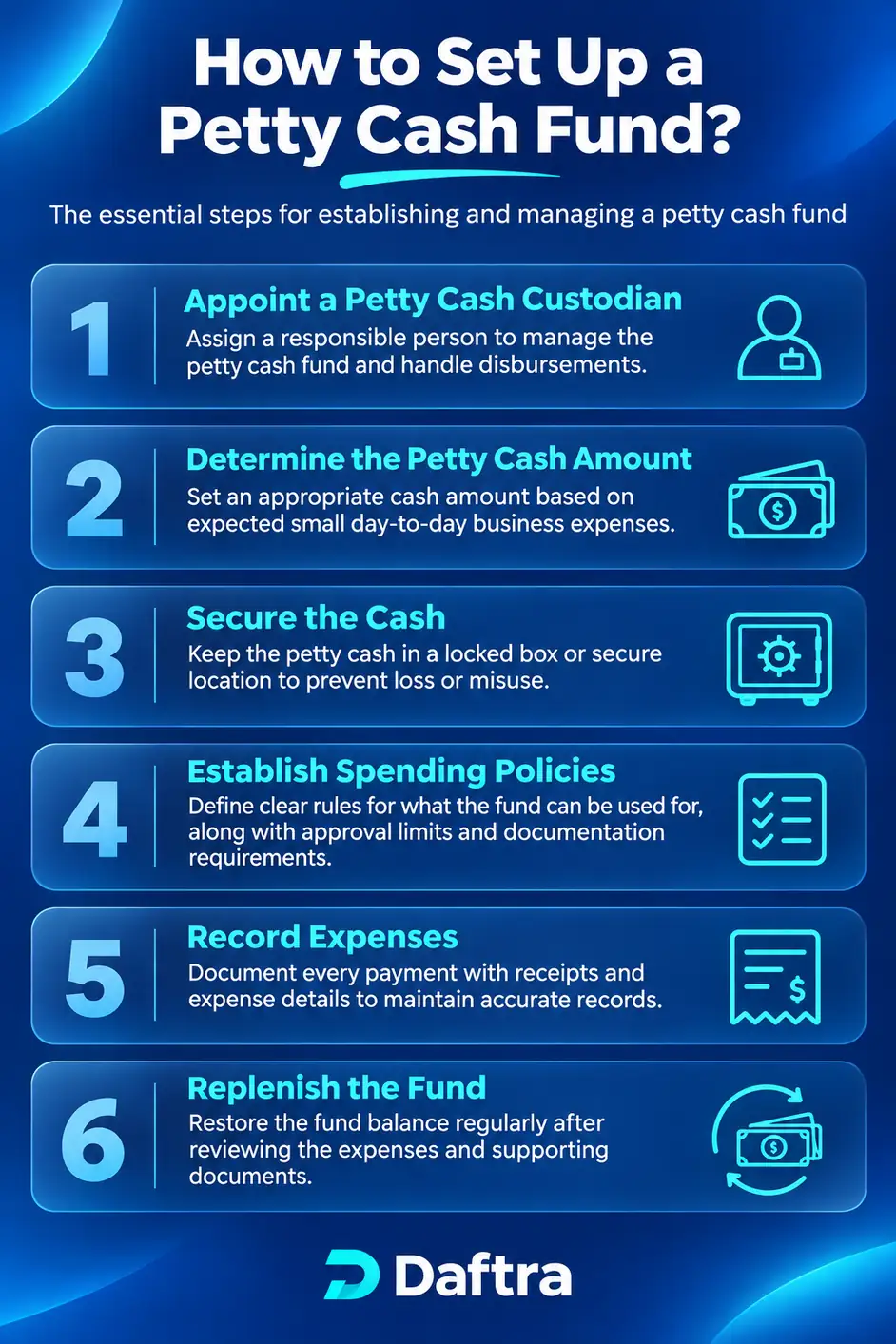
1. Appoint a Petty Cash Custodian
Assign an employee to manage and oversee the fund, including expenses and related receipts.
2. Determine the Petty Cash Amount
Estimate the amount needed to cover small expenses and allocate that amount to the fund.
3. Secure the Cash
Keep the cash in a secure cash box under the custodian's supervision.
4. Establish Spending Policies
Define the permitted uses of the petty cash fund and set spending limits.
5. Record Expenses
Keep purchase receipts and payment vouchers for periodic reviews, reconciliations, and follow-up by the accounting department.
6. Replenish the Fund
After reviewing expenses, replenish the fund as cash is used up to restore it to its original balance.
How to Record Petty Cash Expenses in Accounting
Petty cash is commonly managed using the imprest system, where a company allocates a fixed amount to cover small, recurring daily expenses that don't require bank transfers.
When the company spends cash from the fund, it retains payment receipts for review during periodic reconciliations. The fund is then replenished by the amount spent, restoring it to its original balance.
The imprest system must be managed carefully to safeguard company funds and ensure that all transactions are included in the company's accounting records during reconciliation.
Petty Cash Expense Log Template (Ready to Use)
| Date | Description | Amount | Receipt Number |
| March 1 | Transportation expenses | 50 | 001 |
| March 9 | Office supplies | 15 | 002 |
| March 12 | Cleaning supplies | 20 | 003 |
| March 20 | Minor repairs | 40 | 004 |
Journal Entries for Petty Cash Expenses
Petty cash entries record the amount withdrawn from the fund, along with the transaction date and details, and replenish the fund periodically. The following examples illustrate how these entries are recorded:
1. Entry to Establish the Petty Cash Fund
The process begins by allocating a fixed amount of cash to the fund.
2. Entry to Record Petty Cash Expenses
3. Entry to Replenish the Fund
Petty Cash Fund Control
The accounting department must retain all receipts and submit them for periodic petty cash counts and reconciliations.
Why Are Petty Cash Expenses Important for Businesses?
- Streamlining daily operations
- Strengthening financial controls
- Reducing administrative procedures
- Reducing the accounting workload
- Promoting financial transparency
Disadvantages of Petty Cash Expenses
Petty cash plays an important role in business operations, but poor management can lead to several problems. If not handled properly, it can create discrepancies in a company's financial records. The following table outlines common petty cash disadvantages and ways to address them.
| Disadvantage | Explanation | Solution |
| Misuse of funds | Easy access to cash may lead to personal or unnecessary spending. | Establish clear, strict spending policies and limits. |
| Weak internal controls | Cash transactions can be more difficult to track. | Conduct regular petty cash counts through the accounting department. |
| Expense recording errors | Errors may occur when recording expenditures. | Use a standardized template to record all transactions. |
| Risk of theft or loss | Keeping cash on company premises increases the risk of theft. | Store the petty cash fund securely and assign a single custodian. |
| Exceeding spending limits | Funds may be used for purposes outside the approved scope. | Set a maximum fund limit and require the custodian to adhere to it. |
Best Practices for Managing a Petty Cash Fund
To manage a petty cash fund effectively, businesses should follow procedures that ensure transparency and accurate handling of company funds. Key practices include:
Difference Between Petty Cash Expenses and Operating Expenses
The main difference between petty cash expenses and operating expenses lies in their purpose and how they are managed. Operating expenses run the business and directly affect profitability, while petty cash expenses involve smaller payments that can create budget discrepancies if poorly managed.
Operating expenses include costs such as rent and salaries, whereas petty cash covers small, recurring expenses incurred daily or weekly. The following table highlights the key differences:
| Petty Cash Expenses | Operating Expenses |
| Small, often incidental expenditures | Expenses incurred to run the business |
| Typically used for daily or weekly purchases | Incurred on a recurring or periodic basis |
| Usually paid in cash | May be paid through bank transactions |
| Emergency repairs for unexpected breakdowns | Monthly electricity bill |
Frequently Asked Questions About Petty Cash Expenses
What Are Petty Cash Expenses?
Petty cash expenses are small business expenditures incurred in daily operations that generally do not require checks or complex banking transactions.
What Is the Difference Between a Petty Cash Fund and the Main Cash Fund?
A petty cash fund covers small transactions and is managed by a designated custodian. The main cash fund handles the company's overall cash balance and larger payments. A designated custodian manages it and may also oversee the petty cash fund.
What Is the Appropriate Petty Cash Fund Limit?
The appropriate amount is generally a small portion of the company's total expenses. The maximum fund balance depends on the nature and volume of expenses and the business size, whether small, medium, or large.
How Are Petty Cash Expenses Recorded?
Petty cash expenses are commonly managed using the imprest system, in which a fixed amount is allocated to the fund and replenished as cash is spent or the balance decreases.
Should Receipts for Petty Cash Expenses Be Kept?
Yes. Retain receipts to ensure expenses are properly documented and included in the petty cash reconciliation process when replenishing the fund.
Conclusion
Petty cash expenses are an important part of a company's financial management. They allow businesses to cover essential small, day-to-day expenses without relying on complex payment procedures.
Despite their relatively low individual amounts, these expenses can accumulate and create discrepancies in a company's financial records if they are not recorded properly. By following sound procedures and adopting the imprest system, businesses can track expenditures, strengthen financial controls, and prevent unnecessary financial losses.
Daftra's expense management software helps businesses manage and track petty cash expenses efficiently through automation.







 Invoicing
 POS
 Offers
 Installments
 Sales Commission
 KSA E-Invoice Software
 EGY E-Invoice Software
 JO E-Invoice Software
 E-Invoice Software
 Chart of Accounts
 Asset Management
 Cost Centers
 Expenses
 Cheque Cycle
 UAE VAT-Tax
 Product Management
 Purchases
 Purchase Cycle
 Suppliers
 Requisitions
 Stocktaking
 Organizational Structure
 Personnel Management
 Attendance and Leave
 Contracts
 Payroll
 Requests
 Work Orders
 Booking Management
 Rental and Unit Management
 Time Tracking
 Work Flow
 Lease Contracts
 Manufacturing Management
 Client Follow-Up
 Loyalty Points
 Points and Credits
 Memberships
 Insurance Management
 Daftra ERP Full App
 Point of Sales App
 Point of Sales for Desktop – Support Offline Mode
 AI Expenses Scanner App
 Employee Attendance, Sign & ESS App
 E-invoice Reader App
 Inventory Stocktaking App