




Table of contents:
- Key Summary
- What Is the Concept of Partnerships?
- What Are the Characteristics of Partnerships?
- What Are the Types of Partnerships?
- What Are the Advantages of Partnerships?
- What Are the Disadvantages of Partnerships?
- What Is the Difference Between Partnerships and Mixed Companies?
- What Are the Requirements for Establishing a Partnership?
- What Are the Procedures for Liquidating Partnerships?
- What Is the Difference Between Partnerships and Capital Companies?
- What Is the Liability of Partners in Partnerships?
- Why Daftra for Managing Partnerships?
- Frequently Asked Questions
Partnerships are a common form of business organization, and it is hard to imagine a business environment without them.
Imagine waking up one day to find that all companies had disappeared. Or imagine having a groundbreaking idea you want to turn into a business, make an economic impact, and achieve your vision by providing products or services—but with no concept of a “company” to bring that idea to life. Could life and business continue to function as they normally do?
This is where partnerships come into play. They provide a business structure that lets two or more individuals work together toward a shared commercial objective. Partnerships remain an important business structure today and may be an appropriate option for many businesses.
In this article, we provide a comprehensive guide to partnerships, their characteristics and types, and the key differences between them andother types of companies. You will also learn more about partnerships to help you determine whether this structure is the right choice for your business.
What Is the Concept of Partnerships?
Partnerships are a natural development from operating as a sole trader, as they involve two or more individuals joining together to form a business. Each partner holds an interest in the company's capital, and profits are generally distributed among the partners based on their respective interests, subject to the partnership agreement and applicable law.
In many partnership structures, the partners are closely associated with the business in their personal capacity and may be personally liable for the company's losses and debts, including through their personal assets where the applicable legal structure provides for unlimited liability. This increases the level of risk borne by the partners, while potentially strengthening the confidence of those who deal with the business.
What Are the Characteristics of Partnerships?
Although the types of partnerships differ, they share several common characteristics. Some of the key characteristics of partnerships include:
The characteristics of partnerships can be summarized in several key points, most notably the participation of two or more individuals in establishing the business and combining their efforts toward a common economic objective, along with the ability to pool resources and invest collectively in improving business operations.
Partnerships may also be subject to dissolution following certain events, such as the death or withdrawal of a partner, depending on the applicable legal framework and the partnership agreement. The partners' rights in relation to the business's assets are governed by the partnership structure and applicable law. Partnerships also rely on agreement and consultation among the partners, while their tax treatment depends on the applicable jurisdiction and legal structure.
What Are the Types of Partnerships?
There are several types of partnerships designed to meet different business needs, accommodate the nature of relationships between partners, and reflect the level of liability each partner is willing to assume. Each type has its own advantages and disadvantages. The main types include:
1. General Partnership
A general partnership is one of the most straightforward forms of partnership and is typically relatively simple to establish. Each founding partner holds an interest in the partnership's capital and is entitled to a share of the profits in accordance with the partnership agreement.
The partners in a general partnership may be personally liable for the partnership's financial obligations, including its debts and liabilities. The name of a general partnership may include the names of its partners, or the name of one or more of them, depending on the applicable legal requirements. In this sense, a general partnership can be viewed as a group of individuals who join their commercial activities and resources to operate a business together.
Example: Two partners establish a business to carry out a specific commercial activity. Both participate in managing the business, and profits and losses are distributed between them according to the terms agreed upon in the partnership agreement.
2. Limited Partnership
A limited partnership provides a structure in which some partners can invest in the business without assuming the same level of personal liability as the general partners.
In addition to the general partners, who are responsible for managing the business and may bear unlimited liability, limited partnerships include limited partners who contribute capital and whose liability is generally limited to the extent of their contribution. Limited partners typically do not participate in the management of the partnership, subject to the applicable law.
Example: One partner is responsible for managing the business, while another contributes capital without taking part in its management. The extent of each partner's liability depends on their status and the legal rules governing this type of partnership.
3. Joint Venture
A joint venture of this type is not generally treated as a separate legal entity in the same way as other company forms. It may be established when two or more individuals agree to undertake a particular commercial activity or project and wish to organize their contributions, expenses, and distribution of profits and losses between them.
The partnership is not disclosed to third parties, and the partners generally do not conduct business with external parties collectively under the name of the joint venture. Instead, one partner may conduct transactions with third parties in their own name.
Example: Two individuals agree to carry out a specific project, such as purchasing a group of products and reselling them, and then divide the resulting profits and losses between them. The partnership remains undisclosed to third parties, while one of the partners deals with customers or suppliers in their own name.
Overall, these three partnership types offer different approaches to participation and liability, allowing partners to choose a structure that aligns with their role in the business and their willingness to assume risk. While a general partnership involves broad participation and potentially unlimited liability for the partners, a limited partnership provides a structure that distinguishes between general and limited partners.
A joint venture, meanwhile, can offer flexibility for partners undertaking a specific commercial activity while keeping the partnership's existence undisclosed to third parties. Together, these structures offer different ways to organize business relationships and commercial activities.
What Are the Advantages of Partnerships?
Partnerships suit entrepreneurs who want to establish a business quickly and with limited initial costs, while maintaining management flexibility and building trust among partners. Some of the key advantages of partnerships include:
- Ease of formation: Partnerships may involve relatively straightforward formation procedures and may not require the same level of administrative costs as some other business structures.
- Trust among external parties: The personal liability of partners in certain partnership structures can provide greater confidence to parties dealing with the business.
- Income tax treatment: The tax treatment of partnerships depends on the applicable jurisdiction and legal structure and should not generally be characterized as being subject only to income tax.
- Ability to increase capital: A partnership can begin with more capital than a single entrepreneur might be able to provide independently, as each partner can contribute a share of the business's capital.
- Enhanced external cooperation: Partnerships may benefit from opportunities to work with external parties and from the confidence of suppliers and other business partners, particularly where the partners have established reputations in their market.
Because of these advantages, partnerships can suit many small and medium-sized businesses. They can combine relatively straightforward formation, shared financial contributions, and direct participation in the business, making them a practical option for certain business models.
What Are the Disadvantages of Partnerships?
As markets evolve and businesses face increasingly complex requirements, certain partnership characteristics may create challenges for growth or continuity. Many of these challenges stem from the close relationship between the partners and the business, which can make the business more vulnerable to disputes or personal circumstances affecting the partners.
- Dependence on the partners: The continuity of a partnership may be affected by events involving its partners, depending on the applicable law and the partnership agreement.
- Personal liability of partners: In partnership structures where liability is unlimited, partners may be personally liable for the business's debts and obligations, potentially exposing their personal assets to claims against the business.
- Limitations on raising capital: Partnerships generally cannot raise capital by issuing publicly traded shares like joint-stock companies, which can limit their options for large-scale external investment.
- Potential challenges in decision-making: Decision-making can become more difficult when partners disagree, particularly when the partnership agreement or applicable law requires multiple partners to consent to important decisions.
- Administrative challenges: Involving multiple partners in decision-making can sometimes make management more complex, particularly as the number of partners increases.
- Limitations for certain growth models: Some businesses may eventually require a corporate structure that provides greater access to external capital, share issuance, or other mechanisms associated with larger corporate organizations.
When considering a partnership, evaluate its potential limitations alongside the business's future needs to ensure the chosen structure supports long-term sustainability and growth in a changing business environment.
You can use the Investment Calculator to calculate investment values and their potential returns.
What Is the Difference Between Partnerships and Mixed Companies?
Mixed companies combine characteristics of partnerships and capital-based companies, creating several important differences from partnerships. The following comparison highlights the main differences and how they affect the nature of the business:
| Comparison | Partnerships | Mixed Companies |
| Partners' Liability | Partners may be personally liable for the company's debts, with their personal assets potentially exposed where the applicable partnership structure provides for unlimited liability. | Liability is generally limited for limited partners or shareholders to the extent of their ownership interest or contribution, while general partners may remain personally liable for the company's debts. |
| Formation | Partnerships may be relatively easier to establish because they are based on the partners' personal involvement and, in some structures, their personal liability. | Formation may involve more requirements and procedures depending on the specific legal form and applicable law. |
| Capital | The company's capital is generally based on the partners' contributions, and opportunities to increase capital may be more limited than in share-based corporate structures. | Mixed companies can generally provide greater opportunities to raise capital, depending on their legal structure, which may support expansion and growth. |
| Company Size | The scale of the business may be influenced by the number of partners and the structure's limitations on raising external capital. | Mixed companies may accommodate a larger number of investors or partners, depending on the applicable legal structure and jurisdiction. |
The differences between mixed companies and partnerships reflect fundamental distinctions in their structure, liability, and financing opportunities. Mixed companies can provide greater opportunities for expansion and attracting additional investors while limiting the personal liability of certain participants, making them potentially suitable for larger businesses.
Partnerships, on the other hand, can be relatively straightforward to form and foster closer relationships between partners, but they may face greater limitations when raising capital and expanding through external investment. The right structure depends on the business, the partners' objectives, and the level of liability they are willing to assume.
What Are the Requirements for Establishing a Partnership?
What Are the Procedures for Liquidating Partnerships?
When a partnership is to be liquidated, whether due to bankruptcy, the death of a partner, or the partners' decision to wind up the business, a liquidator may be appointed to handle the liquidation process. The liquidator's role is to assess the company's financial position and settle its outstanding obligations according to the applicable legal priority:
- Payment of the liquidation expenses.
- Settlement of outstanding taxes and secured debts or claims, where applicable. During the liquidation process, Daftra's accounting and tax management software can help generate accurate reports on tax liabilities, track invoices and payments, and provide comprehensive account statements that make it easier for the liquidator to assess the company's financial position accurately and efficiently.
- Payment of debts owed to external creditors.
- Settlement of amounts owed to partners, such as loans or other funds a partner may have provided to support the business, subject to the applicable legal priority and the partnership agreement.
Any remaining amount is then distributed among the partners in accordance with their respective rights under the partnership agreement and applicable law.
As with incorporation, liquidation may require certain documents and procedures. These may be completed through the relevant government authority or a digital platform, depending on the applicable system in each country.
You can use the VAT Calculator to calculate the tax amount and its percentage of a given amount.
What Is the Difference Between Partnerships and Capital Companies?
Partnerships and capital companies share some similarities. Both can conduct commercial activities within a formal legal framework established through incorporation documents or registration in the Commercial Register, and both can pursue the common objective of generating profits by using the capital contributed by their partners or shareholders to establish and invest in the business.
Both may also acquire separate legal personality upon registration, depending on the applicable legal framework. Despite these similarities, there are several important differences between partnerships and capital companies:
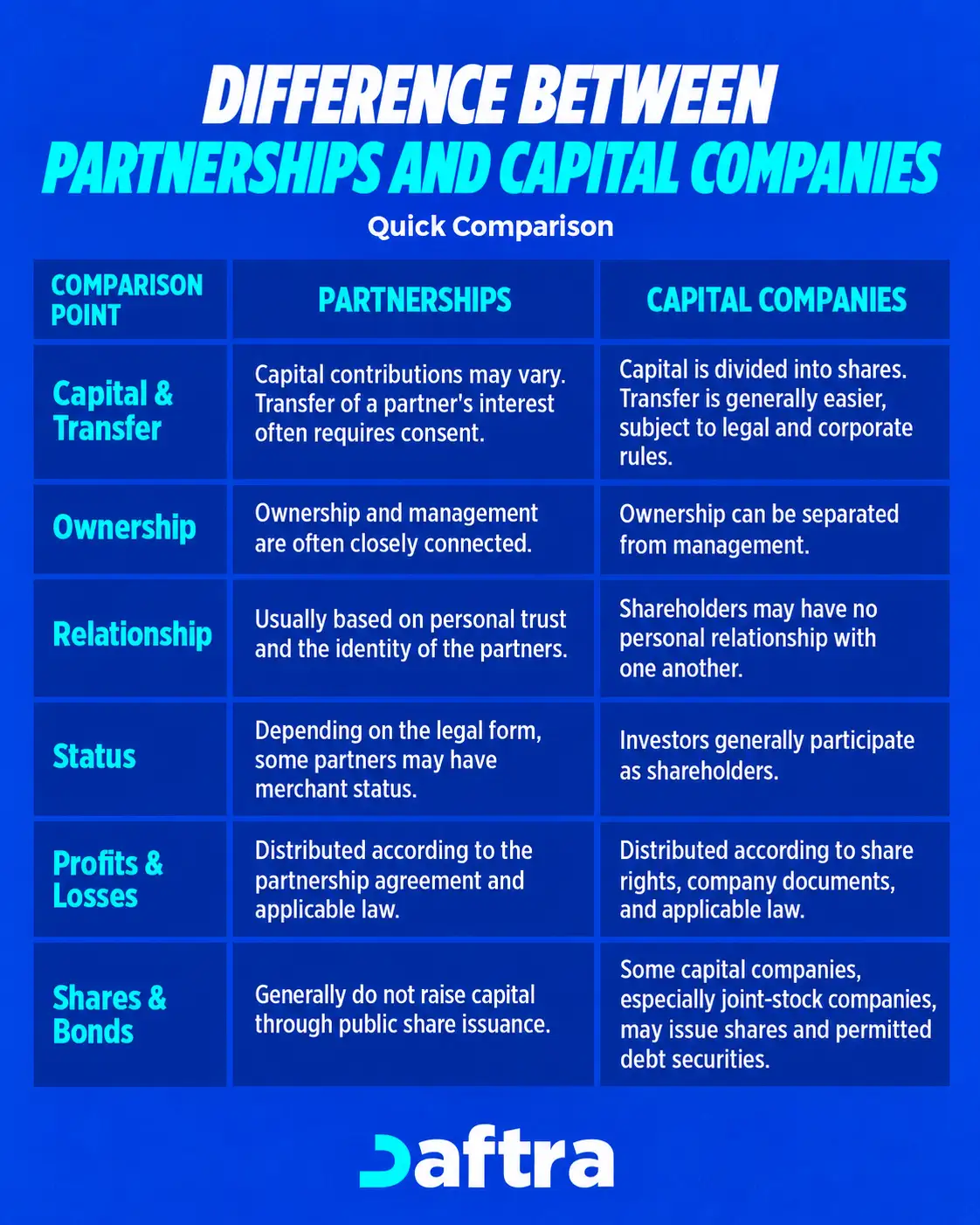
1- Capital Contributions and Transfer of Interests
Partners in partnerships are not necessarily required to make equal capital contributions, and transferring or selling a partner's interest may require the consent of the other partners, depending on the partnership agreement and applicable law. In capital companies, capital is divided into shares with a specified nominal value, but shareholders are not necessarily required to hold equal numbers of shares. Shares may generally be transferred in accordance with the applicable legal and corporate requirements, without necessarily requiring the consent of all shareholders.
2- Ownership
In partnerships, ownership and management are often closely connected because the partners may participate directly in managing the business. In capital companies, ownership can be separated from management, meaning that shareholders can contribute capital or hold shares without being directly involved in managing the company.
3- Relationship Between the Partners
Partnerships are generally based on personal relationships and trust between the partners. The number of partners may be relatively limited, and the identity of each partner can be important to the business. In capital companies, shareholders may have no personal relationship with one another.
4- Status of the Partners
Depending on the applicable legal framework, partners in certain types of partnerships may acquire the status of merchants or be subject to the legal rules applicable to merchants. In capital companies, investors generally participate as shareholders rather than as partners in the traditional partnership sense.
5- Distribution of Profits and Losses
In partnerships, profits and losses are generally distributed according to the partnership agreement and applicable law. Where no agreement specifies a different arrangement, the applicable legal rules determine how profits and losses are allocated. In capital companies, the distribution of profits is generally determined according to the rights attached to the shares and the company's constitutional documents and applicable law.
6- The Right to Issue Shares and Bonds
Partnerships generally do not raise capital through the public issuance of shares in the same way as joint-stock companies. Certain capital companies, particularly joint-stock companies, may be authorized to issue shares and, where permitted by law, debt securities such as bonds, subject to the applicable legal and regulatory requirements.
The differences between capital companies and partnerships show that partnerships are primarily based on trust and personal relationships between the partners, with ownership often closely connected to management and restrictions commonly applying to the transfer of partnership interests.
Capital companies, on the other hand, are primarily based on capital, with ownership potentially separated from management and shares generally offering greater transferability. The two structures also differ in the legal status of their participants and the mechanisms for distributing profits. In addition, certain capital companies can access a broader range of financing mechanisms, including the issuance of shares or debt securities where permitted, which can provide greater flexibility for expansion and financing.
What Is the Liability of Partners in Partnerships?
The liability of partners in partnerships varies depending on the type of partnership:
General Partnership
Partners in a general partnership are generally personally and jointly liable for the company's debts and obligations. A partner's liability is not limited to the amount of their capital contribution and may extend to their personal assets, subject to the applicable law.
Limited Partnership
A limited partner's liability for the partnership's debts and obligations is generally limited to the amount of their contribution to the partnership's capital and does not extend to their personal assets merely because they are a limited partner.
Joint Venture
In a joint venture, the partnership does not generally appear to third parties as a separate legal entity. One of the partners may therefore conduct business with customers or suppliers in their own name, with liability for those dealings generally resting with the partner who entered into them, subject to the nature of the transaction, the agreement between the partners, and applicable law.
Why Daftra for Managing Partnerships?
Daftra offers an affordable solution while providing professional management of your company’s operations. Regardless of your company’s size or the budget allocated to an enterprise resource planning (ERP) system, Daftra offers a plan suited to your business needs.
From issuing compliant electronic invoices and managing inventory and ensuring that products do not fall below minimum stock levels, to managing purchases, working with suppliers, and selecting the most suitable deals, as well as managing marketing activities and promotions, employees, and accounting. All of this is available in one system, with an affordable plan and flexible features that can be tailored to meet your business needs.
Frequently Asked Questions
What Are Partnerships?
A partnership is an extension of the individual trader concept and is formed when two or more people join together, with each partner holding an interest in the company’s capital. Profits are distributed based on each partner’s agreed share or interest. The extent of a partner’s personal financial liability depends on the type of partnership and the applicable law. In general partnerships, partners may be personally liable for the company’s losses and debts, including through their personal assets.
What Are the Types of Partnerships?
The main types of partnerships include general partnerships, limited partnerships, and joint ventures.
What Is Partnership Accounting?
Partnership accounting is responsible for determining the company’s profits and losses and recording the revenues and expenses incurred during the financial period, followed by allocating profits and losses among the partners according to the applicable agreement and legal requirements.
What Is the Difference Between Partnerships and Capital Companies?
Partnerships are generally based on personal relationships and trust among the partners, and some partners may bear personal liability for the company’s debts. Capital companies, on the other hand, are primarily based on capital, with ownership and management generally capable of being separated, and liability typically limited to the amount invested or otherwise determined by the applicable legal form.












 Invoicing
 POS
 Offers
 Installments
 Sales Commission
 KSA E-Invoice Software
 EGY E-Invoice Software
 JO E-Invoice Software
 E-Invoice Software
 Chart of Accounts
 Asset Management
 Cost Centers
 Expenses
 Cheque Cycle
 UAE VAT-Tax
 Product Management
 Purchases
 Purchase Cycle
 Suppliers
 Requisitions
 Stocktaking
 Organizational Structure
 Personnel Management
 Attendance and Leave
 Contracts
 Payroll
 Requests
 Work Orders
 Booking Management
 Rental and Unit Management
 Time Tracking
 Work Flow
 Lease Contracts
 Manufacturing Management
 Client Follow-Up
 Loyalty Points
 Points and Credits
 Memberships
 Insurance Management
 Daftra ERP Full App
 Point of Sales App
 Point of Sales for Desktop – Support Offline Mode
 AI Expenses Scanner App
 Employee Attendance, Sign & ESS App
 E-invoice Reader App
 Inventory Stocktaking App