


Posted on 16 November 2026
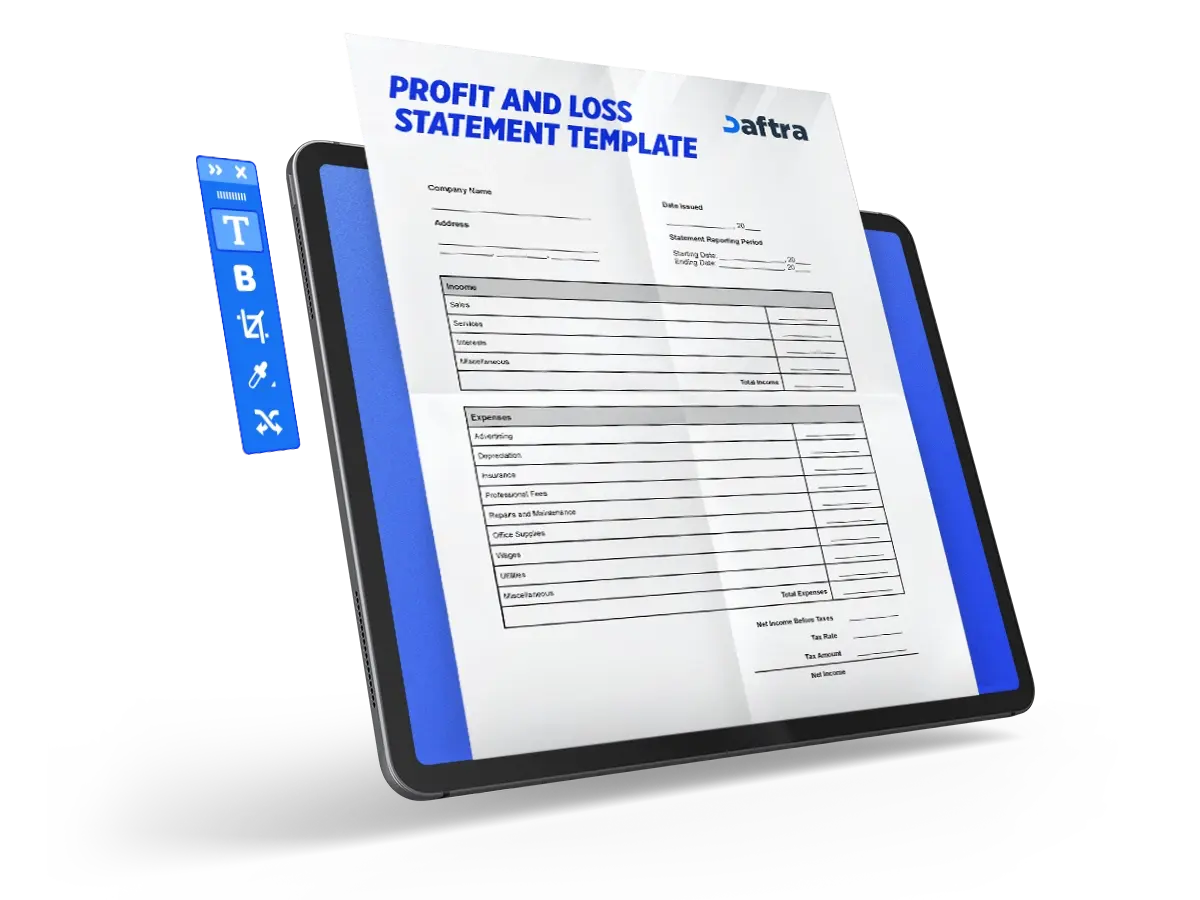
Profit and Loss Statement Template
- A Profit and Loss Statement Template evaluates a company’s performance over a specified period and helps determine whether revenue covers costs and results in profit or loss.
- It provides information about the company’s operating performance and profitability, supporting operating decisions such as production and marketing planning, as well as investment decisions such as expansion or discontinuing unprofitable activities.
- It is also considered an important source of information for shareholders and investors, as it shows the company’s profitability and its ability to generate return on investment.


 Automate Financial Reporting with Daftra
What Is a Profit and Loss Statement Template?
A Profit and Loss Statement Template is one of the main financial statements that reflects the performance of a company or organization over a specific period of time, usually annually or quarterly. A profit and loss statement is used to show how revenue, expenses, and profit or loss were generated during the relevant period. This template includes several items that represent the results of the company’s operating activities.
A Profit and Loss Statement Template gives the company, individuals, and investors a comprehensive view of the company’s performance and its ability to generate profit from its operating activities. This template is considered one of the main tools used in financial performance analysis and in making economic and investment decisions.
Use the Profit Margin Calculator to calculate gross profit, operating profit margin, or net profit margin automatically for free.
What Are the Elements of a Profit and Loss Statement Template?
A Profit and Loss Statement Template includes a number of elements that reflect the performance of the company or organization during a specific period. The main elements included in the template are as follows:
- Revenue: This item shows the total revenue generated from the sale of goods or the services provided.
- Cost of Revenue (Cost of Goods Sold - COGS): This item shows the cost of production or service delivery, including materials, labor, and other direct costs associated with delivering products or services. Its purpose is to calculate the cost of producing the standard unit.
- Gross Profit: This is the difference between revenue and cost of revenue, and it shows the gross profit generated from the core operating activity.
- Operating Expenses: This item includes the costs of running the company, such as wages and salaries, advertising, research and development, and administrative and selling costs. It covers the expenses required for the company’s day-to-day operations.
- Profit or Loss: This item shows the net profit achieved after deducting operating expenses from gross profit. If the value is positive, it indicates profit. If it is negative, it indicates a loss.
- Interest and Taxes: These items include financial costs (interest) and taxes on profit.
- Net Earnings or Loss: This item represents net profit after deducting interest and taxes from profit.
- Earnings Per Share (EPS): This item estimates the earnings generated per share and reflects the company’s performance from the shareholders’ perspective.
- Non-Operating Income and Expenses: These items are used for additional analysis and include non-operating gains or losses such as investments in securities or restructuring costs.
These elements form the core of a Profit and Loss Statement Template and provide information about the company’s performance during a specific financial period. This data is used by investors, financial analysts, and companies to understand financial performance and make financial and investment decisions.
Use the Discount Calculator to calculate the value before discount, after discount, or the discount percentage between two or more numbers automatically for free.
How to Use a Profit and Loss Statement Template
Using a Profit and Loss Statement Template involves several steps to understand and analyze a company's or organization's performance. The general steps are as follows:
- Collect the financial data: Obtain the profit and loss statement for the company or organization. This data can usually be found in the company’s annual reports or quarterly financial reports.
- Understand the structure of the statement: Study the structure of the statement to understand how it presents profit, expenses, and other financial components. This includes revenue, cost of revenue, gross profit, and operating expenses.
- Analyze revenue: Analyze revenue to understand its sources and distribution. Has revenue increased over time? Are there specific products or services contributing significantly to revenue?
- Analyze cost of revenue: You may need to analyze Cost of Goods Sold (COGS) to understand the efficiency of the production process or service delivery. Are there ways to reduce this cost without affecting quality?
- Analyze gross profit: Compare gross profit with revenue to understand the level of profit generated from the core operating activity.
- Analyze operating expenses: Study operating expenses such as wages, salaries, and administrative costs. Have these expenses increased over time? Can they be reduced effectively?
- Analyze net profit: Calculate net profit after deducting operating expenses from gross profit. Did the company achieve net profit or incur a loss?
- Compare performance across periods: Compare profit and loss statements for several different periods, such as quarterly or yearly, to identify trends and changes in performance.
- Analyze non-operating income and expenses: Look for any non-operating income or expenses such as investments or restructuring costs, and assess their impact on overall performance.
- Use the data in decision-making: Analyze the data and use it in making financial and strategic decisions. This information can help identify areas for improvement and assess the strength of financial performance.
- Prepare reports and presentations: You may need to prepare reports or presentations showing the results of the analysis and financial performance for internal and external stakeholders.
Using a Profit and Loss Statement Template can help you understand company performance and make informed financial decisions. Always take the context and specific objectives into account when analyzing this data.
Daftra Generates the Profit and Loss Statement Automatically with One Click
Daftra helps you collect financial data, analyze revenue and costs, and compare performance across periods automatically, using real data from your accounting software.
Whether you are a finance manager, accountant, or business owner, Daftra gives you an accurate, ready-to-use profit and loss statement without a single Excel file.
Start using Daftra for free.
Why Is a Profit and Loss Statement Template Important?
A Profit and Loss Statement Template can be used in many contexts and for different purposes. It is important for the following reasons:
- Evaluating company performance: It can be used to assess the company’s performance over a specific period. This helps determine whether the company is making a profit or recording a loss, and how those results change over time.
- Supporting investment decisions: Investors can use the profit and loss statement to evaluate the attractiveness of investing in the company. If the company is generating strong profits, it may be an attractive investment.
- Monitoring business performance: Business owners can use the statement to monitor performance, verify the achievement of financial goals, and anticipate potential challenges.
- Preparing budgets and strategic plans: Previous profit and loss statements can be used to prepare future budgets and strategic plans. This helps set goals and allocate resources appropriately.
- Comparing performance across periods: The statement can be used to compare the company’s performance across different periods, such as the current quarter versus the previous quarter, or this year versus last year. This can reveal growth or decline trends.
- Analyzing revenue and expenses: The statement can be used to analyze sources of revenue and expenses. Are there specific items contributing significantly to profit or loss?
- Preparing financial reports for investors and regulators: Companies use profit and loss statements to prepare the financial reports required for investors, regulators, and tax authorities.
- Providing information to internal and external parties: The statement can be used to provide internal parties such as the board of directors and managers with information about financial performance and to support decision-making based on that information.
In general, the profit and loss statement is a fundamental tool in financial performance analysis and financial decision-making. It helps explain the company’s current financial position and provides a comprehensive view of how revenue and expenses generate profit.
Who Benefits from a Profit and Loss Statement Template?
- Managers: to analyze and improve company performance.
- Investors: to assess the company’s value and financial stability.
- Lenders: to determine the company’s ability to repay debt.
- Employees: to understand the company’s stability and plan for the future.
You May Also Download
Ready-to-Use Financial Plan Template
Profit Margin Calculation Template
How Daftra Supports Your Financial Work
Because Daftra always seeks to support your company’s financial stability, in addition to Daftra accounting software, we provide the most important ready-made templates and formulas you may need for accounting, sales, auditing, financial analysis, and other activities related to financial resources.
In this section, Daftra helps you to:
- Obtain free accounting tables and templates.
- Save time and invest it in reviewing and analyzing numbers.
- Reduce the effort required to prepare new tables and complex formulas.
By using a Profit and Loss Statement Template, you can gather all company revenue and expenses in one place. If expenses are lower than revenue, the financial year is profitable. If the opposite occurs, the year is loss-making. By filling in the data in the statement, you can know the business results instantly before tax and after tax.
Daftra accounting templates make the task easier, while accounting software performs the task instantly. Subscribe to Daftra and enjoy a smooth experience through a simple user interface and integrated features.





 Invoicing
 POS
 Offers
 Installments
 Sales Commission
 KSA E-Invoice Software
 EGY E-Invoice Software
 JO E-Invoice Software
 E-Invoice Software
 Chart of Accounts
 Asset Management
 Cost Centers
 Expenses
 Cheque Cycle
 VAT & Tax Compliance
 Product Management
 Purchases
 Purchase Cycle
 Suppliers
 Requisitions
 Stocktaking
 Organizational Structure
 Personnel Management
 Attendance and Leave
 Contracts
 Payroll
 Requests
 Work Orders
 Booking Management
 Rental and Unit Management
 Time Tracking
 Work Flow
 Lease Contracts
 Manufacturing Management
 Client Follow-Up
 Loyalty Points
 Points and Credits
 Memberships
 Insurance Management
 Daftra ERP Full App
 Point of Sales App
 Point of Sales for Desktop – Support Offline Mode
 AI Expenses Scanner App
 Employee Attendance, Sign & ESS App
 E-invoice Reader App
 Inventory Stocktaking App