


What Is Withholding Tax and Its Tax Rate Table in Egypt?


Table of contents:
- Key Summary
- What Is Withholding Tax?
- Understanding Withholding and Collection Tax
- Who Is Required to Withhold Tax?
- What Are the Withholding Tax Rates?
- What Is the Purpose of Withholding and Collection Tax?
- What Is the Relationship Between Withholding and Collection Tax and the Advance Tax Payment System?
- What Is the Difference Between VAT and Withholding and Collection Tax?
- How to Calculate Withholding and Collection Tax and File Form 41
- Practical Examples of Applying Withholding and Collection Tax
- Practical Example of a Withholding and Collection Tax Journal Entry
- How to Add Withholding and Collection Tax to Your Invoices in Daftra
- Frequently Asked Questions
Withholding and collection tax is a tax mechanism that does not impose an additional tax burden beyond the taxpayer's tax liability. Instead, it serves as a regulatory measure that makes tax collection more transparent and facilitates tax transactions for the government.
Withholding and collection tax is also known as the tax on commercial and industrial profits or withholding tax. These names reflect the two components originally associated with the system: withholding and collection. However, subsequent legislative amendments have evolved the system, with the focus now primarily on withholding, as the collection component has been abolished and new tax provisions introduced to facilitate compliance.
What Is Withholding Tax?
Withholding tax in Egypt generally refers to tax withheld at source at rates that vary by transaction type and applicable regulations. Rates may range from 1% to 5% for certain commercial and industrial transactions, while other categories may be subject to different rates. The applicable rate depends on the nature of the activity and the relevant tax provisions.
The tax is withheld from payments made to eligible suppliers or taxpayers by the parties legally required to deduct it. The parties then remit the withheld amount to the Egyptian Tax Authority.
The tax is calculated based on the applicable withholding rules and supporting documentation, including stamped withholding tax certificates retained by suppliers for tax inspection purposes. The relevant amounts are reported using Form 41 Modified (Kh.A.T.), in accordance with the statutory filing and payment deadlines, generally on a quarterly basis.
Understanding Withholding and Collection Tax
Withholding and collection tax is also called tax on commercial and industrial profits or withholding tax at source. Under this mechanism, when a qualifying commercial transaction occurs, the customer pays the supplier after deducting the applicable withholding tax. The customer, acting as the withholding agent, then remits the deducted amount to the Egyptian Tax Authority on behalf of the supplier.
Who Is Required to Withhold Tax?
Entities generally required to withhold tax include public-sector companies, public business-sector companies, capital companies, and partnerships with capital exceeding EGP 50,000, subject to applicable Egyptian tax legislation and regulations.
These entities may be required to submit withholding and collection tax forms, ranging from Form 41 to Form 47, through the Egyptian Tax Authority's electronic platform, as applicable.
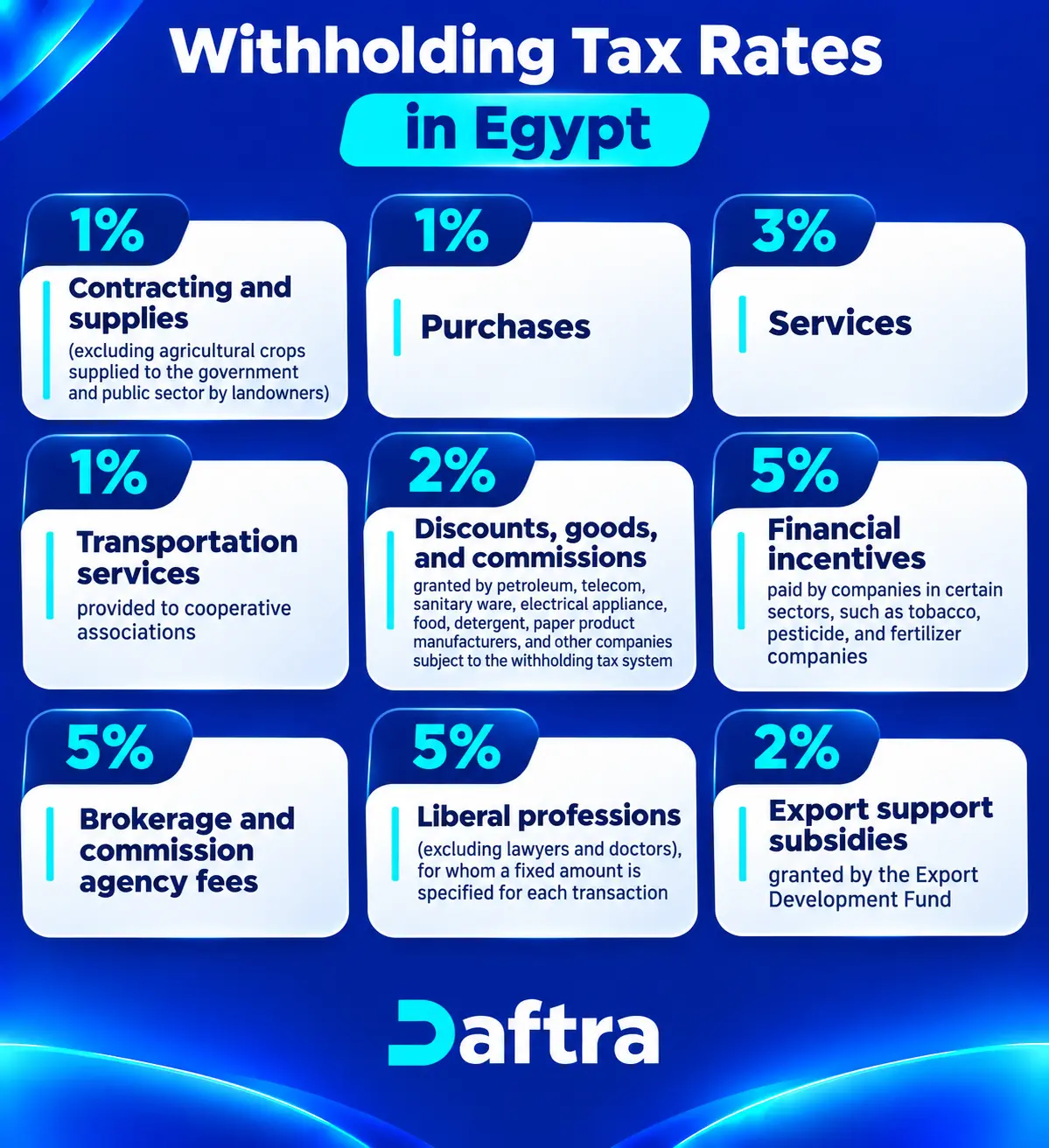
What Are the Withholding Tax Rates?
Egypt's withholding tax rates are set by applicable legislation and ministerial decisions, including Minister of Finance Decision No. 405 of 2018, issued under Article 59 of Income Tax Law No. 91 of 2005. The rates vary by transaction type and applicable tax category.
What Is the Purpose of Withholding and Collection Tax?
Withholding and collection tax does not increase the total amount of tax revenue due to the state. Instead, it serves several purposes:
- Providing regular cash flow to the Egyptian Tax Authority: This helps maintain a steady flow of funds into the state treasury rather than requiring the government to wait until tax returns are filed and taxes are collected.
- Identifying taxpayers liable for tax payments: It helps determine which suppliers must pay taxes, estimate their tax liabilities, and speed up tax collection.
- Reducing tax evasion: It enables the government to monitor commercial transactions from both sides, involving both suppliers and customers in the tax process rather than leaving oversight to one party alone.
- Distributing the annual tax burden: Withholding and collection tax allows tax payments to be made gradually across commercial transactions in different business sectors.
What Is the Relationship Between Withholding and Collection Tax and the Advance Tax Payment System?
The advance tax payment system is an optional system offered by the Egyptian Tax Authority. It exempts eligible taxpayers from the mandatory withholding tax obligation, but it does not exempt them from the tax collection system, under which tax is collected on account. The following explains how it works.
Under Article 61 of Income Tax Law No. 91 of 2005, the advance payment system allows taxpayers to pay 60% of the most recent tax amount paid to the Tax Authority, or the amount estimated by the taxpayer for the financial year in which they wish to apply the system. The latter option applies when the company is dealing with the Tax Authority for the first time.
This system provides the state with cash flow while exempting eligible taxpayers from the obligation to apply withholding tax, which can be administratively challenging for companies that deal with numerous suppliers. To benefit from this system, the taxpayer must provide the buyer with the relevant supporting documents so that the buyer can exempt them from the withholding tax notifications normally required of taxpayers.
What Is the Difference Between VAT and Withholding and Collection Tax?
VAT and withholding and collection tax are sometimes confused. However, they differ in several important ways:
- Tax type: Withholding and collection tax is a direct tax deducted at source from payments, while VAT is an indirect tax imposed on taxable supplies and generally borne by the final consumer.
- When the tax applies: VAT generally applies to taxable sales, whether payment is made immediately or deferred. Withholding and collection tax, as described in this context, is linked to payment.
- Tax settlement: VAT accounts are settled through the applicable input-output tax offset mechanism. Withholding and collection tax is handled differently, with amounts withheld or collected generally credited against the taxpayer’s tax liability, subject to the applicable rules.
How to Calculate Withholding and Collection Tax and File Form 41
According to the source text, withholding and collection tax applies when an invoice exceeds EGP 300. It is calculated on the net transaction value after excluding commercial discounts and other taxes. The buyer then identifies the applicable rate for the category of goods or services purchased and calculates the tax based on the relevant amount.
What Is Form 41 for Withholding and Collection Tax?
Amended Form 41 (Kh.A.T.) is a tax return submitted to the Egyptian Tax Authority detailing transactions and amounts paid to private-sector entities or individuals. Companies subject to the withholding and collection tax system prepare and submit it every three months. Companies exempt from tax, or those covered by the advance tax payment system, are not required to submit this form, subject to the applicable rules.
Information Required for Form 41
The withholding and collection tax return is known as Form 41. Before completing and submitting it to the Egyptian Tax Authority, the accountant should prepare the following information:
- Tax registration number
- Tax file number
- Taxpayer’s name
- Address
- Relevant tax office
- Transaction date
- Transaction type (transaction period/transaction code)
- Total transaction value
- Type and code of deduction
- Net transaction value
- Withholding rate
- Amount collected on account of tax
Practical Examples of Applying Withholding and Collection Tax
Al Nour Company purchased car spare parts from Al Mostafa Factory for EGP 133,000, with a 5% commercial discount and 14% VAT. Payment was made by check. The invoice details are shown below.
Al Mostafa Factory
- Commercial Registration No.: 151324
- Tax File No.: 111111
- Date: July 7, 2022
The following items were supplied to Al Nour Company:
| Item | Quantity | Unit Price (EGP) | Amount (EGP) |
| H7 headlights | 300 | 100 | 30,000 |
| H4 headlights | 300 | 80 | 24,000 |
| Steering wheels | 100 | 460 | 46,000 |
| Total | 100,000 | ||
| Commercial discount (5%) | ??????? | ||
| Net amount after discount | ??????? | ||
| Value Added Tax (14%) | ??????? | ||
| Net amount payable | ??????? |
Required: Prepare the journal entries and explain how withholding and collection tax is calculated.
1- Calculate the commercial discount
Commercial discount = Total amount × Discount rate
EGP 100,000 × 5% = EGP 5,000
2- Calculate the net amount after the discount
EGP 100,000 − EGP 5,000 = EGP 95,000
3- Calculate VAT
EGP 95,000 × 14% = EGP 13,300
4- Calculate withholding and collection tax
Assuming a 1% rate applies to this transaction:
EGP 95,000 × 1% = EGP 950
5- Calculate the net amount payable
EGP 95,000 + EGP 13,300 − EGP 950 = EGP 107,350
Practical Example of a Withholding and Collection Tax Journal Entry
A supplier received a tax deduction certificate from a customer for EGP 2,500. The supplier's tax liability at year-end was EGP 40,000. Assuming the amount withheld can be credited against that liability, the remaining tax payable is:
EGP 40,000 − EGP 2,500 = EGP 37,500
Required: Prepare the journal entries for tax withheld from the supplier's payment.
1- Journal entry in the customer's books when withholding tax from the supplier's payment
2- Journal entry in the supplier's books when receiving the payment and tax deduction certificate
How to Add Withholding and Collection Tax to Your Invoices in Daftra
Daftra Electronic Invoicing Software in Egypt lets you configure tax rates for use in your invoices, where supported by the system and the relevant transaction type. You can also choose the appropriate tax treatment for each transaction.
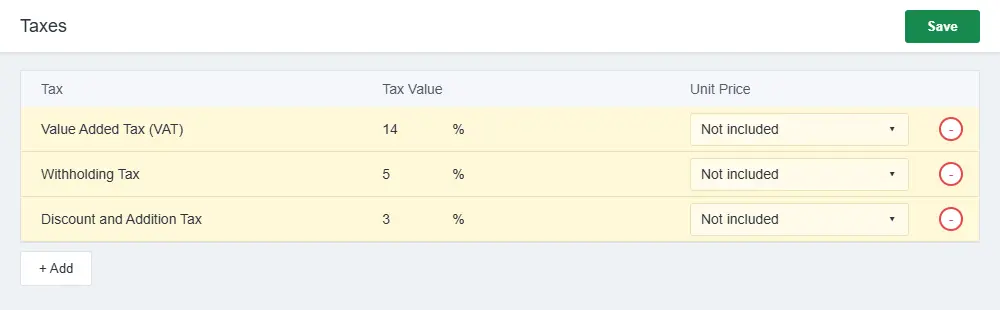
For detailed instructions, refer to the Guide to Virtual Taxes in Daftra.
Frequently Asked Questions
Are rental payments subject to the "withholding and addition" tax?
Yes, rental payments are subject to the "withholding and addition" tax in accordance with Article 45 of the Income Tax Law No. 91 of 2005. This article stipulates that the rates for this tax on various types of rentals are to be determined by the Minister of Finance. The tax is calculated based on 50% of the rental revenue (after accounting for expenses). Individuals are required to ensure payment to avoid penalties stipulated under the provisions of the Withholding and Addition Tax Law (Law No. 91 of 2005) and the Unified Tax Procedures Law (Law No. 206 of 2020). An exemption from this tax may apply if the net annual revenue from rentals—whether for furnished properties or fixed-term leases—does not exceed 21,000 EGP, which is the threshold for the tax-exempt bracket. The taxpayer must file a tax return that meets the requirements for this exemption.
When should Form 41 be submitted?
Form 41 must be submitted on a quarterly basis, at the end of the third month of each quarter of the year.
What companies are exempt from withholding and addition tax?
According to the Income Tax Law No. 91 of 2005, these companies and cases are exempt from the withholding and addition tax:-
- Distributions of securities investment funds.
- Poultry production companies, beekeeping companies, livestock breeding pens, fisheries companies, and fish farms, which are exempt for 10 years from the date the activity begins.
- Capital gains resulting from settlements made on the debts of public business sector companies or state-owned companies.
- The returns obtained by legal persons from investing in securities and certificates of deposit issued by the Central Bank.
- Dividends received by the parent company or holding company from subsidiaries.
Which goods are exempt from the withholding and addition tax?
- Inputs for paper manufacturing.
- Services provided by the Suez Canal Authority to transiting vessels, as well as sewage/sanitation services.
- Goods or services supplied to projects located within special economic zones.
- Civil aircraft, their engines, parts, and components.
What is the withholding and addition tax on commissions?
The withholding and addition tax on commissions is 1% for commercial activities, 3% for investment services, and 5% for freelance/professional services.
What is the withholding tax (deduction and addition tax) on contracting?
The withholding tax on contracting and supplies is 1%. (Note: Government-procured horticultural products are exempt from this withholding tax.)
What is the withholding tax on airline tickets?
The withholding tax on airline tickets is 14%. (Note: Civil aircraft, their engines, and their components are exempt from taxes.)
What is a withholding tax (deduction and addition tax)?
A withholding tax is a type of tax imposed on individuals or companies, with rates ranging from 1% to 5%
What is the status of the withholding tax in Saudi Arabia?
Currently, a withholding tax is not actively applied in Saudi Arabia; however, where applicable, rates range from 1% to 5% (the specific rate is determined based on the company’s field or business activity).
What are the accounting entries for withholding and value-added taxes?
Accounting entry when tax is withheld from a supplier:
| Account | Debit | Credit |
| Supplier | ✔️ | |
| Bank or Cash | ✔️ | |
| Withholding and Additional Tax Payable | ✔️ |
Accounting entry when tax is added to a sales invoice:
| Account | Debit | Credit |
| Customer | ✔️ | |
| Revenue | ✔️ | |
| Output Value Added Tax Payable | ✔️ |
How is the withholding and additional tax calculated?
The withholding and additional tax are calculated based on the company’s sector and business activity, with rates ranging from 1% to 5%.
Withholding tax amount = Total value of the (taxable) invoice × Withholding rate.
Additional tax amount = Invoice value (before tax) × Additional tax rate.
In conclusion, withholding and collection tax is one of the mechanisms used to collect tax in advance in Egypt. Understanding the applicable rules, maintaining supporting documentation, and recording withheld amounts correctly can help businesses reconcile their accounts and meet their tax obligations. Because tax rates, exemptions, and filing procedures can change, businesses should consult current Egyptian Tax Authority guidance when making tax decisions.












 Invoicing
 POS
 Offers
 Installments
 Sales Commission
 KSA E-Invoice Software
 EGY E-Invoice Software
 JO E-Invoice Software
 E-Invoice Software
 Chart of Accounts
 Asset Management
 Cost Centers
 Expenses
 Cheque Cycle
 VAT & Tax Compliance
 Product Management
 Purchases
 Purchase Cycle
 Suppliers
 Requisitions
 Stocktaking
 Organizational Structure
 Personnel Management
 Attendance and Leave
 Contracts
 Payroll
 Requests
 Work Orders
 Booking Management
 Rental and Unit Management
 Time Tracking
 Work Flow
 Lease Contracts
 Manufacturing Management
 Client Follow-Up
 Loyalty Points
 Points and Credits
 Memberships
 Insurance Management
 Daftra ERP Full App
 Point of Sales App
 Point of Sales for Desktop – Support Offline Mode
 AI Expenses Scanner App
 Employee Attendance, Sign & ESS App
 E-invoice Reader App
 Inventory Stocktaking App