




Table of contents:
- Key Summary
- How to Start an Agricultural Project in Saudi Arabia
- How to Prepare a Feasibility Study for an Agricultural Project
- What Are the Requirements for Starting an Agricultural Project in Saudi Arabia?
- What Are the Advantages and Disadvantages of Starting an Agricultural Project in Saudi Arabia?
- How Much Does It Cost to Establish an Agricultural Project?
- Examples of Agricultural Projects in Saudi Arabia
- Can Artificial Intelligence Be Used to Develop Profitable Agricultural Projects in Saudi Arabia?
- What Are the Latest Developments in Modern Agriculture in Saudi Arabia?
- How Can Modern Technology Help You Manage Your Agricultural Project Efficiently?
- How Can Daftra Help You Manage Your Agricultural Project?
- Frequently Asked Questions
- Conclusion
Agricultural projects in Saudi Arabia represent promising investment opportunities, given their contribution to local food security and the national economy. The Kingdom supports agricultural investors as part of its efforts to promote economic development and benefit from its natural resources and agricultural potential.
This guide explores how to start an agricultural project in Saudi Arabia, including the requirements, costs, benefits, and challenges involved. It also explains how modern technology and smart digital solutions can help investors manage agricultural projects more efficiently.
How to Start an Agricultural Project in Saudi Arabia
Starting an agricultural project in Saudi Arabia involves defining the project concept, conducting a comprehensive feasibility study to estimate costs, revenues, and risks, and securing funding from sources such as banks or the Agricultural Development Fund (ADF). Investors must also select a suitable location based on soil quality and climate.
The next steps include obtaining the necessary licenses, registering the business with the relevant authorities, and developing the required infrastructure. Then, recruit and train qualified workers. Finally, implement the agricultural plan according to a defined schedule and support it with an effective marketing strategy.
The main steps are outlined below.
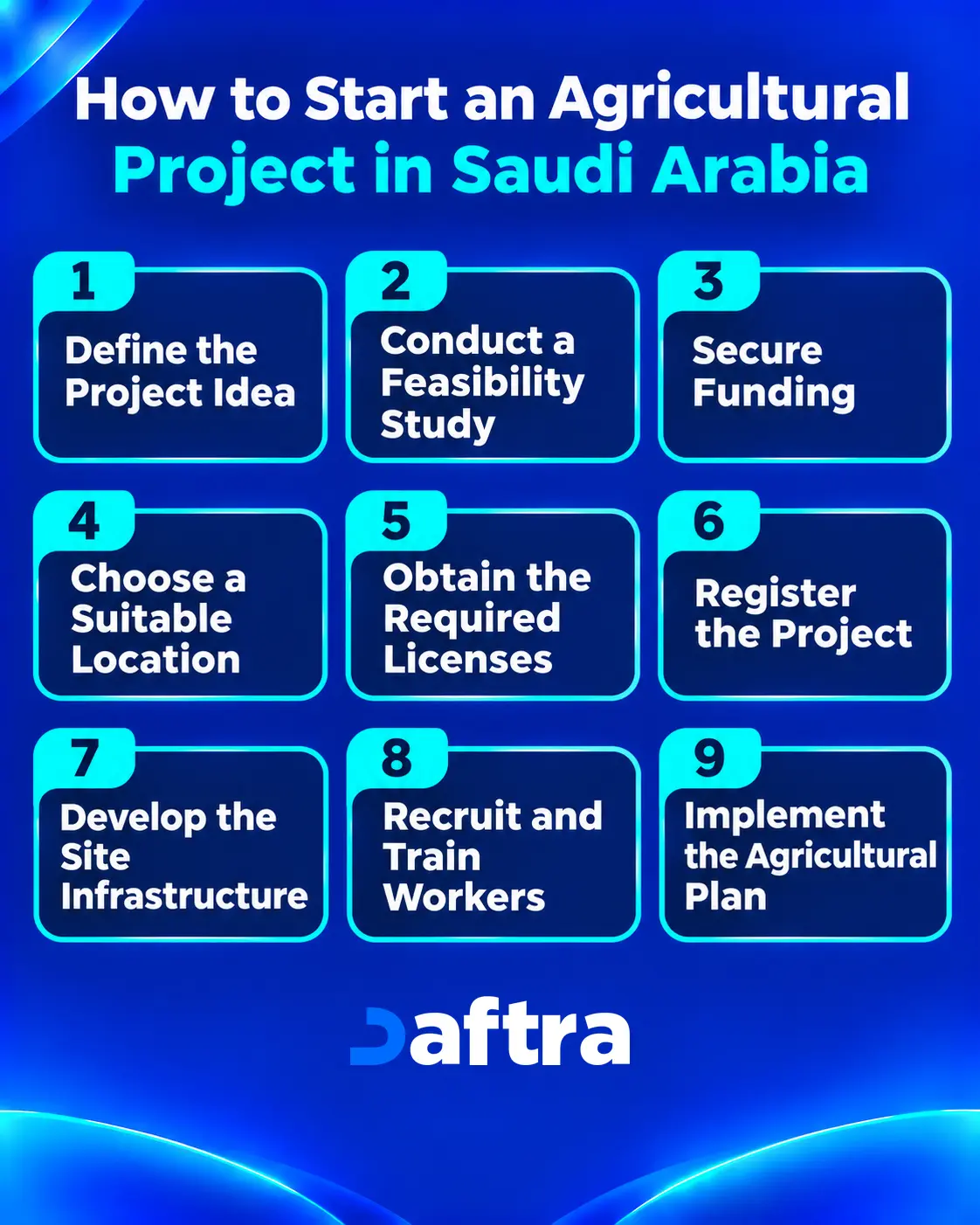
1. Define the Project Idea
First, determine the type of agricultural project you intend to establish. For example, you may grow food crops such as vegetables and grains, cultivate fruit trees, or start an organic farming business.
2. Conduct a Feasibility Study
A feasibility study should assess the project from technical, financial, and legal perspectives. Its primary purpose is to identify the factors that will influence the project's success and determine which options best suit the Saudi agricultural market.
The study should estimate all expected expenses, including seeds, high-quality agricultural supplies suited to the target crops, and the costs of modern agricultural technologies and equipment designed to improve efficiency and productivity.
It should also forecast potential revenues, identify possible risks, and outline measures to mitigate and manage those risks.
3. Secure Funding
Explore available financing options, including banks, government entities, and private investors. Prepare a detailed financial plan explaining how the funds will be used and how resources will be allocated.
The Agricultural Development Fund (ADF) is one of Saudi Arabia's key government financing sources for agricultural activities. Established in 1430 AH by a Council of Ministers decision, the fund provides financing facilities and concessional loans to support the continuity and development of agricultural businesses.
4. Choose a Suitable Location
Select a location whose soil, climate, and water resources are suitable for the crops you intend to grow. You may purchase farmland or explore leasing options through the Ministry of Environment, Water and Agriculture (MEWA), subject to the applicable regulations and procedures.
5. Obtain the Required Licenses
The project owner must apply to the Saudi authorities for the licenses required to establish and operate the agricultural business.
6. Register the Project
After obtaining the required licenses and commercial registration, the agricultural project must be registered with the relevant government entities in Saudi Arabia.
Depending on the project's legal structure and activities, these may include the Ministry of Human Resources and Social Development, the Zakat, Tax and Customs Authority (ZATCA), the General Organization for Social Insurance (GOSI), and Saudi Post.
7. Develop the Site Infrastructure
Once the location is selected and the required licenses and registrations are obtained, the project owner can begin developing the necessary infrastructure. This may include irrigation systems, storage facilities, and other essential utilities.
8. Recruit and Train Workers
After completing the initial planning and officially registering the agricultural project, the owner should recruit a qualified team with relevant agricultural experience.
Workers should receive the training needed to strengthen their technical knowledge, improve their agricultural skills, and help them perform their duties effectively. They should also have the tools and resources needed to achieve the desired results.
9. Implement the Agricultural Plan
Implement the agricultural plan according to the project's defined objectives, assigned responsibilities, and established schedule.
Also develop an effective marketing strategy to promote and distribute products in local and international markets, helping the business achieve its expected revenue and profitability targets.
Example: Managing a Vegetable Farm
A vegetable farm owner in Saudi Arabia established a 20,000-square-meter farm. As production increased, so did purchasing and sales operations. The farm began working with 12 suppliers to obtain seeds, fertilizers, pesticides, and packaging materials, while also covering daily labor, irrigation, transportation, and maintenance expenses.
Initially, the farm recorded these transactions using invoices and Excel spreadsheets. However, as the business grew, managing everything this way became increasingly difficult. Purchases were recorded separately, daily expenses were tracked in another file, and sales and remaining crop and supply quantities were documented in different records.
This fragmented approach made it difficult to determine the actual cost of production and consistently monitor inventory value. The owner also had to review multiple records to calculate monthly expenses or sales. As transactions increased, manual tracking no longer provided a clear picture of the farm's financial position or inventory movements.
To address these challenges, the owner needed a system that could consolidate financial and operational activities in one place. The farm therefore began using Daftra to manage purchasing, sales, inventory, expenses, and accounting.
After organizing operations in the system, the owner could more easily track purchases, inventory receipts, and sales, record expenses, and review them through reports. The system could monitor sales, inventory movements, and expenses in one place, providing organized data to assess farm performance and make informed decisions about production, purchasing, and sales.
How to Prepare a Feasibility Study for an Agricultural Project
Preparing a feasibility study for an agricultural project in Saudi Arabia involves several key stages. These include conducting an initial local market analysis, identifying target customers, assessing the site's technical suitability, evaluating the land and climate, and determining the necessary agricultural tools and equipment.
The study should also assess the project's environmental and social impacts. Consulting agricultural specialists is another key step to ensure the project is implemented efficiently and achieves the desired results.
The following steps can help you prepare a comprehensive feasibility study for your agricultural project.
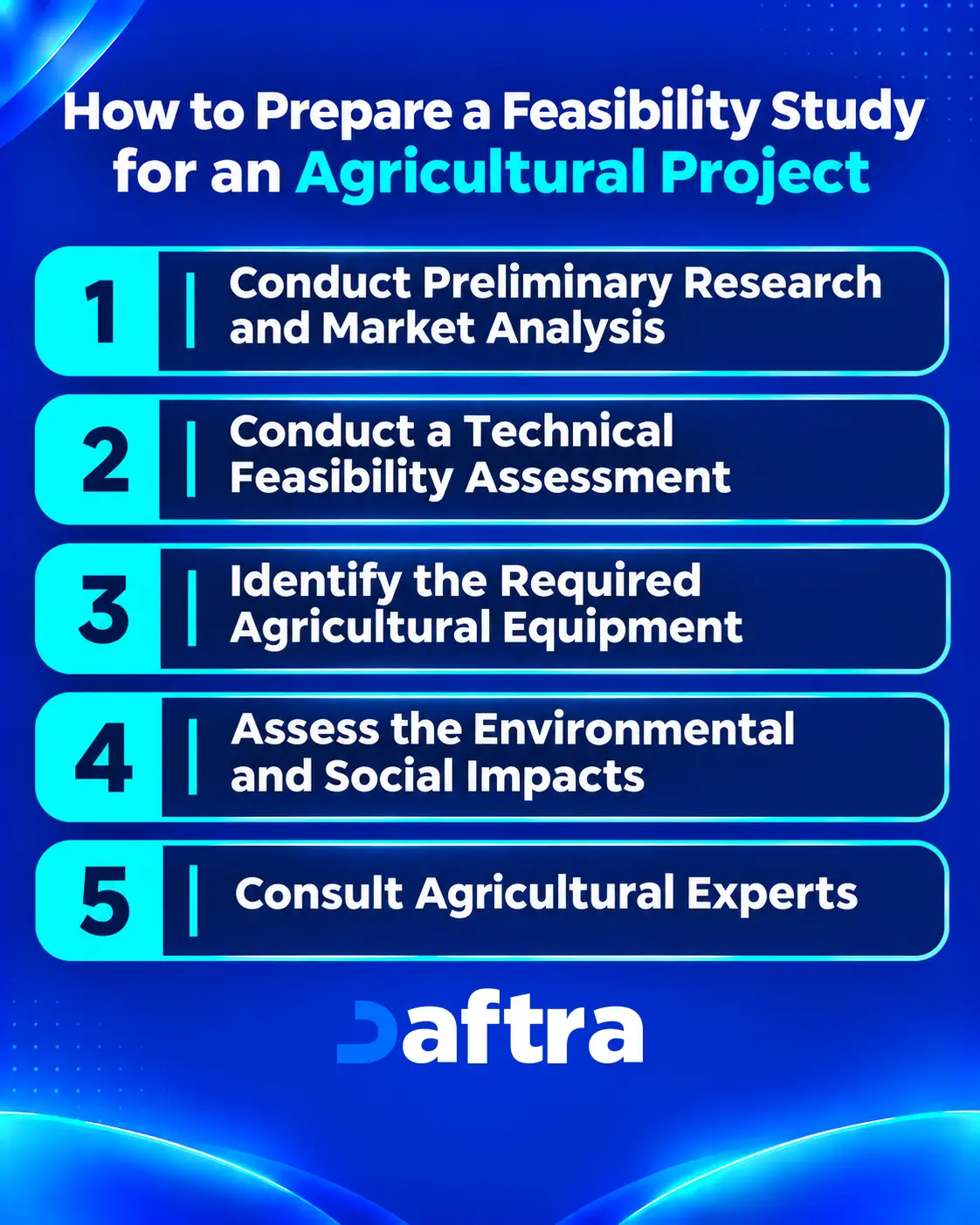
1. Conduct Preliminary Research and Market Analysis
Conduct field research into the local agricultural market to identify demand for agricultural products. Analyze competing agricultural businesses in Saudi Arabia and identify target customers and other potential buyers who could benefit from the project's harvest.
You should also identify the most effective ways to reach these customers, whether through social media marketing or direct sales in local markets.
2. Conduct a Technical Feasibility Assessment
Evaluate the proposed project site and the factors that may affect agricultural production. These include soil conditions, water availability, and climate.
You should also identify the geographic locations of your target markets, preferably selecting a site within reasonable proximity to those markets. Consider the competitive landscape and the presence of other agricultural businesses operating nearby.
3. Identify the Required Agricultural Equipment
An agricultural project may require a range of tools and equipment, depending on the crops and scale of operations. These may include:
- Tractors and sickles.
- Excavation and planting machinery.
- Sprayers, hoes, and pruning shears.
- Irrigation hoses and water pumps.
- Fertilizer application equipment.
- Temperature and humidity meters.
- Sensors and monitoring devices.
- Storage boxes and containers.
- Refrigerated storage units.
- Transportation vehicles.
4. Assess the Environmental and Social Impacts
Evaluate how the project will use natural resources, including water and soil, and ensure that these resources are managed sustainably.
The study should also assess the environmental effects of fertilizers and pesticides. It should outline preventive measures to reduce pollution and other potential harm caused by their use.
In addition, consider the project's social impact on the local community. This may include the creation of new jobs, changes in local living conditions, or the potential relocation of residents due to adverse effects associated with the project.
5. Consult Agricultural Experts
Agricultural specialists can play an important role in preparing and implementing the feasibility study. Their expertise can help workers follow agricultural plans effectively, improve productivity, and work toward the project's expected sales and profitability targets.
What Are the Requirements for Starting an Agricultural Project in Saudi Arabia?
Establishing an agricultural project in Saudi Arabia requires compliance with various regulatory, environmental, and planning requirements. Multiple government entities oversee these requirements to help ensure that projects comply with applicable regulations and support sustainable agricultural activities.
The main requirements may include the following, depending on the type, location, and scale of the project.
- Secure agricultural land: Obtain suitable farmland through ownership or a lease agreement.
- Obtain engineering plans: Commission an accredited engineering office to prepare the required building and site plans in accordance with Saudi regulations.
- Obtain an agricultural registration certificate: Apply for agricultural registration and provide the required documents, such as a national ID, proof of ownership or a lease agreement for the agricultural site, and a land survey file containing at least four boundary-coordinate points expressed in decimal format.
- Register on the Namaa platform: Use the Namaa platform to access the relevant agricultural licensing and renewal services.
- Complete the MEWA site inspection: Undergo a field inspection by the Ministry of Environment, Water and Agriculture to obtain a technical report on the proposed site. This report helps verify whether the project meets the applicable agricultural requirements.
- Obtain preliminary poultry project approval, where applicable: New poultry projects may require preliminary licensing if they fall within the relevant livestock-related activities.
- Provide an aerial image of the site: Submit an aerial image illustrating the proposed agricultural project's layout or development plan, where required.
- Prepare an environmental impact assessment: Category III projects with potentially significant environmental impacts may require an environmental impact assessment prepared by a licensed consulting office. The applicable requirements depend on the nature of the project and the energy sources it uses.
- Obtain the required environmental permit: Projects subject to environmental licensing must comply with the requirements of the National Center for Environmental Compliance (NCEC). Depending on the activity, the application may require a valid commercial registration certificate, contracts with licensed providers for the transportation and disposal of hazardous and non-hazardous industrial waste, a valid Zakat or tax certificate, a national ID or residence permit, proof of ownership or a lease agreement, and a completed classification form.
- Obtain municipal approval: Secure approval from the relevant planning authority within the Ministry of Municipalities and Housing for the proposed project location, where required.
- Obtain an agricultural building permit: Apply for a building permit in accordance with the applicable urban code. Requirements may include preliminary project approval, approvals from relevant authorities based on the project's activity and location, the necessary environmental approvals, and building plans prepared by an accredited engineering office. Additional documentation may be required to confirm that the site is outside the urban boundary.
- Verify the site's distance from urban areas: Certain projects, including new poultry projects subject to specific siting requirements, may need to be located at least 10 kilometers outside designated urban and development boundaries.
- Apply for worker visas: Submit the necessary applications and supporting documents to recruit foreign workers for the agricultural project.
In summary, starting an agricultural project in Saudi Arabia requires compliance with a combination of regulatory, environmental, and planning requirements. The process generally begins with securing suitable farmland, obtaining the necessary engineering plans, and applying for agricultural registration.
The project owner must then use the relevant government platforms, including Namaa where applicable, to obtain agricultural licenses and complete any required environmental licensing through the appropriate authorities.
Other requirements may include a field inspection by MEWA, an environmental impact assessment, approval of the project location by the Ministry of Municipalities and Housing, and a building permit issued in accordance with the applicable urban code. Certain projects must also meet location-specific requirements, and employers must complete the applicable procedures for recruiting foreign workers.
What Are the Advantages and Disadvantages of Starting an Agricultural Project in Saudi Arabia?
Agriculture is an important contributor to economies worldwide. Agricultural projects can offer attractive opportunities for investors and entrepreneurs seeking to generate profits. However, prospective investors should carefully consider both the advantages and the challenges before making a decision.
Starting an agricultural project in Saudi Arabia can offer promising investment opportunities, supported by government initiatives, suitable agricultural areas, climatic diversity, and demand for agricultural products.
Nevertheless, investors must account for challenges such as climate change, water scarcity, high operating costs, and market competition. Careful feasibility analysis and a well-developed business plan are essential to improving the project's prospects for success and long-term sustainability.
How Much Does It Cost to Establish an Agricultural Project?
The cost of establishing an agricultural project depends on several factors, including the project type and location, equipment and raw material costs, labor expenses, utility costs, and marketing and distribution expenses.
In general, the article estimates that the cost of establishing an agricultural project in Saudi Arabia starts at SAR 30,000 per feddan. Livestock farming projects are described as among the more expensive types of agricultural ventures.
Actual costs can vary significantly depending on the project's requirements and scale.
Examples of Agricultural Projects in Saudi Arabia
Saudi Arabia has seen growing interest in agricultural investment because of the sector's importance to food security. Investors can choose from a range of agricultural projects suited to local market conditions and demand.
1. Date Farming
Date farming is well suited to the Saudi agricultural market. The Kingdom produces a wide variety of dates and exports them to markets around the world.
2. Livestock Farming
Livestock farming produces meat and dairy products, both of which are in demand in the Saudi market. These projects can also create additional employment opportunities.
3. Fodder Cultivation
Growing demand for animal products has increased the need for animal feed. Crops such as alfalfa and corn can help supply livestock farming operations.
Major agricultural opportunities in Saudi Arabia therefore include date cultivation, livestock farming to meet demand for meat and dairy products, and fodder production to support the livestock sector.
4. Agritourism Farms
A farm can be developed into a visitor destination by offering experiences connected to agriculture. These may include guided farm tours, tastings of local products, opportunities to participate in harvesting, and the purchase of fresh produce.
5. Perfume and Essential Oil Production
Producing perfumes and essential oils offers a way to transform agricultural crops into higher-value products instead of selling them only as raw materials.
One example is the cultivation of Taif roses, which are associated with the production of rose oil and other derivatives used in perfumes and related products.
The Ministry of Environment, Water and Agriculture has issued licenses for facilities in Makkah and Al-Baha that specialize in distilling and extracting aromatic plant oils. The Ministry also highlighted Taif rose farms and facilities producing rose derivatives, showing how agricultural activities can connect to processing and value-added production.
6. Hydroponic Farming
Hydroponics is a modern agricultural method that lets crops grow without relying on conventional soil. Instead, plants receive the water and nutrients they need through specialized growing systems.
7. Fish Farming and Aquaculture
Fish farming is another agricultural business opportunity in Saudi Arabia. It involves raising fish in dedicated facilities rather than relying exclusively on wild fishing.
Depending on the project's location and design, these farms may use seawater or inland water systems.
According to the General Authority for Statistics, Saudi Arabia's 2023 fisheries and aquaculture statistics showed that marine aquaculture production exceeded 92,000 tonnes, while inland aquaculture production exceeded 47,000 tonnes.
These figures illustrate the diversity of aquaculture activities and the different environments in which fish farming operates across the Kingdom.
Can Artificial Intelligence Be Used to Develop Profitable Agricultural Projects in Saudi Arabia?
Yes. Artificial intelligence is increasingly becoming a useful tool for farmers and agricultural investors. It can analyze weather and soil data and help forecast expected yields before the growing season begins.
Modern irrigation systems can also reduce water consumption, helping lower operating costs and improve the sustainability of agricultural operations.
What Are the Latest Developments in Modern Agriculture in Saudi Arabia?
Some of the key developments in modern agriculture in Saudi Arabia include:
- Expansion of hydroponics and aquaponics: These methods can support crop production while improving water-use efficiency.
- Advances in greenhouse farming: Modern greenhouses use sophisticated temperature-control systems to create suitable growing conditions throughout the year.
- Artificial intelligence and smart farming: Modern technologies and AI are being introduced into agricultural activities such as crop monitoring and data analysis.
How Can Modern Technology Help You Manage Your Agricultural Project Efficiently?
Modern agricultural technology plays an important role in improving the performance of agricultural projects. It can help business owners increase productivity and reduce costs.
The following technologies can improve the efficiency and productivity of agricultural operations:
- Smart irrigation systems: These systems help reduce water consumption and improve irrigation efficiency.
- Unmanned aerial vehicles (UAVs): Drones can be used to monitor crops from the air, assess soil conditions, distribute fertilizers and pesticides, and conduct topographic surveys of agricultural land.
- Agricultural robots: Robots can reduce manual labor in tasks such as harvesting and fertilizer application.
- Agricultural software applications: These applications provide information about weather forecasts and market developments, helping farmers make better-informed decisions.
Together, these technologies can improve agricultural management. Smart irrigation systems help conserve water, drones support land monitoring and the distribution of agricultural supplies, and agricultural robots reduce manual effort in field operations.
Agricultural software also helps business owners make informed decisions using weather and market data. By combining these technologies, agricultural businesses can improve production efficiency, reduce costs, and support long-term sustainability.
How Can Daftra Help You Manage Your Agricultural Project?
Daftra is an integrated accounting and business management system that helps agricultural businesses manage their operations more efficiently.
With Daftra, you can:
- Manage agricultural inventory: Track agricultural supplies and other inventory items.
- Plan purchases effectively: Control purchasing costs and allocate resources more efficiently.
- Track sales and payments: Monitor sales, send electronic invoices to customers, and track payment collection.
- Manage employees and agricultural workers: Organize employee records, shifts, leave, and payroll.
- Monitor financial performance: Access detailed financial reports to support decisions based on accurate accounting and financial data.
- Prepare budgets: Monitor costs and revenues more effectively.
- Manage tax reporting and e-invoicing: Prepare tax reports and electronic invoices in line with applicable requirements of the Zakat, Tax and Customs Authority (ZATCA).
- Integrate payment systems and manage customer relationships: Connect with various payment systems and manage customer relationships to help strengthen customer loyalty.
Frequently Asked Questions
What Is the Most Profitable Agricultural Project in Saudi Arabia?
Potentially profitable agricultural projects in Saudi Arabia include:
- Date farming: Saudi Arabia is one of the world's major date producers, with a wide variety of date varieties and established export opportunities.
- Livestock farming: Demand for meat and dairy products in the Kingdom creates opportunities for livestock businesses.
- Fodder cultivation: Growing crops such as alfalfa and corn can help meet the needs of livestock farms.
The profitability of any project depends on factors such as location, startup costs, operating expenses, market demand, and management efficiency.
How Do I Start an Agricultural Business?
To start an agricultural project in Saudi Arabia, follow these steps:
- Define your project idea, such as crop farming, livestock farming, or organic agriculture.
- Conduct a feasibility study to estimate costs, expected returns, and risks.
- Secure funding from sources such as the Agricultural Development Fund or private investors.
- Choose a suitable agricultural site based on soil and climate conditions.
- Obtain the required licenses from the relevant authorities.
- Register the project with the appropriate government entities.
- Develop the necessary infrastructure, including irrigation systems and storage facilities.
- Recruit and train workers.
- Implement your agricultural plan and develop an effective marketing strategy for your products.
What Should an Agricultural Business Plan Include?
A successful agricultural business plan should include:
- Market analysis to identify target customers and determine how to reach them.
- A technical assessment of the land and the suitability of the proposed location for farming.
- A list of the tools and equipment required for the project.
- An assessment of the project's environmental and social impacts.
- Consultation with agricultural experts to support implementation and improve productivity.
- A marketing plan for distributing products locally or exporting them to international markets.
What Are the Requirements for Obtaining a Commercial Registration in Saudi Arabia?
To obtain a commercial registration for a sole proprietorship in Saudi Arabia, the applicant must generally be at least 18 years old and must not be a government employee. The applicant must also specify the business activity and obtain any licenses required for activities that need prior approval.
Applicants should verify the current requirements and procedures with the relevant Saudi authorities before submitting an application.
Can I Obtain an Agricultural Registration Certificate Without a Title Deed?
It may be possible to obtain an agricultural registration certificate without a formal property title deed if acceptable alternative documentation is available, such as an approved lease agreement. Eligibility depends on the applicable requirements and the documents accepted by the relevant authority.
How Can I Apply for Agricultural Land in Saudi Arabia?
Applications for agricultural land-related services may be submitted electronically through the Namaa platform, operated by the Ministry of Environment, Water and Agriculture.
Applicants should select the relevant service and meet its eligibility conditions and documentation requirements.
Is Agriculture Profitable in Saudi Arabia?
Yes, agricultural projects can be profitable in Saudi Arabia when supported by effective planning and appropriate technology. Factors that may contribute to their success include:
- Government support through financing and incentives.
- Access to land suitable for agricultural production.
- Demand for agricultural products.
- Modern technologies, including smart irrigation systems, drones, and agricultural robots, which can help reduce costs and improve productivity.
However, investors should also account for challenges such as climate change, water scarcity, and rising operating costs.
Conclusion
Starting an agricultural project in Saudi Arabia requires careful planning, an understanding of the applicable regulations, and a realistic assessment of the project's costs and potential returns.
As discussed in this guide, the Kingdom offers several agricultural investment opportunities, including date farming, livestock production, fodder cultivation, agritourism, essential oil production, hydroponics, and aquaculture.
Beyond commercial returns, agricultural investment can contribute to food security and the goals of Saudi Vision 2030, which seeks to diversify the economy and support sustainable development across different sectors.
With a sound feasibility study, suitable financing, effective operational management, and appropriate technology, investors can better position their agricultural projects for long-term success in Saudi Arabia.














 Invoicing
 POS
 Offers
 Installments
 Sales Commission
 KSA E-Invoice Software
 EGY E-Invoice Software
 JO E-Invoice Software
 E-Invoice Software
 Chart of Accounts
 Asset Management
 Cost Centers
 Expenses
 Cheque Cycle
 VAT & Tax Compliance
 Product Management
 Purchases
 Purchase Cycle
 Suppliers
 Requisitions
 Stocktaking
 Organizational Structure
 Personnel Management
 Attendance and Leave
 Contracts
 Payroll
 Requests
 Work Orders
 Booking Management
 Rental and Unit Management
 Time Tracking
 Work Flow
 Lease Contracts
 Manufacturing Management
 Client Follow-Up
 Loyalty Points
 Points and Credits
 Memberships
 Insurance Management
 Daftra ERP Full App
 Point of Sales App
 Point of Sales for Desktop – Support Offline Mode
 AI Expenses Scanner App
 Employee Attendance, Sign & ESS App
 E-invoice Reader App
 Inventory Stocktaking App