


What Is External Auditing and How Does It Help Organizations?


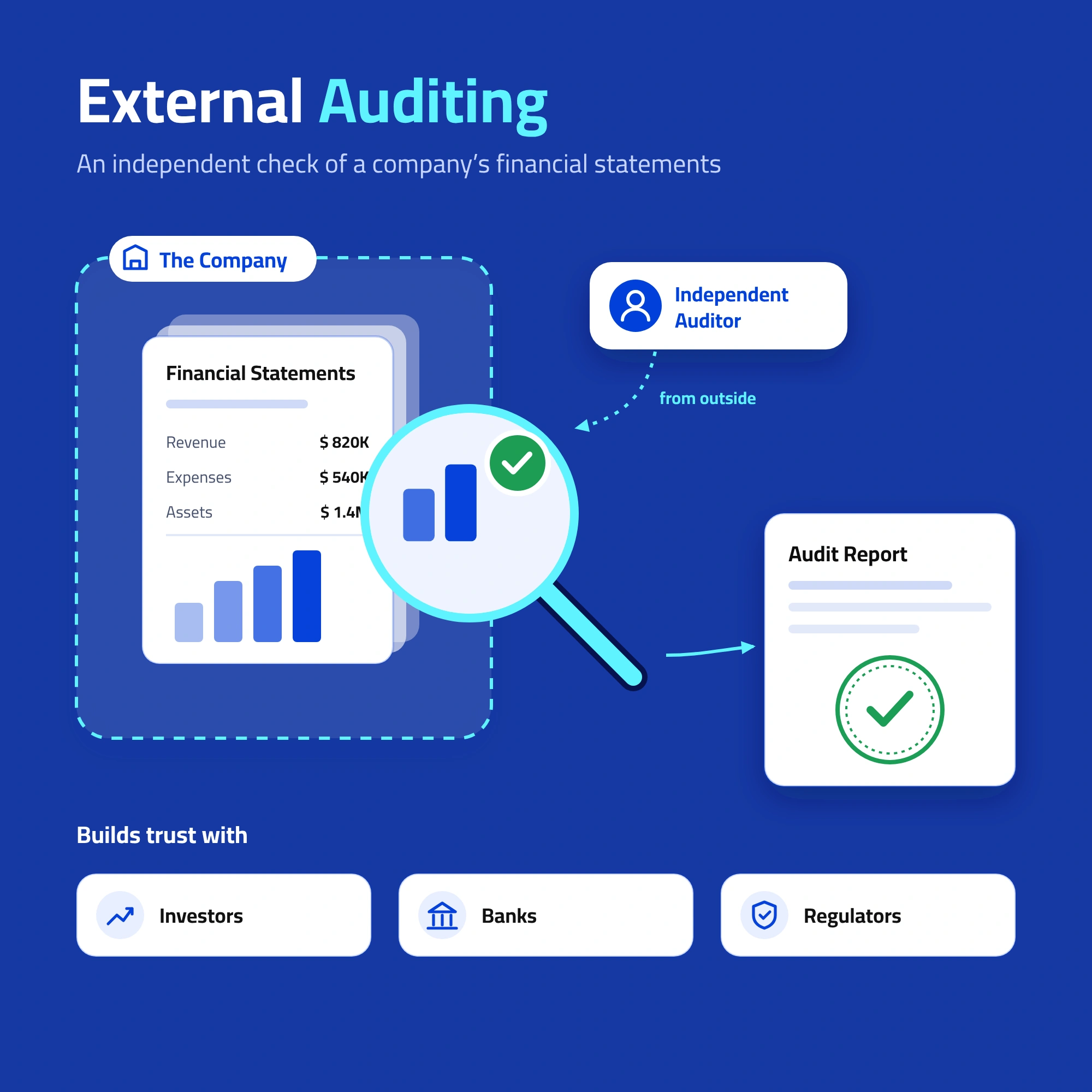
Table of contents:
- key summary
- What Is External Auditing?
- What Are the Standards for External Auditing?
- Steps of the External Audit
- Factors Affecting the Quality of an External Audit
- What Is the Role of External Auditing in Ensuring Financial Accuracy?
- The Importance of External Auditing in Ensuring Credibility
- Frequently Asked Questions
Investors, banks, and financial institutions sometimes need an objective assessment of a company’s financial position, independent of the company's own reports, which may present an overly favorable picture. This is where external auditing plays an important role.
What Is External Auditing?
External auditing is a financial review conducted by independent parties with no affiliation with the company or its management. In many cases, applicable laws and regulations make external audits mandatory. External auditing follows strict rules and professional standards, helping ensure financial reports are presented objectively and without bias. Investors, government entities, regulatory authorities, and the company’s management use these reports to support informed, well-considered decision-making.
What Are the Standards for External Auditing?
The American Institute of Certified Public Accountants (AICPA) has established standards and requirements to make the financial auditing process more professional and reliable. The key standards include the following:
First: General Standards
01
Professional Competence and Due Qualification: The auditor should have sufficient time, knowledge, and professional competence to perform the audit effectively.
02
Independence: The auditor must maintain independence and remain free from undue influence throughout all stages of the audit.
03
Due Professional Care: The auditor should exercise the necessary level of care and diligence when performing audit procedures and preparing the final report.
Second: Standards of Fieldwork
01
Planning and Supervision: The audit should be appropriately planned, and the audit team should be properly supervised.
02
Understanding the Entity and Assessing Risks: The auditor should seek to understand the nature of the entity being audited, its operating environment, and its internal controls in order to assess the risk of material misstatements in its financial statements, whether caused by fraud or unintentional error, and design an appropriate and effective audit plan.
03
Obtaining Audit Evidence: The auditor should obtain sufficient and appropriate audit evidence to support reasonable conclusions regarding the financial statements under review.
Third: Reporting Standards
01
Compliance with Accounting Principles: The auditor should state in the final report whether the financial statements have been prepared in accordance with generally accepted accounting principles.
02
Consistent Application of Accounting Principles: The auditor should identify any circumstances in which accounting principles have not been applied consistently in the current period compared with the preceding period.
03
Adequacy of Disclosures: If the auditor determines that the disclosures provided are insufficient for the purposes of the audit, this should be stated in the audit report.
04
Expression of Professional Opinion and Clarification of Responsibility: The auditor should express an opinion on the financial statements examined or clearly state that an opinion cannot be expressed. In the latter case, the reasons should be clearly explained in the report.
In general, the auditor should clearly explain the nature of the audit work performed, and the degree of responsibility assumed.
The principles of external auditing provide a professional framework for organizing the auditor’s work and ensuring accuracy and transparency. These standards comprise three main groups:
General standards, which focus on the auditor’s competence, independence, and diligence; fieldwork standards, which cover proper planning, understanding the entity’s environment, and obtaining audit evidence.
Finally, the reporting standards require the auditor to comply with applicable accounting principles and clearly communicate their professional opinion. Collectively, these standards help ensure that financial audits are conducted accurately and reliably.
Steps of the External Audit
An external audit follows several key steps to achieve its objectives accurately. These steps include the following:
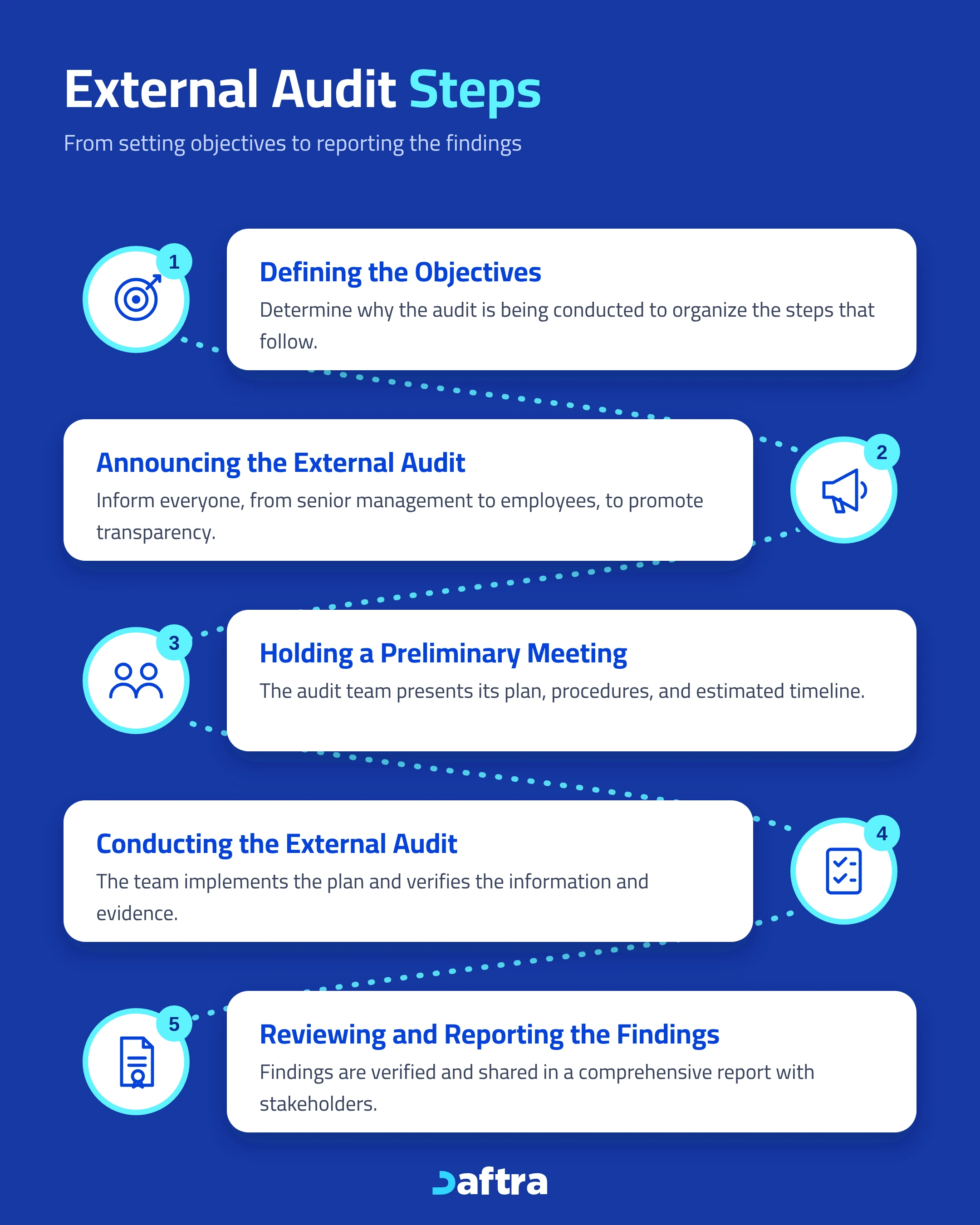
1. Defining the Objectives
Before starting the external audit, determine why it is being conducted. This helps establish the subsequent steps and ensures that the audit is carried out in an organized manner.
2. Announcing the External Audit
Inform everyone in the organization that an external audit is being conducted, from senior management to employees at all levels. This helps promote transparency throughout the audit process.
3. Holding a Preliminary Meeting Before the Audit
The external audit team should present its audit plan, explain the procedures it will follow, and provide an estimated timeline for completing the external audit.
4. Conducting the External Audit
At this stage, the external audit team implements the audit plan, verifying the information and evidence needed to assess its accuracy and transparency. This helps ensure the audit objectives are met, and the findings are accurate and useful.
5. Reviewing and Reporting the Findings
Once the audit findings have been obtained, they should be reviewed and verified before being communicated clearly and systematically to stakeholders and senior management. This is typically presented as a comprehensive report outlining the auditor’s findings and observations. The report helps stakeholders make informed decisions and enables the company to review and improve its internal systems in preparation for future audits.
The external audit process has five main stages: defining the objectives, announcing the audit within the organization, holding a preliminary meeting to present the audit plan, conducting the audit, and finally reviewing and reporting the findings in a detailed report to management and stakeholders. Together, these stages help promote transparency and accuracy when evaluating the organization’s financial performance.
Factors Affecting the Quality of an External Audit
Several factors may affect the quality of the results of an external audit of financial statements. The key factors include the following:
Several key factors affect the quality of an external audit, most notably the external auditor’s experience, professionalism, and competence, as well as the time available to conduct the audit. Together, these factors contribute to the accuracy and reliability of the audit findings and final reports.
What Is the Role of External Auditing in Ensuring Financial Accuracy?
External auditing plays a key role in ensuring the accuracy of companies' financial disclosures. The following are the main ways in which external auditing contributes to financial accuracy:
- Independent Audit of Financial Statements: External auditors play an important role in the financial disclosure process by independently examining the company’s financial statements.
- Objective Assessment of Financial Position: The primary objective of an audit is to provide an objective assessment that confirms whether the financial records accurately reflect the company’s financial position.
- Ensuring Neutrality and Avoiding Bias: External auditors provide an independent third-party perspective, free from potential bias or influence that may affect individuals within the organization, its beneficiaries, or its shareholders.
- Enhancing Investor and Shareholder Confidence: Ultimately, these reports help reassure investors and shareholders about the company’s financial health and the protection of their rights and investments. They also influence decisions, such as increasing capital or adopting more ambitious investment strategies.
In summary, external auditing supports financial accuracy by independently examining financial statements, objectively assessing the company’s financial position, and ensuring neutrality in audit reports. This enhances investor and shareholder confidence and supports their financial decision-making.
The Importance of External Auditing in Ensuring Credibility
External auditing helps companies verify their financial records and statements, enhancing transparency within the organization. Because external auditing is independent by nature, it helps ensure financial information is presented realistically, accurately, and objectively, supporting the company’s reputation and market credibility.
Frequently Asked Questions
What Is the Role of an External Auditor?
An external auditor is a certified public accountant who independently evaluates a company’s financial statements and disclosures to ensure that they are free from material misstatements. The external auditor is fully independent of the organization whose financial statements and internal control systems are being audited, enabling the auditor to issue unbiased reports. These reports provide a reliable reference for stakeholders inside and outside the organization, including investors and government authorities.
What Is the Difference Between an Internal Auditor and an External Auditor?
Both internal and external auditors help improve an organization’s operations. As discussed throughout this article, the external auditor provides an independent assessment of the company’s financial statements. An internal auditor, on the other hand, is an employee of the organization and performs audits to improve financial risk management, strengthen internal control systems, identify weaknesses in organizational processes, and recommend improvements. This makes internal auditing a management tool that supports decision-making.
Internal auditing is generally flexible and ongoing, with senior management determining its scope and frequency according to the company’s needs and objectives. External auditing, in contrast, follows formal requirements and standards established by applicable laws and regulations in the country where the organization operates.
How Can Companies Benefit from the Recommendations Provided by External Auditors?
Companies can benefit significantly from external audit recommendations by making informed decisions, developing strategies to address weaknesses and strengthen performance, and reinforcing their credibility and transparency with other organizations they do business with.
What Common Challenges Do External Auditors Face During Their Work?
External auditors may face several challenges while performing their duties, including:
- Difficulty obtaining complete access to certain financial information due to confidentiality requirements or data protection regulations.
- In some cases, an external audit may rely on only a portion of the company’s financial information, so observations about performance may not provide a complete or accurate picture if the reviewed information does not cover the most significant or high-risk areas.
- External auditors may sometimes have insufficient time to conduct an in-depth review of the company’s financial data, which can significantly affect the accuracy of the final reports.
How Does External Auditing Affect a Company’s Relationship with Banks and Financing Institutions?
External auditing can strengthen financial institutions' and financing providers' confidence in a company. These institutions may rely on information in external audit reports when making financing and lending decisions, based on what the reports indicate about the company's financial health.
Does an External Auditor Analyze Long-Term Financial Trends?
Yes. An external auditor may analyze a company’s financial trends over several years to assess its performance and its ability to anticipate and effectively respond to potential challenges. This can provide a broader view of the organization’s performance and market position.
What Are the Types of External Auditing?
External auditing can be divided into three main types:
- Financial Statement Audit: To verify the accuracy and fair presentation of financial statements in accordance with applicable accounting standards.
- Operational Audit: Evaluates the efficiency and effectiveness of operations and provides recommendations for improvement.
- Compliance Audit: To ensure that the company complies with applicable laws and internal policies.
What Is the Objective of External Auditing?
The primary objective of external auditing is to provide an objective, independent assessment of financial records and confirm whether the financial statements reflect the company’s financial position and comply with applicable accounting principles. Investors, government authorities, regulatory bodies, and company management use these reports to support informed, well-considered decision-making.
What Are the Responsibilities of an External Auditor?
An external auditor is responsible for:
- Conducting an independent financial audit without being involved in the company’s management.
- Applying applicable auditing standards, including general, fieldwork, and reporting standards, to ensure accuracy and transparency.
- Issuing unbiased reports that explain the extent to which the financial statements comply with applicable accounting principles and disclosure requirements.
What Are the Procedures of an External Audit?
External auditing procedures go through five main steps:
- Defining the Objectives: Understanding the purpose of the audit and determining the required procedures.
- Announcing the Audit: Informing all employees within the organization that the audit process has begun.
- Holding a Preliminary Meeting: Presenting the audit plan and timeline to the audit team.
- Conducting the Audit: Implementing the audit plan accurately and gathering sufficient audit evidence.
- Reviewing and Reporting the Findings: Preparing a comprehensive report for stakeholders and senior management based on the audit findings.
Why Is the Independence of an External Auditor Important?
Independence protects the audit process from internal pressures or the interests of individuals associated with the company. This helps ensure an unbiased audit opinion and accurate reports while strengthening the confidence of investors and financing providers.
What Are the Requirements for an External Auditor?
The general standards that should apply to an external auditor include:
- Professional Competence and Adequate Time: Having sufficient time and the necessary professional competence.
- Independence: Performing the work without being influenced by any external party.
- Due Professional Care: Performing audit procedures diligently and without negligence.
What Does an External Auditor’s Report Contain?
An external auditor’s report should include:
- A statement regarding the extent to which the financial statements comply with generally accepted accounting principles.
- An explanation of any cases in which accounting principles were not applied consistently compared with the previous period.
- A statement indicating whether the financial disclosures are adequate.
- A clear professional opinion or a statement that the auditor is unable to express an opinion, together with the reasons.
- A description of the nature of the audit work performed and the degree of responsibility assumed by the auditor.
Why Did the Need for External Auditors Arise?
The need for external auditors arose from investors, banks, and financing institutions seeking an objective, independent assessment of a company’s financial position, separate from internal reports that may present an overly favorable or biased picture.
Who Appoints the External Auditor?
The company’s board of directors or audit committee typically appoints the external auditor, subject to approval by the shareholders’ general assembly, particularly in joint-stock companies.
In conclusion, this article covered the key aspects of external auditing and addressed the most important questions on the subject. If you found this topic useful, follow our blog for the latest articles on accounting and business management.












 Invoicing
 POS
 Offers
 Installments
 Sales Commission
 KSA E-Invoice Software
 EGY E-Invoice Software
 JO E-Invoice Software
 E-Invoice Software
 Chart of Accounts
 Asset Management
 Cost Centers
 Expenses
 Cheque Cycle
 VAT & Tax Compliance
 Product Management
 Purchases
 Purchase Cycle
 Suppliers
 Requisitions
 Stocktaking
 Organizational Structure
 Personnel Management
 Attendance and Leave
 Contracts
 Payroll
 Requests
 Work Orders
 Booking Management
 Rental and Unit Management
 Time Tracking
 Work Flow
 Lease Contracts
 Manufacturing Management
 Client Follow-Up
 Loyalty Points
 Points and Credits
 Memberships
 Insurance Management
 Daftra ERP Full App
 Point of Sales App
 Point of Sales for Desktop – Support Offline Mode
 AI Expenses Scanner App
 Employee Attendance, Sign & ESS App
 E-invoice Reader App
 Inventory Stocktaking App