


Posted on 22 November 2026
Debt-to-Equity Ratio Template
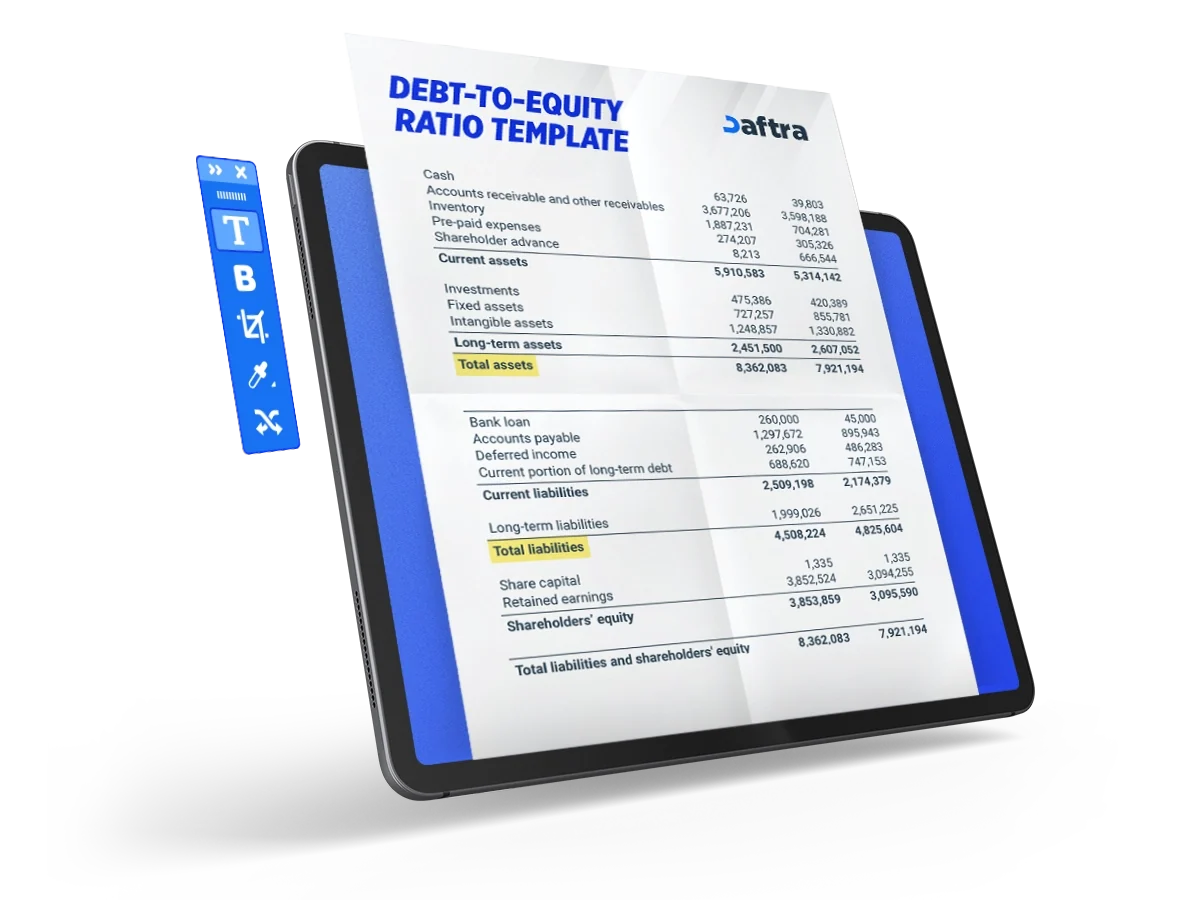
- A Debt-to-Equity Ratio Template measures the company’s total debt in comparison with its total equity.
- It is used to assess the company’s level of debt and its ability to repay its obligations and meet them on time.
- The template is also used to evaluate the company's financial position and capital structure, compare it with competitors in the same industry, and determine the extent to which the company relies on debt to finance its operations.


 Stop spreadsheet errors. Try Daftra

What Is a Debt-to-Equity Ratio Template?
A Debt-to-Equity Ratio Template measures a company's financial risk and its reliance on borrowing by comparing its total liabilities, both short-term and long-term, with its shareholders' equity, including capital, retained earnings, and reserves.
A high debt-to-equity ratio indicates that the company relies heavily on debt to finance its operations, which increases its financial risk and may make it harder to meet its obligations. A low ratio indicates that the company relies more on its own funds, which generally reflects greater financial stability, a stronger borrowing capacity, and lower risk for investors. However, what counts as an acceptable ratio varies by industry.
Why Is a Debt-to-Equity Ratio Template Important?
- It helps investors evaluate companies and make better investment decisions, as a high ratio indicates higher financial risk, while a low ratio indicates greater stability.
- Companies use it to assess their financial position and capital structure and to make informed decisions about reducing debt or seeking new financing.
- Banks and lenders review it when evaluating loan applications to assess the company's ability to take on additional debt, and some loan agreements require the company to keep its ratio below a specific limit.
What Are the Elements of a Debt-to-Equity Ratio Template?
A Debt-to-Equity Ratio Template consists of a calculation formula used to arrive at the ratio and assess the risks facing the company. The formula is as follows:
Debt-to-Equity Ratio = Total Liabilities ÷ Total Shareholders' Equity
Elements:
- Company name
- Reporting period
- Short-term liabilities
- Long-term liabilities
- Total liabilities
- Total shareholders' equity
- Debt-to-equity ratio (result)
- Notes or interpretation of the result
How Is a Debt-to-Equity Ratio Template Used?
Enter the company's short-term and long-term liabilities and its total shareholders' equity. The template then calculates the ratio automatically using the following formula:
Debt-to-Equity Ratio = Total Liabilities ÷ Total Shareholders' Equity
You can also download:
Who Benefits from a Debt-to-Equity Ratio Template?
The main beneficiaries of a Debt-to-Equity Ratio Template are:
- Analysts and investors: They use the template to evaluate a company's debt level and financial risk before investing in it, and to compare it with other companies in the same industry.
- Banks and lenders: They use the ratio to assess the company's existing debt and its ability to take on and repay a new loan before approving it.
- Company management: Management uses the ratio to monitor the company's reliance on debt, assess its capital structure, and make informed financing decisions, such as whether to borrow or raise capital.
- Accountants and financial managers: They use the template to prepare financial analysis reports for their clients, and accounting firms can manage this work more efficiently with Daftra's software for accounting firms.







 Invoicing
 POS
 Offers
 Installments
 Sales Commission
 KSA E-Invoice Software
 EGY E-Invoice Software
 JO E-Invoice Software
 E-Invoice Software
 Chart of Accounts
 Asset Management
 Cost Centers
 Expenses
 Cheque Cycle
 VAT & Tax Compliance
 Product Management
 Purchases
 Purchase Cycle
 Suppliers
 Requisitions
 Stocktaking
 Organizational Structure
 Personnel Management
 Attendance and Leave
 Contracts
 Payroll
 Requests
 Work Orders
 Booking Management
 Rental and Unit Management
 Time Tracking
 Work Flow
 Lease Contracts
 Manufacturing Management
 Client Follow-Up
 Loyalty Points
 Points and Credits
 Memberships
 Insurance Management
 Daftra ERP Full App
 Point of Sales App
 Point of Sales for Desktop – Support Offline Mode
 AI Expenses Scanner App
 Employee Attendance, Sign & ESS App
 E-invoice Reader App
 Inventory Stocktaking App