

Posted on 22 November 2026
Bill of Exchange Template
- One of the oldest forms of commercial paper commonly used in three-party transactions.
- The party who receives the money is the beneficiary. The drawer is the party who orders payment to be made by the drawee, which is the party responsible for making the payment.
- A bill of exchange is a credit instrument under law and commercial practice.


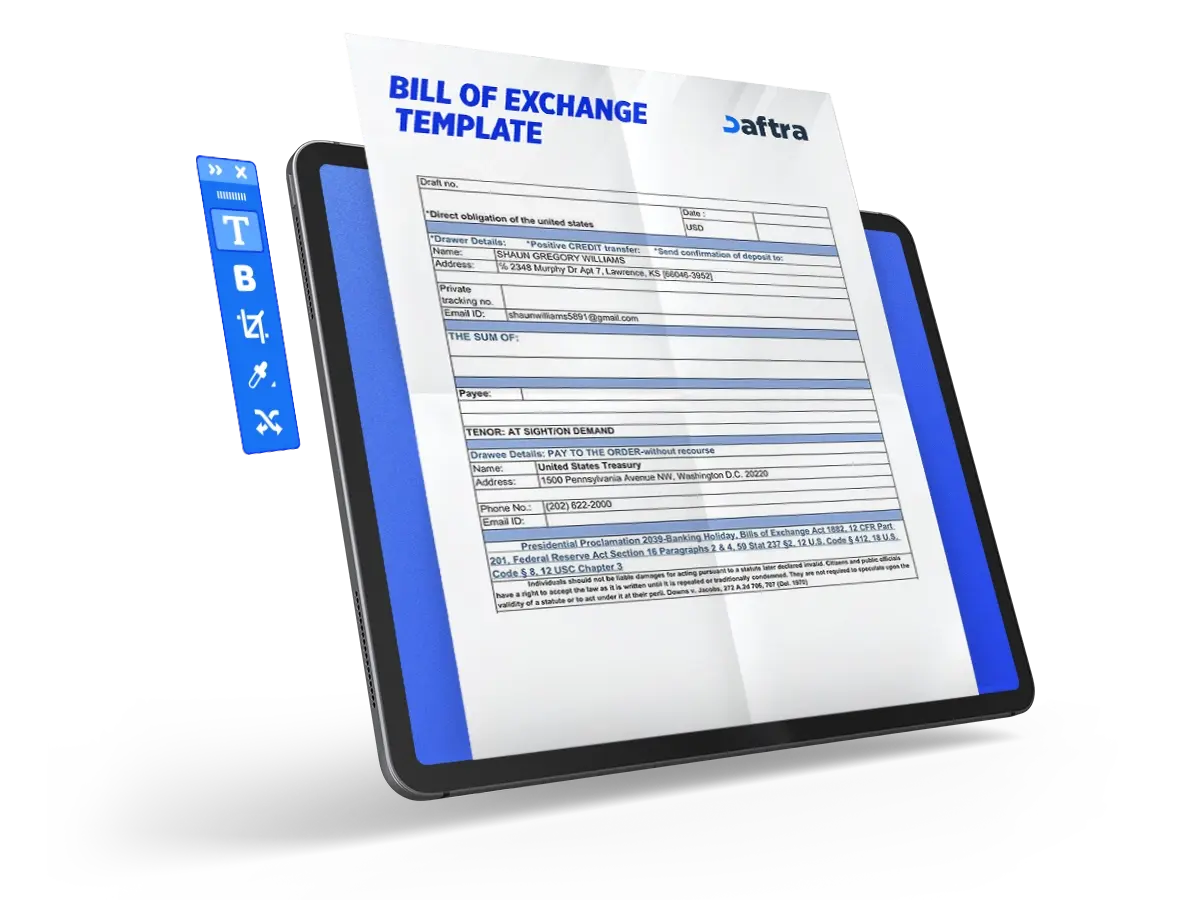
 Register in Daftra to auto-generate bills of exchange

What Is a Bill of Exchange?
A bill of exchange is a three-party commercial instrument in which one party, called the drawer, orders a second party, called the drawee, to pay a specified amount to a third party, the beneficiary. Any of the three parties may be an individual, organization, or legal entity.
Why Is a Bill of Exchange Important?
The importance of a bill of exchange comes from several advantages, including:
- A clear and legally recognized agreement.
- Protection for lenders.
- A role in the periodic recording of financial transactions.
What Are the Requirements of a Bill of Exchange?
All of the following requirements should be met for a bill of exchange to be valid for use:
- The commercial paper must clearly state that it is a Bill of Exchange.
- The payment order must be unconditional.
- The bill of exchange must include the names of the three parties, or their representatives: the drawer, drawee, and beneficiary.
- The date and place of issue of the bill of exchange must be stated.
- The payment due date must be stated.
- The bill of exchange must be payable for one amount only.
- The amount may be written in figures and words, or in figures only.
- A condition imposing interest for late payment may be added, provided it is stated when the bill of exchange is prepared; otherwise, it will not be recognized.
What Should a Bill of Exchange Template Include?
A Bill of Exchange Template includes the following elements:
- The name and address of the drawer and beneficiary.
- The due date.
- The borrowed amount.
- The payment date.
- The interest rate and the conditions governing its application.
What Are the Advantages and Disadvantages of a Bill of Exchange?
A bill of exchange has a number of advantages and disadvantages, as follows:
Advantages of a Bill of Exchange
- Clarity of the Commercial Instrument: A bill of exchange is an important commercial instrument for documenting the rights and roles of the named parties. It states the borrowed amount, the payment schedule (if paid in installments), and the interest amount (if any). This makes it a documented instrument that can help reduce future disputes and disagreements.
- Flexibility: One of the key advantages of a bill of exchange is flexibility. It applies the terms stated and recorded in the instrument according to the agreement between the drawer and the beneficiary.
- Legal Protection for Lenders: The bill of exchange documents the lender's right to receive payment from the borrower, regardless of how the borrower obtains sufficient liquidity, helping protect the lender's claim.
Disadvantages of a Bill of Exchange
- Misuse: Like other important commercial instruments, a bill of exchange may be misused, and some investors may become victims of fraud involving claims of financing fictitious projects.
- Failure of the Lender to Recover the Amount: Despite the lender's documented legal right, the borrower may still fail to pay when there are insufficient fixed or current assets to cover the debt.
What Is the Difference Between a Bill of Exchange and a Promissory Note?
Both documents are commercial papers that can serve as instruments of payment and credit. A bill of exchange involves three parties, while a promissory note involves two. A bill of exchange requires endorsement, whereas a promissory note does not require this procedure.
What Is the Difference Between a Bill of Exchange and a Check?
A bill of exchange and a check may involve the same types of parties: the drawer, drawee, and beneficiary. However, in the case of a check, the drawee must be a bank. A check has a due date only and does not have an issue date, unlike a bill of exchange.
How Do You Use a Bill of Exchange?
Before providing the requested amount as a lender, a bill of exchange is prepared in which the drawer identifies the drawee and names you as the beneficiary. Once the required information is completed, the due date is specified, and the necessary signatures are obtained, the borrower can receive the funds.







 Invoicing
 POS
 Offers
 Installments
 Sales Commission
 KSA E-Invoice Software
 EGY E-Invoice Software
 JO E-Invoice Software
 E-Invoice Software
 Chart of Accounts
 Asset Management
 Cost Centers
 Expenses
 Cheque Cycle
 VAT & Tax Compliance
 Product Management
 Purchases
 Purchase Cycle
 Suppliers
 Requisitions
 Stocktaking
 Organizational Structure
 Personnel Management
 Attendance and Leave
 Contracts
 Payroll
 Requests
 Work Orders
 Booking Management
 Rental and Unit Management
 Time Tracking
 Work Flow
 Lease Contracts
 Manufacturing Management
 Client Follow-Up
 Loyalty Points
 Points and Credits
 Memberships
 Insurance Management
 Daftra ERP Full App
 Point of Sales App
 Point of Sales for Desktop – Support Offline Mode
 AI Expenses Scanner App
 Employee Attendance, Sign & ESS App
 E-invoice Reader App
 Inventory Stocktaking App