



The increasing adoption of technology and digital transformation across various business sectors has led to the widespread use of many technical terms and abbreviations, most notably ERP, which stands for Enterprise Resource Planning.
But the more important question is: How can these systems improve your business efficiency and enhance resource management within your organization?
In the era of digital transformation, and with government authorities moving toward e-invoicing, choosing an ERP system has become increasingly necessary, at least for issuing invoices. If you want to compare different ERP systems and choose the one that best suits your business, the ideal approach is to list each system's advantages and disadvantages alongside your business needs, then match those needs with the ERP system that can fulfill them.
That is why this article provides a comprehensive overview and balanced analysis of the benefits of ERP systems, as well as the key challenges and disadvantages businesses may face when using them.
What Are the Advantages of an ERP System?
There are essential ERP features available in almost all systems. These are basic functions businesses cannot do without, such as issuing invoices and determining profitability.
Some features aren't available in every system, so verify their availability before purchasing an ERP solution. Other features may be specific to your own business processes and therefore require customization, provided that the ERP software you purchase supports such customization.
Here are the key advantages of an ERP system:
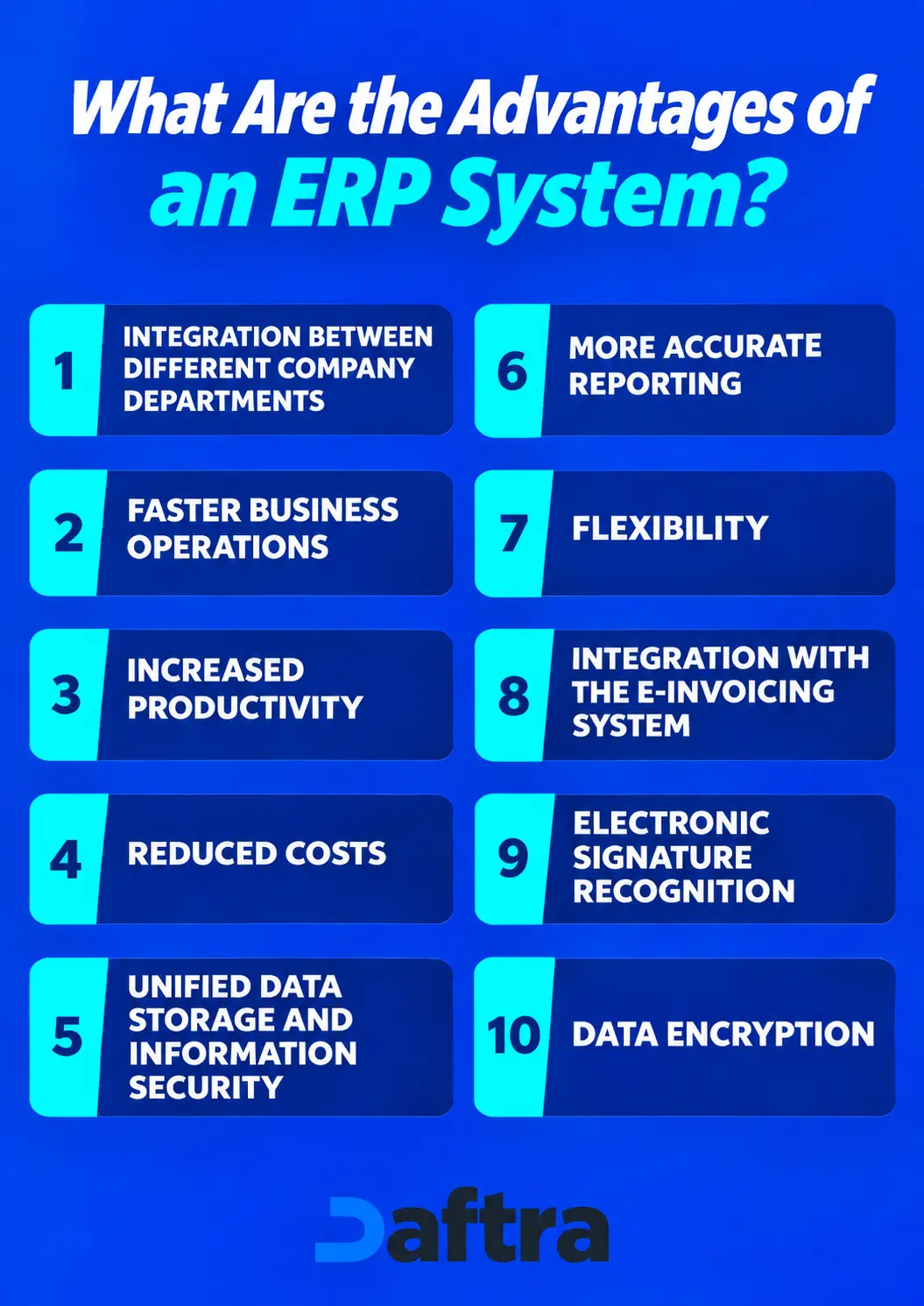
1- Integration Between Different Company Departments
Before ERP systems, companies typically relied on separate technological solutions. You would find countless files for storing customer data, supplier data, and partner information, countless accounting books and reports, dedicated CRM systems for customer management, and, of course, various tools for managing the company’s human resources.
In addition to the pressure caused by handling such a massive amount of data, the difficulty of exchanging it between departments, and the increased costs of providing separate systems and tools for each department, business processes were often less efficient and less streamlined.
User interfaces were not unified or as simple as they are in modern ERP software. With an ERP system, employees and managers can access a single system simultaneously and view the data they need without spending excessive time and effort exchanging information or communicating with other departments to obtain it.
This is where ERP systems provide integration and centralized data management, offering the following:
- Centralized and unified data, often connected to the cloud.
- Fewer errors caused by entering data manually or storing it in unstructured, disconnected files.
- Faster data updates that keep pace with changes, with updates delivered in real time to all relevant users.
- Verification of the accuracy and quality of available data, reducing uncertainty about its reliability.
- Faster decision-making because data is readily available, preventing project delays due to missing or late information.
- Improved communication between different departments and fewer problems caused by ineffective or insufficient communication.
- Managing the entire company through a single ERP system.
- Synchronization across all company operations without requiring data to be exchanged and shared sequentially.
2- Faster Business Operations
Your ability to deliver services quickly while maintaining quality may set you apart from competitors, but speed isn't limited to customer service.
ERP software covers the company’s entire production and operational workflow. This means faster manufacturing, supply chain and transportation operations, recruitment, and many other business activities. The benefits of an ERP system that contribute to faster business operations include:
- Automating routine and repetitive tasks.
- Automating certain processes when a preceding action triggers them.
- Faster uploading and processing of all types of data and faster execution of different transactions.
- Providing customers with real-time updates, information about your offers and products, your responses to current events, and important news, which increases credibility and strengthens customer engagement.
- Providing immediate reports on production stages and manufacturing processes, which improves the speed and accuracy of decisions related to monitoring production operations.
- Providing comprehensive financial information and quickly generating detailed and segmented reports that explain different aspects of your finances, making it easier to make timely financial decisions and reducing the risks associated with insufficient financial information and reporting.
- The simplicity of ERP software makes it easier to understand through technical support or online educational videos, allowing operations to run quickly and smoothly.
- It enables all departments to monitor business activities in real time, eliminating delays caused by data exchange or limited access to information.
3- Increased Productivity
Increased productivity is not solely related to increasing resources. Effective management of available resources can make a significant difference. Since an Enterprise Resource Planning (ERP) system primarily aims to improve management efficiency through greater integration and speed, its impact on productivity should not be overlooked.
The following are some of the reasons and factors behind increased productivity when using an Enterprise Resource Planning system:
- Communication between different departments: Improves employees’ efficiency in carrying out their assigned responsibilities and makes the final output of projects requiring multiple departments to work together more organized, with clearer processes throughout the project.
- Reliance on automation: Automation and reduced human intervention in many processes play a major role in increasing productivity through ERP systems.
- Integration and reduced time wastage: Eliminating unnecessary time spent on interdepartmental processes is a key factor in increased productivity.
- Improved supply chain management: Enhancing the flow of supply chain operations and controlling how products are transported and stored.
- Faster escalation of errors: Quickly notifying the employees responsible for resolving errors helps reduce losses resulting from the time an error remains unresolved.
- Unlimited capacity: No limit on the total number of users, no matter how much your workforce grows, and no restrictions on the tasks assigned to them.
- Monitoring: Monitoring inventory levels and replenishing products continuously before they run out.
4- Reduced Costs
Many businesses still measure organizational success based on their financial position. Reducing costs while maximizing profits is often considered the primary goal. Although this view is incomplete, the fact that some businesses use cost reduction as a key measure of success highlights the importance of effectively managing a company's financial aspects.
When discussing the advantages of an Enterprise Resource Planning (ERP) system, it is important to highlight how ERP software can help reduce costs through the following:
- Streamlining unnecessary steps and processes that only complicate workflows, thereby reducing spending on redundant tasks.
- Eliminating the need to purchase multiple systems and relying instead on a single integrated system.
- Managing tax-related matters more efficiently to reduce unnecessary expenses caused by errors.
- Managing financial and accounting operations and restructuring expenses and revenues with more informed insight.
- Calculating the return on investment based on the cost of purchasing an ERP system and therefore ensuring that the investment contributes to the company’s profitability.
5- Unified Data Storage and Information Security
Cloud solutions have made it easier for businesses to store and share data and communicate. These solutions vary in terms of what they offer, their efficiency, and how they operate. ERP software has provided a comprehensive, unified cloud-based solution.
This applies particularly to cloud-connected ERP systems. You can find more details on this point in the explanation of the different types of ERP systems:
- Unified data storage is based on a shared database that serves as the foundation for data storage and is known as Master Data.
- Defining each employee’s permissions and limiting access to the information relevant to their role.
- Centralizing data in one location while providing advanced security technologies.
- Ensuring the reliability and legitimacy of data stored and exchanged through the system, with the ability to treat it as official documentation.
- Easily signing invoices, checks, and other documents electronically.
6- More Accurate Reporting
Reports are a practical way for a company to communicate its achievements. Many financial statements are also considered public documents that people both inside and outside the company have the right to review. An Enterprise Resource Planning (ERP) system helps you generate reports in the easiest and most effective way possible.
Enterprise Resource Planning systems help generate accurate reports by:
- Automatically detecting and addressing errors, improving the quality and reliability of generated reports.
- Predicting future information before it becomes available and presenting it in reports that support decision-making.
- Generating reports instantly as transactions occur.
- Using highly advanced technological methods for collecting and analyzing information.
7- Flexibility
Every company has a different organizational structure and workflow, so its needs vary. So, can ERP software meet the needs of all these different companies?
The answer is: Yes.
The more sophisticated an Enterprise Resource Planning (ERP) system is, the more flexible it tends to be. You can configure it to serve the specific purpose you need. The following points highlight the central role of flexibility in ERP systems:
- Regardless of your company’s needs, an ERP system can be reconfigured to meet them.
- Data can be made available at any time, supporting numerous processes across the company regardless of operating system differences.
- Flexible monitoring of different company branches from anywhere and at the same time.
- Greater alignment with Agile principles for project management.
8- Integration with the E-Invoicing System
One key advantage of Enterprise Resource Planning (ERP) systems is their integration with the approved e-invoicing system, which relies on digital documents to record transactions related to the sale of goods and services and to issue and send invoices digitally. This eliminates the traditional reliance on paper invoices and documents, which can lead to more errors and data loss.
This highlights the importance of integrating ERP software with the e-invoicing system and the tax authority. Through the user interface, business owners can monitor and review all invoices in real time while reducing the administrative burden and effort required to enter data and submit it to the tax authority.
9- Electronic Signature Recognition
The e-invoicing system relies on a pre-approved electronic signature before an issued invoice is approved. ERP systems can read this signature and recognize the invoice identification code, helping ensure invoice accuracy and validity.
10- Data Encryption
Most Enterprise Resource Planning systems encrypt data during transmission, providing strong security and protection for customer data. This helps build the organization’s trust, credibility, and reputation.
What Are the Disadvantages of an ERP System?
ERP systems have several disadvantages, and some of them may be difficult for your business to handle. So, if you are considering implementing an ERP system, study its disadvantages carefully and assess your ability to handle the potential consequences. The most important disadvantages include:
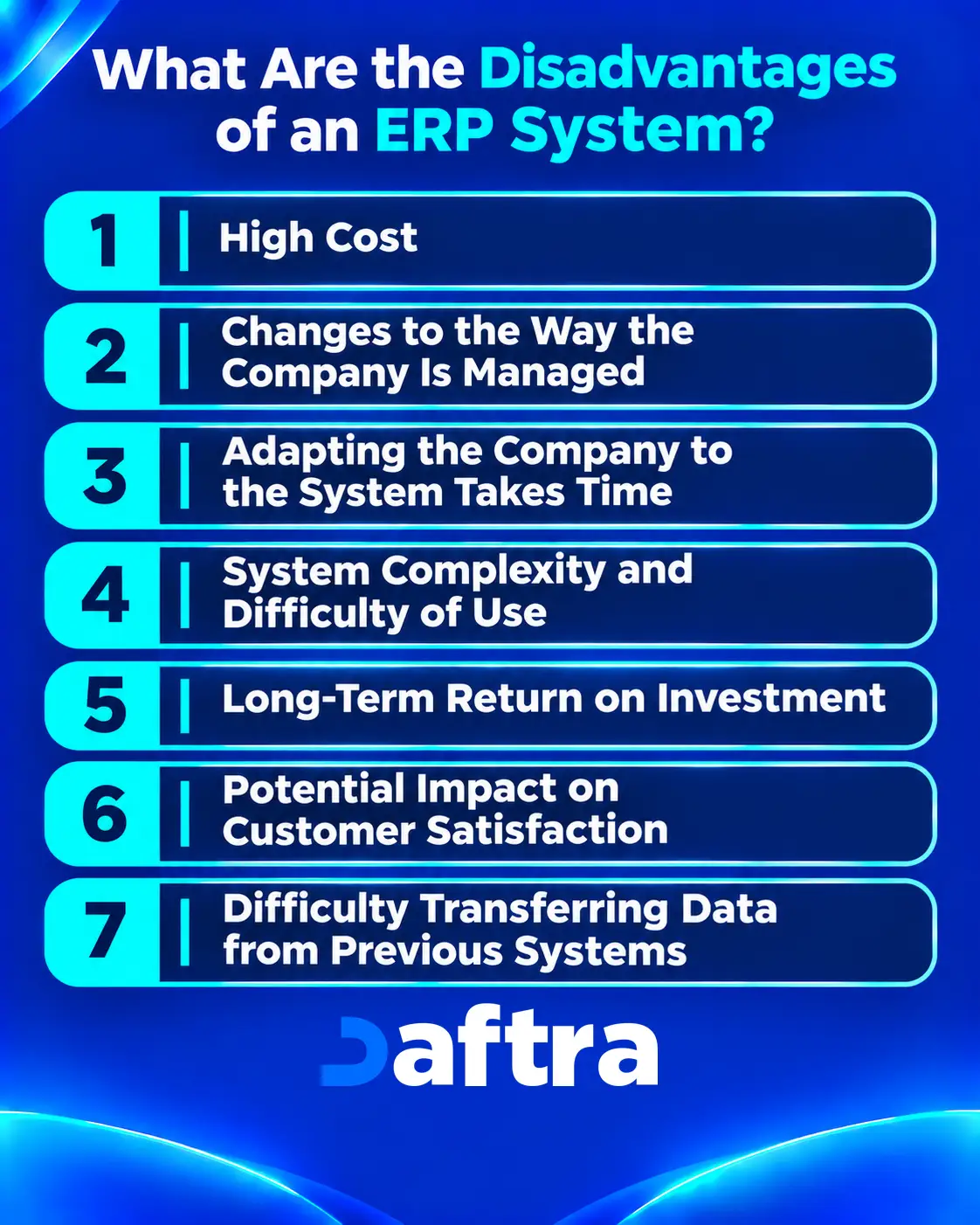
1- High Cost
ERP systems can be expensive, whether in the cost of purchasing the system and monthly subscriptions or in configuration and implementation. ERP implementation failure rates can reach 70%, so it's critical to choose the right pricing and ensure successful implementation.
2- Changes to the Way the Company Is Managed
Implementing an ERP system requires adjusting your organization’s workflows to align with the system. This can lead to significant changes across the company, including restructuring management methods and how departments communicate.
3- Adapting the Company to the System Takes Time
System implementation can be slow and may take years in companies with complex structures and requirements. In addition, ERP specialists responsible for implementation can be expensive, making the alignment period relatively long.
4- System Complexity and Difficulty of Use
Despite the training employees receive before implementing ERP software, the company will still need highly qualified technology professionals who can meet the ERP system's requirements, understand its advanced functions, and use it effectively.
5- Long-Term Return on Investment
The results of implementing an ERP system do not appear immediately. The system requires time to configure, implement, and replace existing systems. As a result, the financial return on the investment may not become apparent for some time.
6- Potential Impact on Customer Satisfaction
When employees interact with customers through the same system, operational complexity increases, and system accuracy becomes even more important. An ERP system is no longer merely an internal system, and when it has an issue, the problem may also affect customers.
7- Difficulty Transferring Data from Previous Systems
Transferring a large volume of historical data into the new system before or during implementation can create time-consuming, effort-intensive challenges. Data may need to be reorganized and reformatted to fit the current ERP software, highlighting the importance of maintaining a stable system for an extended period.
What Are the Advantages of Daftra ERP?
- Daftra’s dashboard offers a comprehensive suite of applications for integrated business management, including sales, general accounting, inventory management, employee management, operations management, and customer relationship management.
- Daftra ERP for enterprise resource planning covers more than 50 different business sectors, including retail, crafts and professional services, business services, healthcare, logistics, transportation and hospitality, sports activities, education, real estate, and automotive businesses. This makes it highly unlikely that the system will not suit your business activity.
- Daftra ERP provides free 24/7 technical support, offering fast, effective solutions to answer customer inquiries and resolve unexpected issues.
- The software’s cost suits the financial capabilities of small and medium-sized businesses, given the wide range of services it provides to simplify routine accounting tasks and complex financial operations.
- Daftra accounting software offers extensive customization capabilities to meet business requirements. It also supports both English and Arabic and features a smooth, user-friendly interface that both beginners and experienced business managers can use easily.
Frequently Asked Questions
What does ERP mean, and why do we need it?
ERP stands for Enterprise Resource Planning. It is a system that manages all company departments by integrating and connecting different software solutions, improving operational efficiency and simplifying data analysis and reporting.
Businesses need Enterprise Resource Planning systems to improve financial operations, reduce the time, effort, and errors involved in daily tasks, and increase productivity by connecting data and simplifying processes for employees. This ultimately supports better decision-making based on accurate results.
Which companies use ERP systems in Saudi Arabia?
Companies that use ERP systems in Saudi Arabia include large, medium-sized, and, in some cases, small businesses. Well-known companies in Saudi Arabia that use ERP systems include Saudi Aramco, SABIC, and Saudi Electricity Company.
What are the most important features of an Enterprise Resource Planning (ERP) system?
Key features of an Enterprise Resource Planning system include integration across systems, continuous database updates, automation of routine accounting processes, and customization to the company’s business activities.
What are the steps for implementing an ERP system?
Implementing an ERP system involves five main steps. First, identify your company’s objectives and needs. Then, compare systems that support your business language and comply with your country's regulations. Next, select and subscribe to the system. Then, customize the software to meet your needs. Finally, provide ongoing support and monitoring.
What makes ERP implementation decisions more accurate?
Comprehensive analysis of data across the company’s departments and operations helps make ERP implementation decisions more accurate.
What is an ERP system for manufacturing companies?
Manufacturing companies use ERP systems to manage their manufacturing operations, improve production efficiency and effectiveness, and monitor workflow step by step.
Can I generate multiple reports from an ERP accounting system?
Yes. You can generate multiple reports from an ERP accounting system, including financial reports, inventory reports, sales reports, balance sheets, income statements, trial balances, and others.
Is Daftra approved in Saudi Arabia?
Yes, Daftra is approved in Saudi Arabia and is one of the most widely used systems in the Kingdom because the Zakat, Tax and Customs Authority approves it.
Is Daftra free?
Yes, Daftra offers a 14-day free trial.
Is Daftra an ERP system?
Yes, Daftra is an Enterprise Resource Planning (ERP) system.
What is one of the key strengths of ERP software?
One of ERP software's greatest strengths is integrating and connecting financial processes, saving time and effort and helping avoid common errors.
Does an ERP system contribute to improving product quality?
Yes. An ERP system can improve product quality by enhancing production processes, continuously monitoring workflows, and controlling quality, which helps reduce defects and prevent recurring errors.
What are the objectives of an ERP system?
The objectives of an Enterprise Resource Planning system include improving operational efficiency, enhancing communication and collaboration among employees within the company, improving inventory management, and supporting decision-making regarding the company’s future, among other objectives.
What are the best ERP software programs in the Arab world?
Daftra ERP is considered one of the leading ERP solutions in the Arab world, alongside SAP ERP and Microsoft Dynamics 365.
Can an ERP system be cloud-based and open source?
Yes. An ERP system can be cloud-based and open source.
What are the reasons for ERP system failure?
Common reasons for ERP system failure include poor planning, inadequate training, employees’ inability to adapt to change, and setting unclear objectives.
Can I use an ERP accounting system from anywhere in the world at any time?
Yes. You can use an ERP accounting system anywhere in the world at any time, as long as you have an internet connection.
What is the role of an ERP system in supply chain management?
An ERP system in supply chain management provides a comprehensive view of financial operations, connects different systems, simplifies financial processes, and helps reduce costs.
What are the best ways to learn ERP accounting software?
The best way to learn ERP accounting software is to start with accounting concepts and terminology, then use educational videos on YouTube, and put what you learn into practice.
What is an ERP system for warehouses?
A warehouse ERP system is a component of an Enterprise Resource Planning system. It helps monitor and manage inventory effectively to reduce costs, improve operational accuracy, and provide a comprehensive view of inventory movements.
How can I improve sales operations using an ERP system?
You can improve sales operations using an ERP system by regularly tracking sales activity, improving inventory management, reducing costs, and analyzing customer data and market trends.
Conclusion
In conclusion, when Enterprise Resource Planning (ERP) systems are implemented and used correctly, they can transform how you manage your business, improve operational efficiency, increase profits and returns, and support sustainable success in a competitive market.
After examining the extensive advantages of Enterprise Resource Planning systems, one of their most notable benefits is their ability to provide integrated reports covering various operational and administrative activities, which contributes to more accurate and efficient decision-making.
However, you should also pay close attention to the challenges of ERP systems and understand the disadvantages you may encounter, most notably the high purchase cost and the need to ensure seamless integration with other systems.
Ultimately, if you choose the right ERP system for your goals, needs, and financial capabilities, you can expect positive results that support your organization's success and growth.












 Invoicing
 POS
 Offers
 Installments
 Sales Commission
 KSA E-Invoice Software
 EGY E-Invoice Software
 JO E-Invoice Software
 E-Invoice Software
 Chart of Accounts
 Asset Management
 Cost Centers
 Expenses
 Cheque Cycle
 VAT & Tax Compliance
 Product Management
 Purchases
 Purchase Cycle
 Suppliers
 Requisitions
 Stocktaking
 Organizational Structure
 Personnel Management
 Attendance and Leave
 Contracts
 Payroll
 Requests
 Work Orders
 Booking Management
 Rental and Unit Management
 Time Tracking
 Work Flow
 Lease Contracts
 Manufacturing Management
 Client Follow-Up
 Loyalty Points
 Points and Credits
 Memberships
 Insurance Management
 Daftra ERP Full App
 Point of Sales App
 Point of Sales for Desktop – Support Offline Mode
 AI Expenses Scanner App
 Employee Attendance, Sign & ESS App
 E-invoice Reader App
 Inventory Stocktaking App