


Posted on 30 September 2026
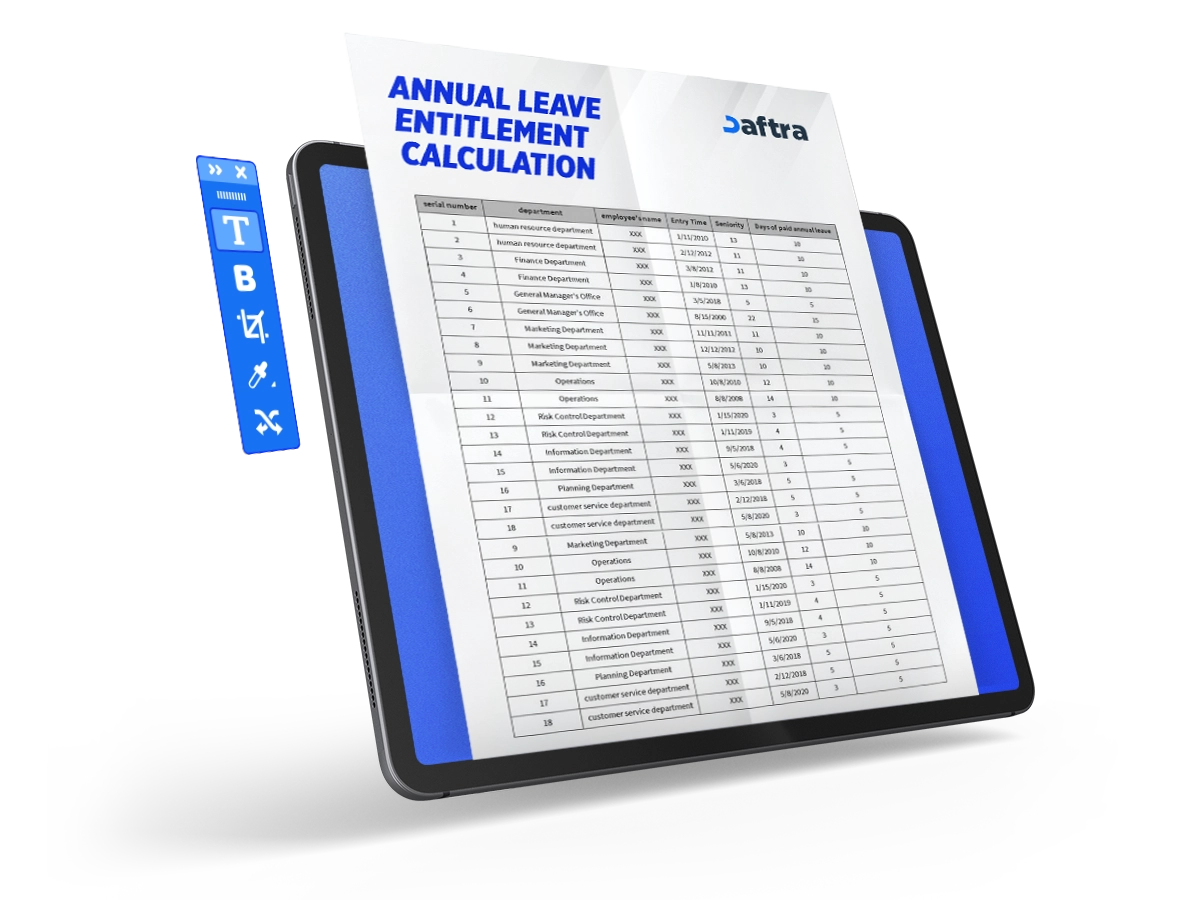
Annual Leave Entitlement Calculation Template
- This template helps your company identify the amounts that should be paid to employees at the end of the accounting period or fiscal year in respect of annual leave they have not used.
- It also helps you determine the remaining leave entitlements on an ongoing basis with each leave request submitted by the employee.
- The template is aligned with the labor laws applied in Egypt, the Kingdom of Saudi Arabia, and the United Arab Emirates.


 Try Daftra’s Employee Management System.
What Is an Annual Leave Entitlement Calculation Template?
An Annual Leave Entitlement Calculation Template is a comprehensive tool that helps you determine the employee’s remaining leave entitlements in accordance with the applicable local labor law and based on the leave balance already used by the employee. The template is designed in line with the labor laws of three Arab countries: Egypt, Saudi Arabia, and the United Arab Emirates.
Under Egyptian labor law, an employee in the private sector is entitled to 21 days of annual leave, or a proportional amount thereof, in the first year of service after three months from joining the company. In the public sector, however, the employee becomes entitled to annual leave only after six months, so the number of months should be considered and adjusted in the template depending on the case.
According to Egyptian law, if an employee remains with the same company for ten years or more, they become entitled to 30 days of annual leave. Likewise, once the employee reaches the age of fifty, they become entitled to 30 days of annual leave.
Under Saudi labor law, an employee may become entitled to 21 days of annual leave after three months from joining the company. This increases to 30 days once the employee has completed five years or more in service.
As for the UAE, the employee is not entitled to annual leave until completing six months from the start of employment. After that, the employee may accrue two leave days for each month. Once a full year has passed, the employee becomes entitled to 30 days of annual leave.
Use the Salary Calculator to calculate salary value with or without allowances and social insurance percentages automatically for free.
Why Is an Annual Leave Entitlement Calculation Template Important?
- Determining employee leave-related expenses: The template helps identify the amounts payable for leave not used by employees.
- Tracking employee leave: Through the Annual Leave Entitlement Calculation Template, you can identify the leave already used by the employee and the remaining balance.
- Determining the status of each leave request: With every leave request submitted by the employee, the template automatically shows whether the request is accepted or rejected.
- Flexibility of the template: One of the template’s main advantages is that it adapts to different labor systems by country, including Egypt, Saudi Arabia, and the UAE.
What Are the Elements of an Annual Leave Entitlement Calculation Template?
- Employee Code: The template includes a code or number assigned to the employee, which can be referred to at any time and is linked to the payroll record on the basis of which the salary is paid.
- Employee Name: The employee’s full name should be recorded in three or four parts to avoid confusion or duplicate names. A filter may also be used to gather all leave taken and remaining for the employee.
- Job Title: It is preferable to add the job title to the template so that you can refer to the salary category to which the employee belongs and determine the value of a leave day accordingly.
- Employee Start Date: This is an important element used to determine whether the employee is entitled to leave or is still in the probation period. The employee’s length of service in the company also determines the leave period available to them.
- Number of Remaining Days: This is calculated based on the leave days used by the employee during the working year. It is the basis used to calculate the entitlement.
- Annual Leave Entitlements: This is the field that includes the total amount that should be paid to the employee at the end of the accounting period, and it is calculated by multiplying the employee’s daily salary by the number of remaining leave days.
You can also download:
How to Use an Annual Leave Entitlement Calculation Template
- Identify the labor law that should be followed in your country: The template includes several versions for calculating annual leave entitlements, as it has been designed to work with Egyptian, Saudi, and UAE labor law. Choose the sheet that matches your company’s needs.
- Record the employee’s salary: The employee’s salary should be included in the template so that the entitlement can be calculated according to the salary value and the remaining leave balance.
- Determine the number of leave days available as regular annual leave: Before determining the employee’s remaining leave days, you should identify the category the employee falls under. Has the employee worked for three months in the company? Has their service exceeded five years? Has it exceeded ten years? Based on that, the template will determine whether the employee is entitled to 21 days, 30 days, or another annual allowance.
- Determine the days the employee has already used from their balance: After identifying the total number of leave days, the next step is to determine the total days the employee has already used from their leave balance, in order to calculate the remaining days and convert them into entitlements at the end of the accounting period.
- Calculate the annual leave entitlement: To make proper use of the template and achieve its purpose, you should identify the employee’s remaining days at the end of the period after collecting all leave requests and determining which ones were approved. Once the remaining days are identified, multiply the number of days by the value of one working day, and you will reach the annual leave entitlement.
Who Benefits from an Annual Leave Entitlement Calculation Template?
- Human Resources Department: Through the template, HR can identify the extent of the employee’s commitment to work and attendance. The experience of HR specialists also allows them to observe indicators that show whether the employee uses leave for legitimate benefit or uses it to avoid work.
- Finance Department: In this case, the template is similar to a payroll statement, except that it is dedicated to leave payouts. For this reason, it is important to the finance department, as it helps determine the amounts that should be paid to employees who have not used all of their regular and casual leave balances.
- The Employee: The template helps safeguard the employee’s right to receive their annual leave entitlements.









 Invoicing
 POS
POS Offers
 Installments
 Sales Commission
 KSA E-Invoice Software
 EGY E-Invoice Software
 JO E-Invoice Software
 E-Invoice Software
 Chart of Accounts
 Asset Management
 Cost Centers
 Expenses
 Cheque Cycle
 UAE VAT-Tax
 Product Management
 Purchases
 Purchase Cycle
 Suppliers
 Requisitions
 Stocktaking
 Organizational Structure
 Personnel Management
 Attendance and Leave
 Contracts
 Payroll
 Requests
 Work Orders
 Booking Management
 Rental and Unit Management
 Time Tracking
 Work Flow
 Lease Contracts
 Manufacturing Management
  Client Follow-Up
 Loyalty Points
 Points and Credits
 Memberships
 Insurance Management
 Daftra ERP Full App
 Point of Sales App
 Point of Sales for Desktop – Support Offline Mode
 AI Expenses Scanner App
 Employee Attendance, Sign & ESS App
 E-invoice Reader App
 Inventory Stocktaking App