


Posted on 30 September 2026
End-of-Service Benefits Template
- An End-of-Service Benefits Calculation Template is a document used to calculate and record the financial benefits due to an employee at the end of employment, in accordance with Saudi Labor Law.
- The template helps ensure accurate calculations and protects both parties' rights when the employment relationship ends.
- The main beneficiaries of an End-of-Service Benefits Template are employees, as it helps them understand their financial entitlements accurately and protects their rights when the employment relationship ends.


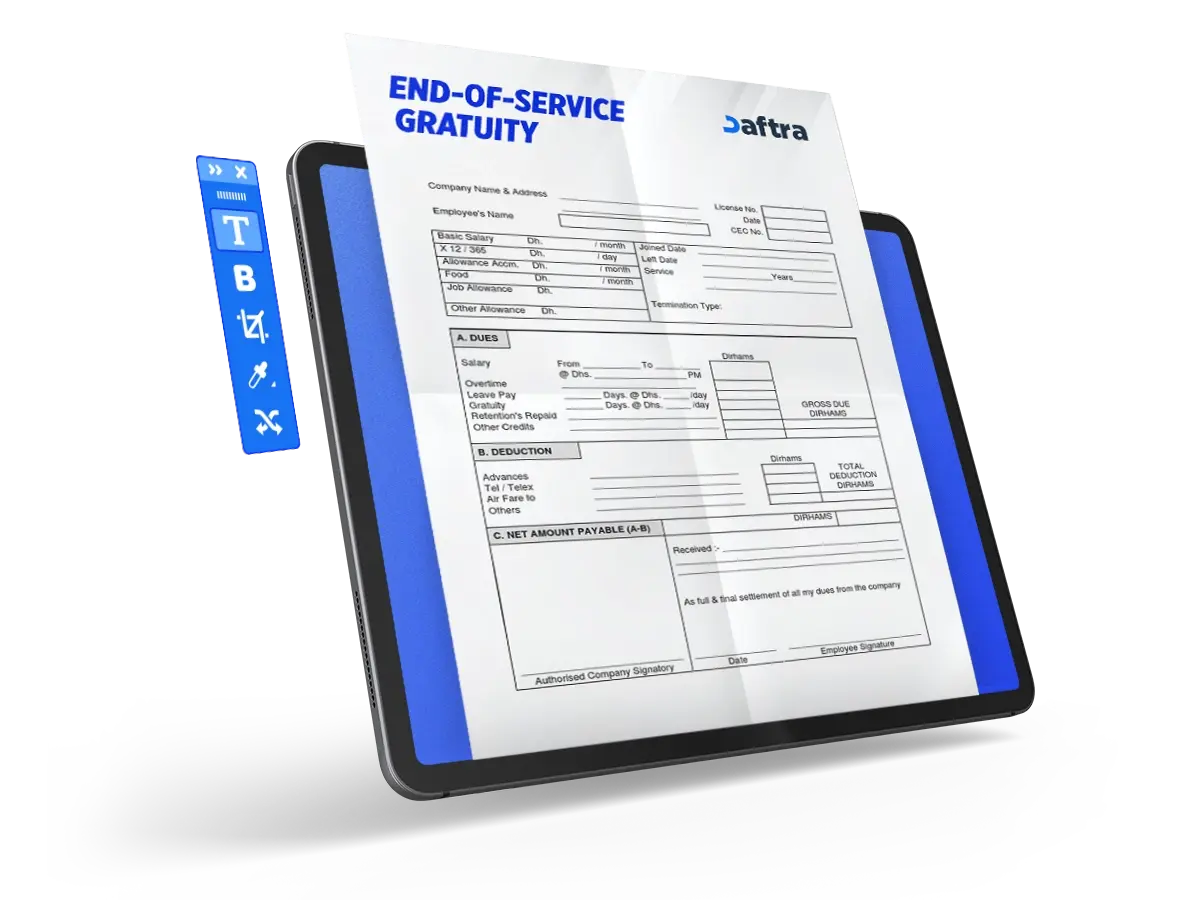
 Register with Daftra and calculate employee gratuity automatically
What Is an End-of-Service Benefits Template?
An End-of-Service Benefits Calculation Template is an official document used to calculate and record the financial benefits due to an employee at the end of employment, in accordance with Saudi Labor Law. It protects the employee's rights and provides financial support while clearly and accurately showing the calculation details.
Why Is an End-of-Service Benefits Template Important?
The importance of an End-of-Service Benefits Calculation Template appears in several key areas, including:
- Ensuring accuracy and legal compliance: The template helps calculate end-of-service benefits accurately according to the provisions of the Saudi Labor Law, while taking into account the service period, salary, and accrued leave. This reduces errors and legal compliance issues.
- Helping employers meet payment deadlines: The template provides an organized framework that enables employers to pay end-of-service entitlements on time and helps avoid penalties or legal disputes resulting from delay or miscalculation.
- Enhancing transparency and protecting rights: A clear and documented template helps create transparency between the employer and the employee. It protects the rights of both parties by officially showing the entitlement details and calculation method.
- Organizing records and making them easier to reference: The template is an effective tool for keeping records related to end-of-service entitlements, making them easier to refer to when needed for administrative or legal purposes.
- Enabling employees to understand their entitlements: The template helps employees understand the value of the end-of-service benefits due to them and how they are calculated, which increases awareness of their rights and reduces the likelihood of disputes.
- Speeding up employment termination procedures: The End-of-Service Benefits Calculation Template helps simplify and speed up the process of ending the employment contract, ensuring a smooth and organized transition for both parties when the employment relationship ends.
Accordingly, the End-of-Service Benefits Calculation Template is an essential tool for organizing the payment process and ensuring fairness and clarity at the end of service.
What Are the Elements of an End-of-Service Benefits Template?
An End-of-Service Benefits Calculation Template includes the following main components:
- Employee information: This section includes the employee's basic information, such as full name, national ID or Iqama number, job title, hiring date, end-of-service date, and contract type, whether fixed-term or indefinite. This data is recorded to accurately determine the employee's rights and clarify the employment relationship for which the benefit will be calculated.
- Employer information: This section includes information about the company or organization where the employee worked, such as the company name, commercial registration number, and the department or division to which the employee belonged. This data helps document the employer and verify the financial transaction.
- Calculation details: This section includes the employee's latest basic salary, total service period in years and months, and the method used to calculate end-of-service benefits under the Saudi Labor Law: half a month's salary for each of the first five years and a full month's salary for each following year. The amount due for each service period is also recorded, and the total benefit is calculated clearly to facilitate the payment process.
- Acknowledgment and signature: This section includes the employee's acknowledgment that all end-of-service benefits have been received in full without any future claims, along with the employee's signature and receipt date, in addition to the employer's or authorized representative's signature and the company stamp to make the document official and complete the legal procedures.
Templates You May Also Need:
How to Create an End-of-Service Benefits Template
To calculate end-of-service benefits in Saudi Arabia, the template is prepared based on two main elements: the half-month salary rule and the employee's service period. These elements determine the amount due when the employee's contract ends. The template also accounts for resignations and special exceptions to ensure accurate calculations in accordance with Saudi Labor Law. The following are the steps for creating an End-of-Service Benefits Calculation Template:
1- Collect Employee Information
Record the employee's basic information, such as full name, national ID or Iqama number, job title, hiring date, end-of-service date, and contract type, whether fixed-term or indefinite.
2- Record Employer Information
This section includes the name of the company or organization, the commercial registration number, and the department or division to which the employee belonged. This ensures that the transaction is documented and linked to the correct entity.
3- Define the Calculation Details
- Half-month salary rule: The amount due is determined based on the employee's latest salary. An employee with an indefinite-term contract receives half a month's salary for each of the first five years and a full month's salary for each following year. For employees with fixed-term contracts, the benefit is calculated according to the contract period.
- Service period: The template records the employee's total service period with the same employer, including full years and additional months after the first year. The longer the service period, the higher the amount of the benefit due, reflecting the employee's contribution and continuity at work.
- Resignation cases: The template should account for the following resignation cases:
- The employee receives one-third of the benefit if the service period is two consecutive years and does not exceed five years.
- The employee receives two-thirds of the benefit if the service period is more than five consecutive years.
- The employee receives the full benefit if the service period is 10 years or more.
- Exceptional cases that entitle the employee to the full benefit upon resignation: These include the following cases:
- An employee who left work due to force majeure beyond their control.
- A female employee who ended her contract within 6 months of marriage or within 3 months from the date of childbirth.
After defining the rule and service period, calculate the amount due for each period or case, then add them to arrive at the total end-of-service benefits amount.
4- Add the Acknowledgment and Signature
The template should include an acknowledgment confirming that the employee has received all entitlements in full, with no future claims, along with the employee's signature, the employer's or authorized representative's signature, the date, and the company stamp to ensure the document's validity and the process's transparency.
How Is an End-of-Service Benefits Template Used?
An End-of-Service Benefits Template is used to document all details related to paying the employee's financial entitlements at the end of service. It shows the employee and employer information, as well as the method used to calculate the benefit based on salary and service period.
The template also accounts for resignation cases and special exceptions. It helps ensure accuracy and legal compliance, simplify entitlement calculations, preserve records, and document acknowledgment from both the employee and employer when the benefit is paid.
Who Benefits from an End-of-Service Benefits Template?
The main beneficiaries of the template are:
- Employees: The template helps employees clearly and fairly understand their financial entitlements, know how the benefit is calculated, and protect their rights when service ends.
- Employers: The template helps employers pay entitlements accurately, comply with laws and regulations, avoid errors and penalties, and maintain official records.
- Management and legal teams: The template can be used as an official reference in the event of any dispute or when reviewing financial obligations in a documented manner.










 Invoicing
 POS
POS Offers
 Installments
 Sales Commission
 KSA E-Invoice Software
 EGY E-Invoice Software
 JO E-Invoice Software
 E-Invoice Software
 Chart of Accounts
 Asset Management
 Cost Centers
 Expenses
 Cheque Cycle
 UAE VAT-Tax
 Product Management
 Purchases
 Purchase Cycle
 Suppliers
 Requisitions
 Stocktaking
 Organizational Structure
 Personnel Management
 Attendance and Leave
 Contracts
 Payroll
 Requests
 Work Orders
 Booking Management
 Rental and Unit Management
 Time Tracking
 Work Flow
 Lease Contracts
 Manufacturing Management
  Client Follow-Up
 Loyalty Points
 Points and Credits
 Memberships
 Insurance Management
 Daftra ERP Full App
 Point of Sales App
 Point of Sales for Desktop – Support Offline Mode
 AI Expenses Scanner App
 Employee Attendance, Sign & ESS App
 E-invoice Reader App
 Inventory Stocktaking App