



Table of contents:
- Key Summary
- Is E-Invoicing Mandatory in Egypt?
- Who Is Required to Use E-Invoicing?
- What Is the Unique Invoice Identification Number (UUID)?
- Is There a Standard E-Invoice Format That Businesses Must Follow?
- What Are the Steps Required to Integrate with the E-Invoicing System?
- What Languages Are Supported for Issuing E-Invoices and Other Documents?
- Is an Invoice Sent to the E-Invoicing System Immediately After It Is Created, or Is It Submitted Separately?
- How Are Errors in Previously Issued Invoices Handled?
- Can a Single Credit Note Be Issued for Multiple Invoices?
- Can More Than One Credit Note Be Issued for the Same Invoice?
- How Are Transactions with Customers Who Are Not Tax Registered Handled?
- Will Tax Returns Be Pre-Populated Electronically with Invoices Recorded Through the E-Invoicing System?
- What Is the GS1 Global Coding Standard?
- What Is the GPC Standard?
- Do Businesses Need to Notify the Egyptian Tax Authority When Adding Codes for New Products?
- What Does an E-Invoice Look Like?
- Is There a Unified Coding System Within the E-Invoicing System?
- What Happens If a Business Uses a Coding System Other Than GS1? Does It Need to Change Its Internal Product Codes?
- When the Seller and Buyer Use Different Product Codes, Which Code Should Be Used?
- Can New Products or Services Be Added to the E-Invoicing System?
- Who Is Responsible for Mapping Product Codes the Business or the Tax Authority?
- How Should Product Codes Be Handled When Selling a Fixed Asset or Raw Material?
- How Has E-Invoicing Been Adopted in Egypt?
- How Can an Electronic Signature Certificate Be Obtained for E-Invoices?
- What Are the Procedures for Obtaining an Electronic Signature Certificate in Egypt?
- Where Are Electronic Signature Certificates Issued?
- Can a Registered Business Authorize More Than One Person to Use Its Electronic Signature?
- What Electronic Documents Can Be Exchanged with Other Businesses and Parties?
- How Are Errors in Previously Issued Invoices Handled?
- Can a Credit or Debit Note Be Issued for Multiple Invoices?
- Is There a Limit on a Credit Note Linked to a Previously Issued Invoice?
- Can More Than One Credit or Debit Note Be Issued for the Same Previously Issued Invoice?
- Can an E-Invoice Be Edited After It Has Been Issued?
- How Are Transactions with Customers Who Are Not Tax Registered Handled?
- Can the Buyer Reject an E-Invoice, and What Is the Time Limit for Rejection?
- Can an E-Invoice Be Canceled, and What Is the Cancellation Time Limit?
- How Can the Seller Cancel an E-Invoice?
- What Should the Recipient (Buyer) Do When the Seller Requests Cancellation of an Invoice or Note?
- What Are the Implications of Canceling an Egyptian E-Invoice for the Seller and Buyer?
- Does E-Invoicing Affect the Company's Accounting System in Terms of Performance or Business Continuity?
- How Can a Business Verify That the Invoices Submitted to the System Belong to Its Company?
- Are Imports Covered by Egypt's E-Invoicing System at This Stage?
- What Is an SDK?
- What Is an API?
- How Can I Confirm That an Issued Invoice Has Been Successfully Submitted to the E-Invoicing System?
- Will Tax Returns Be Automatically Populated with Invoices Recorded Through the E-Invoicing System?
- What Happens If the Seller Cannot Provide Complete Information for an Unregistered Buyer, Such as a Small Trader?
- Can Invoices Be Submitted in Batches?
- If Invoices Are Submitted in Batches, Will Each Invoice Be Validated Separately?
- What Happens to Invoices If the Company's Internal System Experiences a Technical Failure?
- How Can I Integrate My Business with Egypt's E-Invoicing System?
- Are Additional Hardware or Software Licenses Required to Integrate with the E-Invoicing System?
- Does the Egyptian Tax Authority Provide Support to Businesses During the Integration Process?
- How Can E-Invoicing Be Implemented in Your Business in Egypt?
- Why Is Using Accounting Software Important for Integrating with the E-Invoicing System?
An e-invoice is the digital equivalent of a traditional paper invoice. Businesses can generate, access, and store it electronically across devices and platforms, including smartphones, computers, tablets, and other digital systems. This makes it easier for both businesses and their customers to issue, access, and archive invoices.
Many countries have adopted e-invoicing as an official, legally recognized way to document commercial transactions. In Egypt, the system is connected to the Egyptian Tax Authority (ETA), allowing businesses to submit invoice data electronically for tax administration purposes.
E-invoices are also secured using technologies such as encryption and electronic signatures, which help protect invoice data, verify its source, and prevent unauthorized alteration when documents are submitted to the Tax Authority.
Is E-Invoicing Mandatory in Egypt?
Egypt's E-Invoicing System is mandatory for businesses officially required to join it. The Egyptian Tax Authority has rolled out implementation in phases, with each phase covering specific business categories based on the applicable criteria.
The Egyptian Tax Authority announces which businesses are covered in each implementation phase. Businesses can check whether they must join the E-Invoicing System by referring to official information and announcements issued by the Tax Authority.
Who Is Required to Use E-Invoicing?
Businesses can join and use the E-Invoicing System even if they have not yet been required to do so under a specific implementation decision. The Egyptian Tax Authority has allowed eligible businesses to register and use the system voluntarily.
What Is the Unique Invoice Identification Number (UUID)?
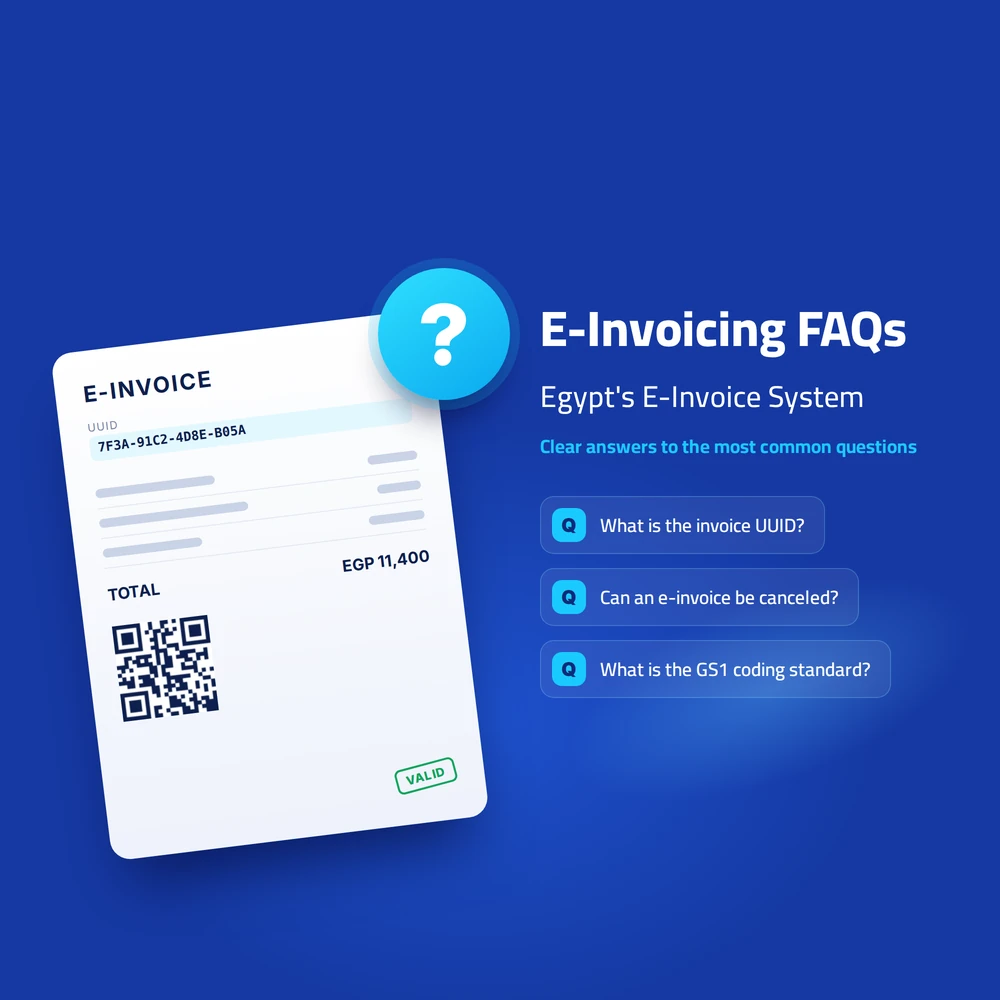
The Universally Unique Identifier (UUID) is a unique identifier assigned to an invoice within Egypt's E-Invoicing System. It is unique across the entire system and cannot be duplicated for another invoice, regardless of which business issued it.
The UUID differs from the internal invoice number or code, which the business generates within its accounting, invoicing, or Enterprise Resource Planning (ERP) system.
The UUID is assigned to the e-invoice after the Egyptian Tax Authority's E-Invoicing System submits and registers it. The Tax Authority's central system generates and assigns it, not the accounting software the business uses to create the invoice.
Is There a Standard E-Invoice Format That Businesses Must Follow?
Egypt's E-Invoicing System uses a standardized data structure for invoice information. This refers to the invoice's data structure, not its visual design or layout. Instead, invoices issued by businesses across industries must include specific data fields.
Invoice data sent from a business's ERP system to the E-Invoicing System follows a standardized structure across businesses. However, this does not mean that all invoices must have the same visual design or formatting.
Businesses can still create invoices using their preferred ERP design, including their own branding and company logo. The key requirement is that the invoice includes the data fields the Egyptian Tax Authority requires for it to qualify as a valid e-invoice.
What Are the Steps Required to Integrate with the E-Invoicing System?
First, you need to register with Egypt's E-Invoicing System and obtain the login credentials for your Egyptian Tax Authority account.
You can then connect your ERP system to the E-Invoicing System, provided your ERP solution is already integrated with the Tax Authority's platform through an Application Programming Interface (API). Daftra supports integration with the Egyptian Tax Authority's platform and can connect directly to the E-Invoicing System.
Once you obtain the required secret key, you can enter it into your ERP system to authorize it to submit invoice data to your account with the Egyptian Tax Authority.
What Languages Are Supported for Issuing E-Invoices and Other Documents?
You can issue invoices, debit notes, and credit notes in either Arabic or English.
Is an Invoice Sent to the E-Invoicing System Immediately After It Is Created, or Is It Submitted Separately?
In Daftra, an invoice is not sent to the Egyptian Tax Authority immediately after creation. After saving the invoice, you need to submit it separately by clicking “Send to the Egyptian Tax Authority.”
How Are Errors in Previously Issued Invoices Handled?
If an invoice is issued with an error, you can issue a Credit Note through the system to document the return of the goods or services covered by the original invoice, along with any amount refunded to the buyer and the related tax amount. The credit note can apply to all items on the original invoice or only part of them.
Can a Single Credit Note Be Issued for Multiple Invoices?
Yes. A single credit note can cover multiple invoices, provided that you specify the original invoice numbers to which the credit note relates and ensure that the final value of the credit note does not exceed the combined total value of those invoices.
Can More Than One Credit Note Be Issued for the Same Invoice?
Yes. You can issue multiple credit notes for the same invoice, as long as their combined value does not exceed the original invoice total.
How Are Transactions with Customers Who Are Not Tax Registered Handled?
When dealing with a customer who is not tax registered, you must provide the customer's National ID number instead of their Commercial Registration and Tax Card details.
Will Tax Returns Be Pre-Populated Electronically with Invoices Recorded Through the E-Invoicing System?
At present, tax returns cannot be prepared directly through the E-Invoicing System. Businesses must continue to file their tax returns using the existing procedures. However, integrating tax return filing into the electronic system is part of the planned future development of the system.
What Is the GS1 Global Coding Standard?
GS1 is a global identification standard used to uniquely identify a specific product or service based on its key characteristics and the company associated with it. A GS1 identifier is unique to the product or service it represents and is not assigned to another product or service.
For example, two products may be similar but differ in a key attribute such as size, color, density, or duration. If they are different products, they will have different GS1 identifiers. The same applies when different companies supply the same type of product or service, as the identifiers distinguish products based on the applicable identification rules.
What Is the GPC Standard?
Global Product Classification (GPC) is a classification standard that categorizes products and services into groups based on their overall characteristics and business nature.
Unlike GS1 identifiers, a GPC code does not uniquely identify an individual product. Different products with different specifications can have the same GPC code if they belong to the same product classification or share the same fundamental category.
In simple terms, GS1 identifies a specific product, while GPC classifies products into broader categories
Do Businesses Need to Notify the Egyptian Tax Authority When Adding Codes for New Products?
Yes. Businesses must notify the Egyptian Tax Authority of any new product codes at least 15 days before using them. New codes can be submitted through the company's account on the Tax Authority's platform, and approval can also be received through the same account.
What Does an E-Invoice Look Like?
Egypt's E-Invoicing System uses a standardized data structure for invoice information. This does not refer to the invoice's visual design or layout. Instead, it collects specific data fields from invoices issued by businesses across different industries.
The data submitted from the business's ERP system to the E-Invoicing System follows a standardized structure across businesses. However, this does not mean that all invoices must have the same design or formatting.
Businesses can still issue invoices using their preferred ERP design, including their own branding and company logo. The main requirement is that the invoice includes the data fields required by the Egyptian Tax Authority to qualify as a valid e-invoice.
Is There a Unified Coding System Within the E-Invoicing System?
Transactions within the E-Invoicing System involving goods and services follow standardized coding requirements. The system uses international product and service classification standards, primarily GS1 and Global Product Classification (GPC).
If a business does not use GS1 codes, it can map its internal product codes to the GPC classification so that its products can be used within the E-Invoicing System.
What Happens If a Business Uses a Coding System Other Than GS1? Does It Need to Change Its Internal Product Codes?
No. Businesses do not need to replace their existing internal product codes. Instead, they can continue using their internal codes and create a mapping between those codes and the GPC classification, allowing them to use their existing coding structure within the E-Invoicing System.
When the Seller and Buyer Use Different Product Codes, Which Code Should Be Used?
The E-Invoicing System uses the applicable standardized coding requirements, namely GS1 and GPC. Accordingly, use the relevant GS1 or GPC code based on the mapping between the seller's internal product classification and the applicable standard.
Can New Products or Services Be Added to the E-Invoicing System?
Yes. Businesses can add new products or services that were not previously registered.
If the business uses GS1, it can update the product coding information in the relevant tax system according to the applicable GS1 process. If the business uses a different internal coding system, it can create a mapping between its internal codes and the applicable GS1 or GPC classification, allowing the business to continue using its internal codes.
Who Is Responsible for Mapping Product Codes: the Business or the Tax Authority?
The business is responsible for preparing and implementing the mapping between its internal product codes and the applicable GS1 or GPC classification.
How Should Product Codes Be Handled When Selling a Fixed Asset or Raw Material?
Before issuing the sales invoice, the code for the fixed asset or raw material being sold must be mapped to the applicable GS1 or GPC standard. The E-Invoicing System uses these standardized coding requirements when processing products and services.
How Has E-Invoicing Been Adopted in Egypt?
The features and benefits of e-invoicing have encouraged many countries to introduce electronic invoicing for business transactions. Egypt has also introduced its E-Invoicing System as part of the digitalization of tax administration and commercial transactions.
The system uses information technology to convert invoices into electronic documents recognized by the Egyptian Tax Authority (ETA), supporting the electronic submission and processing of invoice data.
To learn more about Egypt's E-Invoicing System and how to get started, visit the official E-Invoicing System platform.
How Can an Electronic Signature Certificate Be Obtained for E-Invoices?
The Information Technology Industry Development Agency (ITIDA) oversees electronic signature services in Egypt. An authorized provider, Egypt Trust, issues electronic signature certificates that meet the E-Invoicing System requirements.
What Are the Procedures for Obtaining an Electronic Signature Certificate in Egypt?
Companies can obtain an e-sealing certificate used to sign invoices within the E-Invoicing System by contacting Egypt Trust, an electronic signature service provider associated with ITIDA, which operates under the Ministry of Communications and Information Technology. Companies can also obtain the certificate through Misr for Central Clearing, Depository and Registry (MCDR).
Where Are Electronic Signature Certificates Issued?
Electronic signature certificates can be obtained through authorized electronic signature service providers, including Egypt Trust and MCDR, under the framework overseen by ITIDA.
Can a Registered Business Authorize More Than One Person to Use Its Electronic Signature?
Yes. A taxpayer can authorize more than one person to use the company's electronic signature. There is no maximum limit on the number of authorized representatives acting on behalf of the company.
What Electronic Documents Can Be Exchanged with Other Businesses and Parties?
The approved electronic documents include:
- E-Invoices
- Credit Notes
- Debit Notes
How Are Errors in Previously Issued Invoices Handled?
Errors in previously issued invoices are handled by issuing Credit Notes or Debit Notes linked to the original invoice.
Can a Credit or Debit Note Be Issued for Multiple Invoices?
Yes. A credit or debit note can relate to multiple invoices, provided the note specifies the relevant invoice numbers.
Is There a Limit on a Credit Note Linked to a Previously Issued Invoice?
Yes. The credit note value must not exceed the total value of the original invoice.
Can More Than One Credit or Debit Note Be Issued for the Same Previously Issued Invoice?
Yes. You can issue multiple credit or debit notes for the same original invoice.
Can an E-Invoice Be Edited After It Has Been Issued?
You cannot edit an issued e-invoice directly. If a correction is required, you can cancel the invoice and issue the appropriate Credit Note or Debit Note.
How Are Transactions with Customers Who Are Not Tax Registered Handled?
For customers who are not tax registered, the customer's National ID number is used instead of a Tax Registration Number.
Can the Buyer Reject an E-Invoice, and What Is the Time Limit for Rejection?
Yes. The buyer can reject an e-invoice within three days of its issue date.
Can an E-Invoice Be Canceled, and What Is the Cancellation Time Limit?
Yes. An e-invoice can be canceled within the specified cancellation period.
How Can the Seller Cancel an E-Invoice?
As long as the invoice is still within the permitted cancellation period, the seller can request its cancellation. The buyer is notified of the cancellation request.
What Should the Recipient (Buyer) Do When the Seller Requests Cancellation of an Invoice or Note?
The buyer can either accept or reject the seller's cancellation request. If the buyer rejects the request, the cancellation cannot proceed.
What Are the Implications of Canceling an Egyptian E-Invoice for the Seller and Buyer?
Once the cancellation is completed, the e-invoice is marked as canceled in the E-Invoicing System.
Does E-Invoicing Affect the Company's Accounting System in Terms of Performance or Business Continuity?
No. The E-Invoicing System does not affect the performance or continuity of the company's accounting system.
How Can a Business Verify That the Invoices Submitted to the System Belong to Its Company?
The company verifies this through its electronic signature, which authenticates the invoices submitted to the E-Invoicing System.
Are Imports Covered by Egypt's E-Invoicing System at This Stage?
Foreign exporters are not subject to Egypt's E-Invoicing System. However, Egyptian importers are subject to the system and must comply with its applicable requirements.
What Is an SDK?
A Software Development Kit (SDK) is a set of software tools, information, and resources that developers need to integrate the E-Invoicing System with the company's Enterprise Resource Planning (ERP) system in accordance with the technical requirements set by the Egyptian Tax Authority.
What Is an API?
An Application Programming Interface (API) is the mechanism used to connect the company's ERP system with the E-Invoicing System and exchange invoice data between them.
How Can I Confirm That an Issued Invoice Has Been Successfully Submitted to the E-Invoicing System?
You will receive a notification confirming that the invoice has been successfully submitted to the E-Invoicing System.
Will Tax Returns Be Automatically Populated with Invoices Recorded Through the E-Invoicing System?
Yes. This is planned as part of the future development of the E-Invoicing System.
What Happens If the Seller Cannot Provide Complete Information for an Unregistered Buyer, Such as a Small Trader?
If the invoice exceeds a specified amount, the buyer's National ID number must be provided at a minimum.
Can Invoices Be Submitted in Batches?
Yes. Multiple invoices can be submitted to the E-Invoicing System in batches.
If Invoices Are Submitted in Batches, Will Each Invoice Be Validated Separately?
Yes. Each invoice submitted as part of a batch is validated separately.
What Happens to Invoices If the Company's Internal System Experiences a Technical Failure?
Once the technical issue is resolved, the invoices generated during the downtime can be submitted to the E-Invoicing System in batches.
How Can I Integrate My Business with Egypt's E-Invoicing System?
You can integrate using the SDK provided for the E-Invoicing System, along with the required API connection.
Are Additional Hardware or Software Licenses Required to Integrate with the E-Invoicing System?
No. Integration with the E-Invoicing System does not require any additional hardware or software licenses.
Does the Egyptian Tax Authority Provide Support to Businesses During the Integration Process?
Yes. The Egyptian Tax Authority provides technical support to help businesses with the integration process.
How Can E-Invoicing Be Implemented in Your Business in Egypt?
Implementing e-invoicing in your business involves connecting the company's invoicing software or Enterprise Resource Planning (ERP) system to the E-Invoicing System through an Application Programming Interface (API) and Software Development Kit (SDK) provided by the software solution provider.
The integration enables your business to exchange the invoice data required by the Egyptian Tax Authority with the E-Invoicing System, helping streamline tax-related procedures and reduce the time and effort required to manage them.
The company's invoicing or ERP software sends the invoice data to the E-Invoicing System in a standardized format, such as JSON or XML. While the data structure submitted to the E-Invoicing System follows the applicable requirements, the invoice design used within the company's internal system does not necessarily need to change.
The integration does not require additional hardware or software licenses. Instead, the business needs invoicing software that meets the technical integration requirements and provides the necessary API capabilities to connect with the E-Invoicing System.
Why Is Using Accounting Software Important for Integrating with the E-Invoicing System?
To integrate with Egypt's E-Invoicing System, you need electronic accounting software that supports the required integration. Beyond connecting to the E-Invoicing System, the software can help you manage operations, customers, and suppliers from a single platform, improving efficiency and supporting better financial results.
Daftra provides an integrated Enterprise Resource Planning (ERP) solution that supports accounting and various business operations through a single system. Visit the Daftra website and take a quick tour to learn more about the platform and the features that help you manage and streamline your business.







 Invoicing
 POS
 Offers
 Installments
 Sales Commission
 KSA E-Invoice Software
 EGY E-Invoice Software
 JO E-Invoice Software
 E-Invoice Software
 Chart of Accounts
 Asset Management
 Cost Centers
 Expenses
 Cheque Cycle
 UAE VAT-Tax
 Product Management
 Purchases
 Purchase Cycle
 Suppliers
 Requisitions
 Stocktaking
 Organizational Structure
 Personnel Management
 Attendance and Leave
 Contracts
 Payroll
 Requests
 Work Orders
 Booking Management
 Rental and Unit Management
 Time Tracking
 Work Flow
 Lease Contracts
 Manufacturing Management
 Client Follow-Up
 Loyalty Points
 Points and Credits
 Memberships
 Insurance Management
 Daftra ERP Full App
 Point of Sales App
 Point of Sales for Desktop – Support Offline Mode
 AI Expenses Scanner App
 Employee Attendance, Sign & ESS App
 E-invoice Reader App
 Inventory Stocktaking App