





Table of contents:
- Key Summary
- What Is Job Performance?
- What Is Job Performance Evaluation?
- What Are the Types of Job Performance?
- What Are the Goals of Job Performance?
- Job Performance Evaluation Criteria
- How to Measure Job Performance
- What Factors Affect Job Performance, and What Does It Affect?
- What Should I Write in a Job Performance Evaluation?
- What Is a Job Performance Agreement?
- Frequently Asked Questions About Job Performance
- How Does Daftra Help Evaluate Job Performance?
- Conclusion
Some people believe that job performance is simply about completing daily tasks. However, job performance management goes beyond that and encompasses several important dimensions. How can a job performance management system contribute to the success of an entire organization? And what criteria are used to evaluate job performance?
These questions, along with many others, arise when discussing job performance and assessing employees' behaviors, skills, and experience. This comprehensive guide explores job performance goals, what a job performance charter means, and the factors that influence how performance is measured.
It also explains how employees can receive and use their performance evaluation results to support their professional growth and career development.
What Is Job Performance?
Job performance refers to the standards used to assess whether employees meet an organization's goals and expectations. This assessment is based on the quality of their work and their workplace behaviors.
What Is Job Performance Evaluation?
Job performance evaluation measures how efficiently and effectively an employee carries out their assigned responsibilities and tasks. Those involved in the evaluation process typically include supervisors, managers, the human resources team, colleagues, and customers or service beneficiaries.
Several key criteria and factors influence job performance evaluations and help determine performance ratings and scores. These include accuracy, proficiency, professionalism in completing tasks, meeting deadlines, and the ability to work collaboratively as part of a team.
The following sections explore the main job performance evaluation criteria and the factors that determine performance in greater detail.
What Are the Types of Job Performance?
Understanding the different types of job performance helps human resources management teams develop effective strategies to improve employee performance across different roles and departments. The criteria used to evaluate performance also vary by type, making the evaluation and development process more structured and effective.
Job performance can be divided into the following types:
1. Task Performance
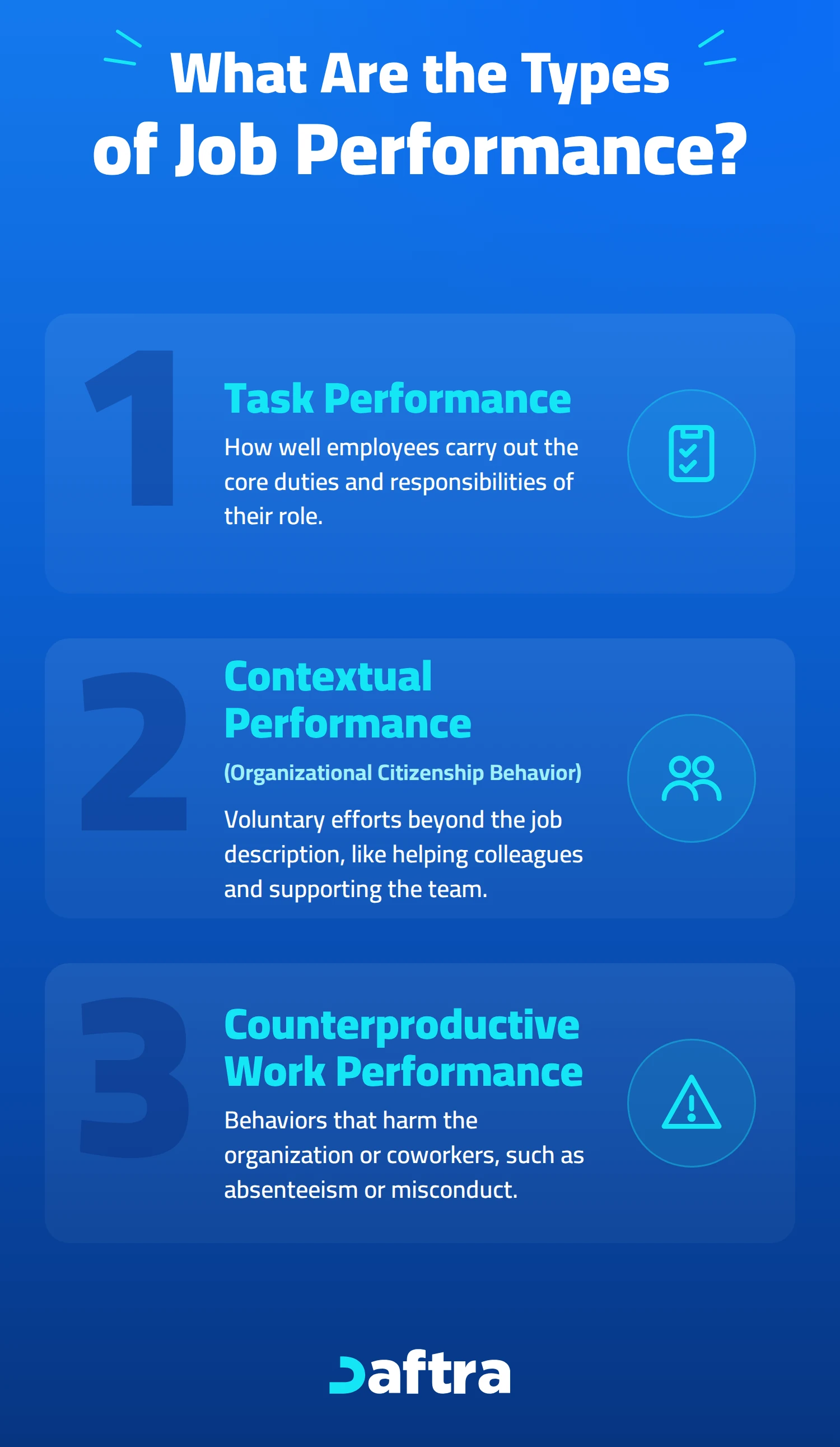
Task performance is one of the main types of job performance. It refers to how well an employee carries out the duties and responsibilities outlined in their job description. In other words, it focuses on clearly defined work tasks and whether employees complete them to the required standards of quality and productivity.
This type of performance focuses on measurable outcomes, such as achieving sales targets or completing projects on time. It emphasizes results achieved rather than effort invested.
Download: Employee Task Tracking Template
2. Contextual Performance (Organizational Citizenship Behavior)
Contextual performance refers to the activities and behaviors employees demonstrate to help maintain a healthy social and psychological work environment. This type of job performance is voluntary and driven by employees' intrinsic motivation rather than formally assigned responsibilities outlined in their job descriptions. It focuses on contributions and efforts that are not easily measured quantitatively.
Contextual performance can be divided into several subtypes:
- Behavioral Performance: Refers to employees' workplace conduct and their ability to adapt to changes in the organization's culture.
- Creative Performance: Refers to an employee's ability to think critically and analytically and generate innovative, effective ideas.
- Team Performance: Refers to how employees communicate, interact, and collaborate with one another, as well as their ability to achieve team goals.
Need a starting point? Download Daftra’s free job description template to define each role’s duties clearly before you evaluate performance.
3. Counterproductive Work Performance
Counterproductive work performance refers to intentional or unintentional negative behaviors that delay or hinder an organization's productivity and strategic goals.
Common signs include failure to adhere to workplace ethics and professional standards, difficult employee behaviors that undermine teamwork, and criminal acts such as embezzlement, fraud, and theft.
Download: Employee Warning Notice Template
4. Developmental Performance
Developmental performance refers to employees' willingness to learn, pursue professional growth, and improve their theoretical knowledge and practical skills.
Use the Overtime Calculator to easily calculate employees' overtime pay.
What Are the Goals of Job Performance?
An organization's performance goals are closely aligned with individual employee performance goals. Both organizations and employees strive for success and growth, which they can achieve through a mutually beneficial relationship that supports employees' career aspirations while meeting the organization's expectations.
The following sections outline the key job performance goals for both companies and employees.
1. Job Performance Goals for Companies
A. Improving and Increasing Productivity
Evaluating employee performance against established criteria helps increase output and improve its quality. This, in turn, boosts customer satisfaction, improves retention, and attracts new customers by ensuring expectations are met on time.
B. Achieving the Organization’s Strategic Goals
Encouraging outstanding job performance fosters innovation and creativity within the organization. It also supports the development of new ideas that help advance the organization’s vision for economic and social sustainability. In addition, developing and improving job performance helps the organization maintain its competitive edge in the labor market.
C. Attracting Talent and Retaining Employees
Regularly monitoring job performance and consistently applying established performance evaluation standards and criteria help identify employees’ strengths and weaknesses. These practices also foster a positive work environment and improve communication between teams and departments, reducing employee turnover and making it easier to attract highly qualified talent.
2. Job Performance Goals for Employees
A. Achieving Career Goals
When an organization clearly and systematically defines its goals and job requirements, it motivates employees to perform at their best and work harder toward their personal career goals. These may include earning promotions, receiving rewards under the employee salary scale, and advancing their careers.
Download: Worker Salary Scale Template
B. Maintaining Work-Life Balance
Clear job performance indicators and evaluations help employees manage their time more effectively, making it easier for them to maintain a healthy work-life balance.
Job Performance Evaluation Criteria
Job performance evaluation criteria are essential tools for objectively and comprehensively assessing and improving employee performance. These criteria are linked to Key Performance Indicators (KPIs), which help organizations measure progress toward their goals through the following factors:
- Accuracy in completing assigned tasks.
- The ability to prioritize work and achieve productivity targets within a specified timeframe.
- Communication and interpersonal skills, including the ability to negotiate, explain ideas and opinions to colleagues or customers, collaborate with others, and support the team in achieving shared goals.
- Adherence to the organization’s values and ethics, as well as its workplace standards and policies.
- Customer and user satisfaction rates.
- Sales targets expected to be achieved within a specified period.
- Comparison of actual revenue against projected profits.
- Technical skills, including the ability to use modern software, technological applications, and artificial intelligence solutions to complete tasks more quickly and accurately.
How to Measure Job Performance
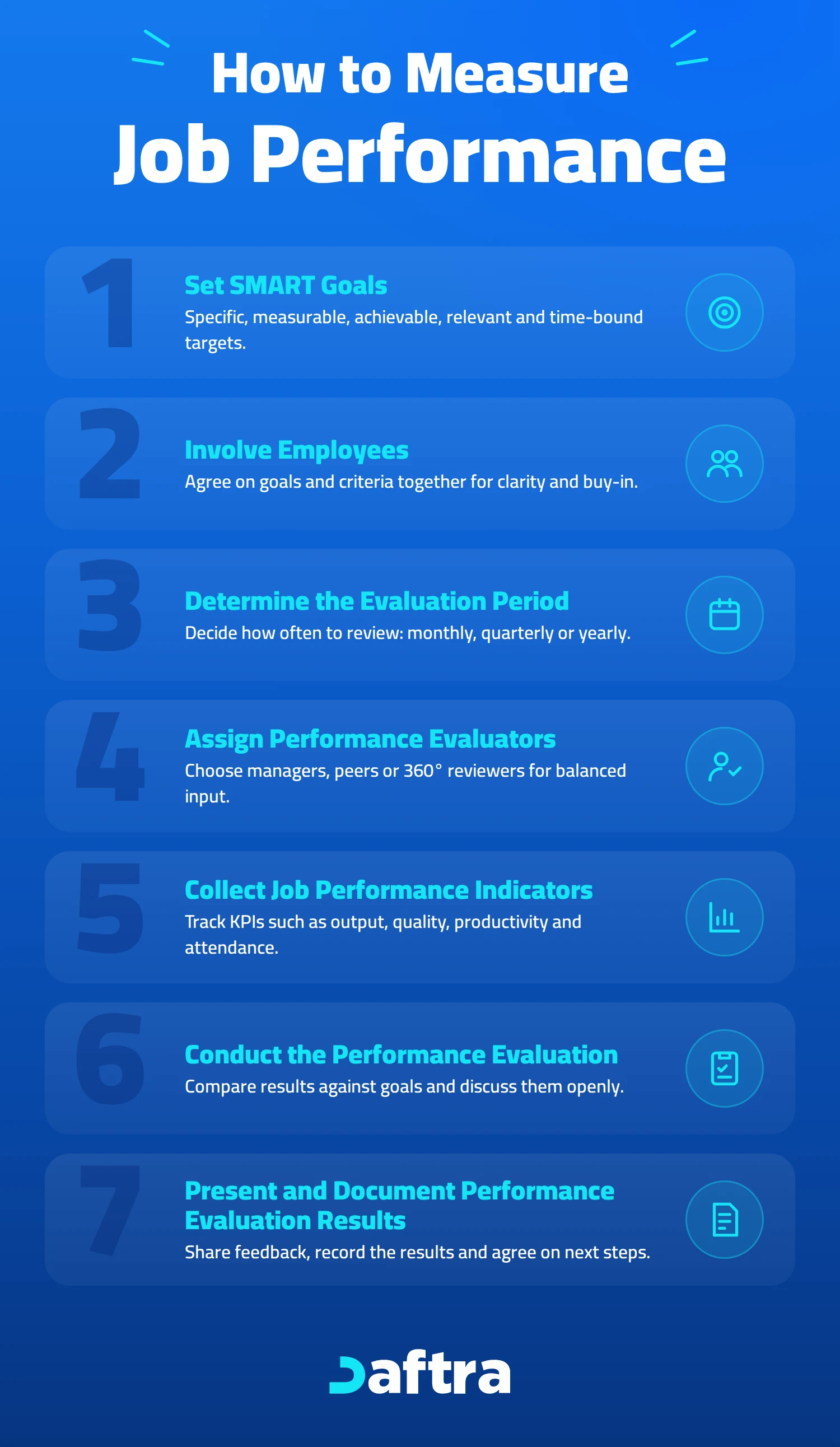
Measuring job performance involves following several steps:
1. Set SMART Goals
SMART goals are specific, measurable, achievable, relevant, and time-bound. For example, instead of setting a general goal to increase sales, a company could aim to increase sales of Product A by 10% within 60 days. This makes the goal measurable and allows the organization to track progress.
An organization’s departmental goals should also align with its overall objectives. For example, if the company’s main goal is to improve customer service, supporting goals might include contacting customers regularly to provide after-sales services or reducing response times to customer inquiries to within one hour.
Overall, SMART goals effectively evaluate and measure employee performance.
2. Involve Employees
Involve employees in the job performance measurement process by informing them of the criteria used in evaluations. They can also help develop these criteria through employee performance surveys. Gathering employees’ perspectives can help establish more accurate, effective performance-measurement criteria.
3. Determine the Evaluation Period
Choose appropriate intervals for measuring job performance based on the organization’s needs. These may include annual, semiannual, quarterly, or monthly evaluations.
Shorter, more frequent evaluation periods are generally preferable because they provide greater flexibility to adjust goals when necessary, respond to changing business requirements, adapt to unexpected developments, identify and resolve problems promptly, and continuously improve performance.
4. Assign Performance Evaluators
Identify the individuals responsible for measuring job performance and train them to use the appropriate tools and methods based on the type of performance evaluation being conducted.
5. Collect Job Performance Indicators
Gather the information and data needed based on the evaluation criteria outlined above. Department heads, colleagues, and customers can help provide clear information about how well employees meet these criteria.
You can also use previous performance evaluation results for historical comparisons and to measure improvement over time.
6. Conduct the Performance Evaluation
Select the type of performance to be measured and determine the appropriate evaluation method, such as:
- 360-Degree Feedback: Provides a comprehensive view of an employee’s performance by collecting feedback from colleagues, supervisors, and customers.
- Manager Evaluation: Assesses employee performance against predefined criteria.
- Management by Objectives (MBO): Measures the extent to which employees achieve established goals.
7. Present and Document Performance Evaluation Results
Discuss the performance evaluation results and explore opportunities for development and improvement in line with future plans and organizational expectations. Keep a record of each employee’s evaluation results for future reference, including when making decisions about promotions and career advancement within the career progression framework.
8. Provide Employee Feedback
Share feedback with employees about their performance evaluation results and link job performance to incentives and rewards.
What Factors Affect Job Performance, and What Does It Affect?
Job performance is influenced by several factors and can also affect various aspects of an employee’s working life, including:
Download: Sick Leave Request Template
What Should I Write in a Job Performance Evaluation?
Record each evaluation item alongside the results for the corresponding performance criterion. Include constructive comments that recognize and appreciate an employee’s contributions, as well as feedback on negative performance, such as recurring mistakes or a lack of engagement in professional development. Encourage employees to participate in open discussions about their performance results.
What Is a Job Performance Agreement?
A job performance agreement defines the criteria and goals used to measure job performance, along with the results used to explain and assess each criterion. The manager responsible for the employee prepares the agreement, and the employee signs it to acknowledge their commitment to the specified responsibilities and standards.
Frequently Asked Questions About Job Performance
What Are the Job Performance Rating Levels?
Organizations use job performance rating scales to measure individual employee performance. This method typically assigns employees a numerical score ranging from 1 to 5.
The scale follows an ascending order: a higher score indicates stronger performance, while a lower score indicates weaker performance, as follows:
- 1/5: Very poor performance
- 2/5: Poor or acceptable performance, but below expectations
- 3/5: Good performance
- 4/5: Very good performance
- 5/5: Excellent performance
Can an Employee Dispute a Job Performance Evaluation?
Yes. An employee can dispute a job performance evaluation when the performance goals and criteria previously communicated to them differ from those actually used to assess their performance. Any formal objection should be raised professionally and respectfully.
Rather than rejecting the evaluation entirely, employees are better off discussing their concerns about the results and requesting a review to seek a more favorable outcome.
Employees also have the right to review their performance evaluation results. Allowing open dialogue between employees and managers promotes fairness and transparency in the workplace. Reviewing their performance also helps employees understand their strengths and weaknesses and identify areas for improvement.
What Is the Purpose of a Job Performance Record?
A job performance record documents an employee’s performance regularly so managers can refer to it when needed. It also helps identify weaknesses, clarify expected outcomes, and outline the tasks the employee must complete within a specific period.
When Should Job Performance Be Evaluated?
Job performance can be evaluated daily, weekly, monthly, or quarterly, depending on the performance evaluation schedule established by the Human Resources department. Evaluations may also occur after projects or complex tasks are completed, or when promotions, positions, or job responsibilities change significantly.
What Causes Poor Job Performance?
Common causes of poor job performance include:
- Employees lacking the skills needed to complete certain assigned tasks.
- Unclear expectations and job goals due to poor communication between employees and management.
- Excessive workloads and tight deadlines that reduce concentration.
- Insufficient financial or non-financial incentives to motivate employees to perform at their best.
- A stressful work environment with frequent conflicts between colleagues, which affects employee performance and concentration.
- Health and family pressures, as well as psychological difficulties, that affect employee performance and productivity.
- Ineffective management or weak leadership, which can directly contribute to poor job performance.
What Is the Difference Between Employee Performance and Job Performance?
The main difference lies in their focus. Job performance focuses on completing work-related tasks and achieving goals, while employee performance focuses on an employee’s behavior in the workplace.
How Can I Evaluate My Own Job Performance?
Self-evaluation is the process by which employees assess their performance by reviewing how well they achieved their goals and seeking feedback from supervisors and colleagues to identify areas for improvement. This type of evaluation encourages employees to take responsibility for developing their performance.
What Are the Ways to Improve Job Performance?
Job performance can be improved by:
- Setting clear, measurable goals to direct employees’ efforts effectively.
- Providing sufficient practical and professional training opportunities to develop employees’ experience and skills.
- Learning time management and organizational skills to increase productivity.
- Strengthening communication between employees and management to ensure employees clearly understand goals and expectations.
What Are the Strengths of Job Performance?
Key job performance strengths include:
- High productivity: Completing tasks efficiently.
- Collaboration and communication: Working effectively with team members.
- Innovation and creativity: Generating new ideas and practical solutions to improve different aspects of work.
- Meeting deadlines: Completing tasks within the required timeframes.
What Are the Barriers to Job Performance?
Common barriers to job performance include poor communication that creates unclear goals and expectations, insufficient skills, and psychological stress from overlapping or excessive tasks.
What Is the Job Performance Cycle?
The job performance cycle includes setting goals, developing a plan to achieve them, carrying out tasks according to the plan, evaluating performance against established criteria, and finally providing feedback and recommendations for improvement.
What Is Evidence of Job Performance?
Job performance evidence refers to the records and indicators that demonstrate an employee’s performance level. Examples include monthly reports, periodic performance evaluations, and customer feedback.
Can Job Performance Be Adjusted?
Yes. Supervisors and managers can improve job performance based on feedback. Employees can also challenge performance evaluation results through a formal objection or grievance supported by reasonable evidence.
How Does Daftra Help Evaluate Job Performance?
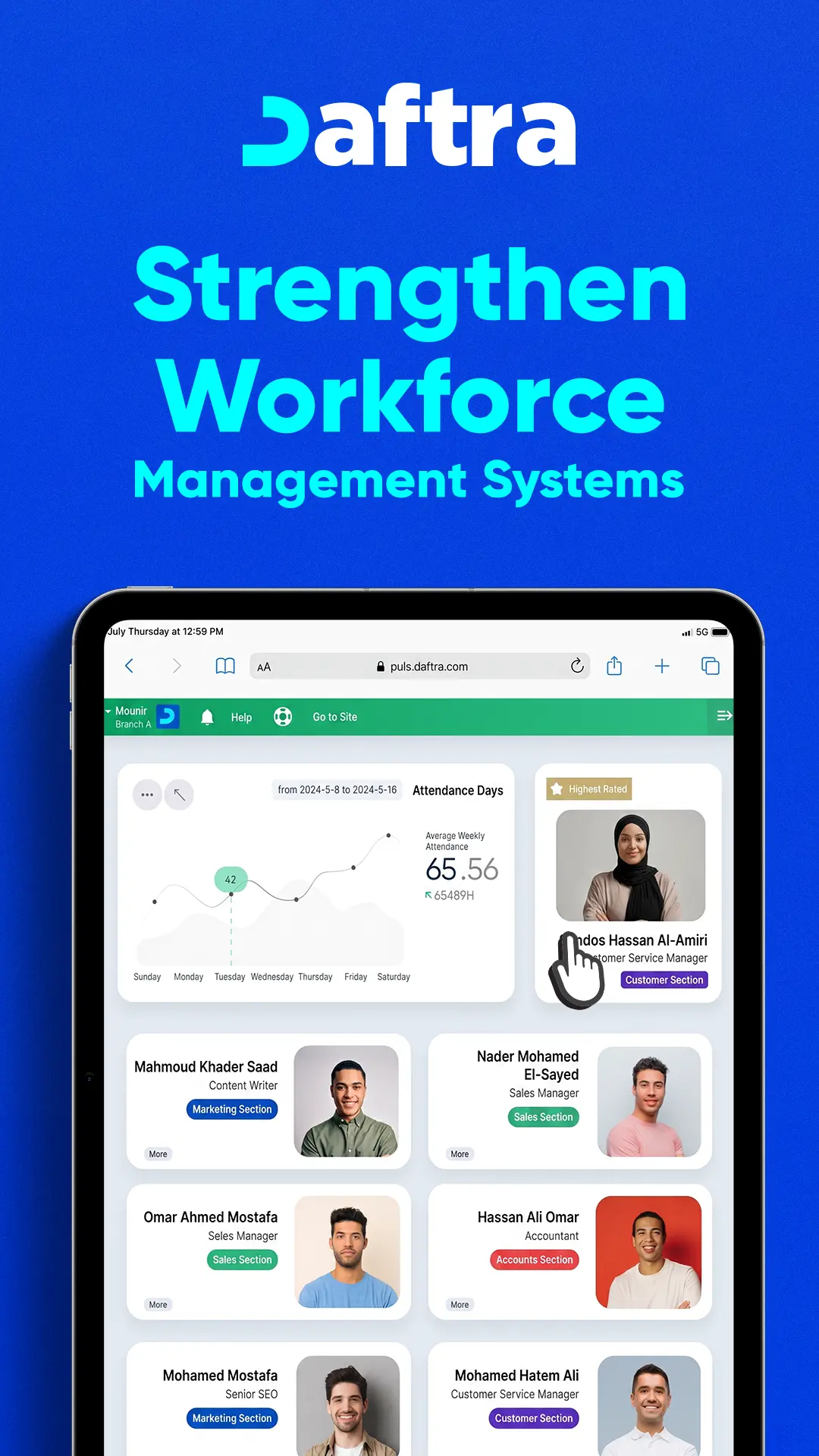
Daftra’s Human Resources software provides detailed shift reports for individual employees or multiple employees. It also allows users to view attendance report summaries by day, week, month, year, or department.
Daftra also provides time-tracking reports by employee or project, with flexible date filters to display tracking reports daily, weekly, monthly, or annually.
These reports help organizations evaluate job performance accurately against established performance measurement and evaluation criteria. Daftra also offers an easy-to-use dashboard, integration with enterprise management software, support for Arabic, and other features.
Conclusion
Now that we have explored job performance, its types, and what to include in a job performance evaluation, organizations should make use of Human Resources management software and the automated solutions these systems offer, such as Daftra’s integrated cloud-based system.
These tools help organizations apply job performance goals and evaluation criteria effectively, improving productivity, enhancing employee satisfaction, and supporting the achievement of organizational goals. They also help create positive, motivating work environments built on fairness and transparency in recognizing employees’ contributions.








 Invoicing
 POS
 Offers
 Installments
 Sales Commission
 KSA E-Invoice Software
 EGY E-Invoice Software
 JO E-Invoice Software
 E-Invoice Software
 Chart of Accounts
 Asset Management
 Cost Centers
 Expenses
 Cheque Cycle
 UAE VAT-Tax
 Product Management
 Purchases
 Purchase Cycle
 Suppliers
 Requisitions
 Stocktaking
 Organizational Structure
 Personnel Management
 Attendance and Leave
 Contracts
 Payroll
 Requests
 Work Orders
 Booking Management
 Rental and Unit Management
 Time Tracking
 Work Flow
 Lease Contracts
 Manufacturing Management
 Client Follow-Up
 Loyalty Points
 Points and Credits
 Memberships
 Insurance Management
 Daftra ERP Full App
 Point of Sales App
 Point of Sales for Desktop – Support Offline Mode
 AI Expenses Scanner App
 Employee Attendance, Sign & ESS App
 E-invoice Reader App
 Inventory Stocktaking App