


Posted on 4 November 2026
Production Plan Template
- The Production Plan Template helps organize the production process by identifying production requirements and assigning employee responsibilities.
- It improves production efficiency, reduces costs, and helps ensure the best possible use of available resources.
- The production manager is the primary beneficiary of the template, as it supports workflow monitoring and informed decisions to improve efficiency.


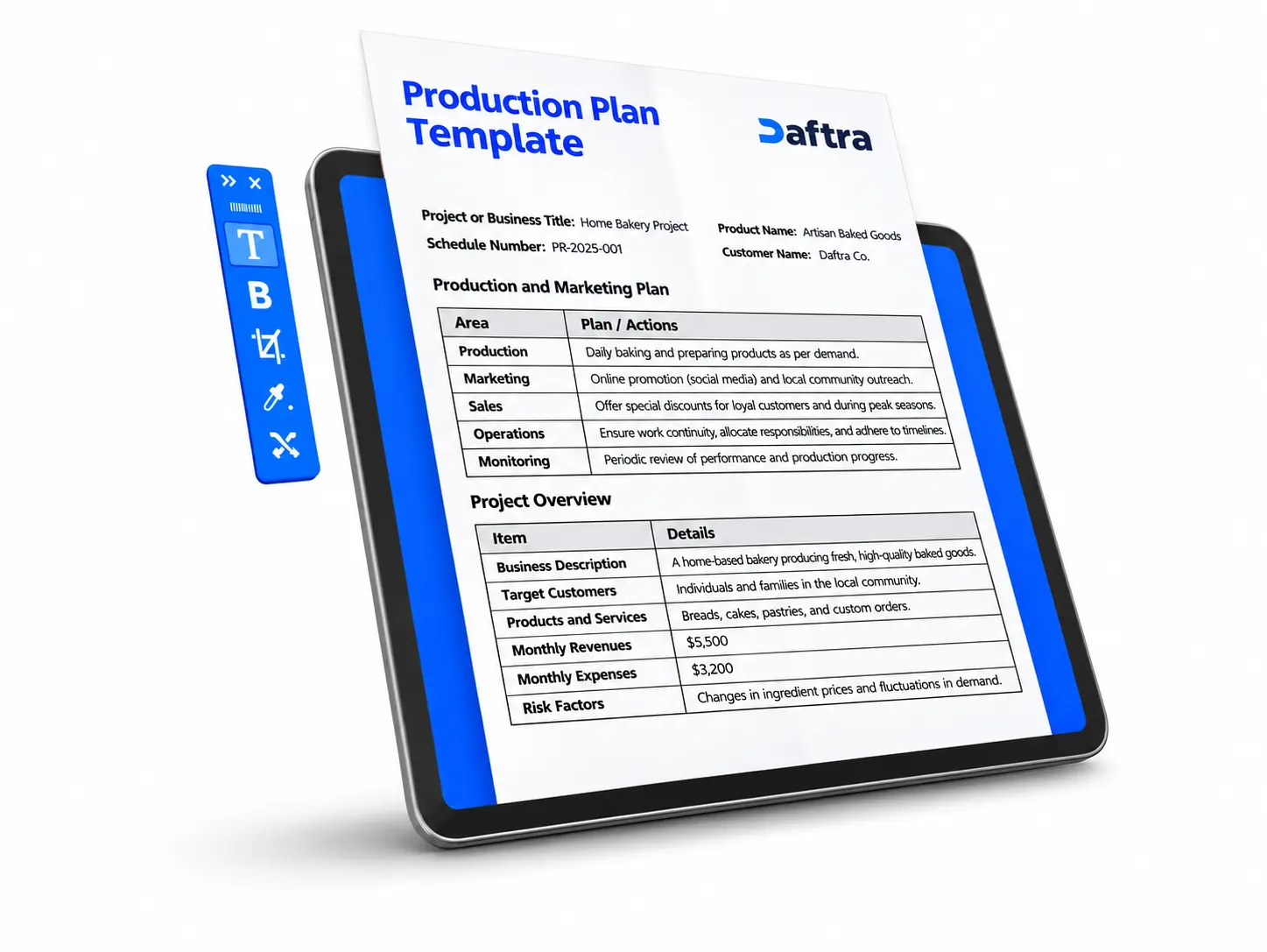
 Keep Your Production on Track with Daftra
What Is a Production Plan Template?
A Production Plan Template is a tool that helps manufacturing companies organize and determine how products or services will be produced before manufacturing begins. It covers multiple planning areas, including supply chain management, raw-material requirements, employee responsibilities, and the physical spaces in which manufacturing will take place.
The template is designed to ensure that operations run efficiently. It directly affects other production activities, such as production scheduling, material requirements planning, and the lead times needed to complete production. It helps companies improve production performance, reduce costs, and achieve higher quality and greater efficiency throughout the production process.
Why Is a Production Plan Template Important?
The Production Plan Template is important because it helps companies manage resources accurately and efficiently, particularly when manufacturing operations are expanding. It ensures that available resources are allocated properly to maximize production over a specified period.
Without effective production planning, excessive resources may be allocated to one product, leaving insufficient resources for others. Poor resource scheduling may also lead to delays that disrupt production or cause unnecessary waste. The template is therefore essential for using resources efficiently, maintaining high product and service quality, and staying within the approved budget. The production manager is usually responsible for managing this process within the organization.
What Are the Components of a Production Plan Template?
- Company Name: The name of the company responsible for production.
- Production Plan: The title identifying the company’s plan for producing goods or services.
- Responsible Department: The department or unit responsible for monitoring and implementing the production plan, such as the production or manufacturing department.
- Work System: The operating system used within the company or factory, such as rotating shifts that divide work across multiple time periods.
- Date: The date on which the template is prepared.
- Last Updated: The date on which the template was last revised or updated.
- Order Status: The current status of the order, such as started, in progress, or completed, showing the stage reached in production.
- Production Number: A unique identification number assigned to each production run or order to simplify tracking and monitoring.
- Customer Name: The customer for whom the product was ordered.
- Product List: A list of the products to be manufactured.
- Variations: Any changes to the products, such as differences in quantity or specifications.
- Total Product Quantity: The total required quantity of the product to be manufactured.
- Opening Inventory: The quantity of raw materials available before production begins.
- Closing Inventory: The quantity of raw materials remaining after production is completed.
- Start Date: The date on which production and order execution begin.
- Completion Date: The date on which the production process is completed.
- Shipping Date: The date on which finished products are shipped to the customer or transferred to warehouses.
- Notes: A field for recording any observations or additional information that may be important during production or shipping.
- Delays: A section used to record any delays in the production or shipping schedule, including the period from and to, and the reason for the delay.
How to Create a Production Plan Template
- Prepare the template’s basic information, including the manufacturing company’s name, the department responsible for production, the work system—whether a single shift or rotating shifts—the date of preparation, and the date of revision or update.
- Enter order information, including whether the order has started, production has been completed, or the order has been suspended for any reason; the production order number; the customer’s name, if applicable; the list of products to be manufactured; any product variations in color or specifications; the total quantity required for each product; the quantity of raw materials available before production; and the remaining quantity after production is completed.
- Enter production and shipping dates, including the production start date, manufacturing or production completion date, and the shipping date to the customer or warehouse.
- Add any notes or additional details about production or shipping that may be important for understanding workflow, such as challenges encountered or unexpected schedule changes.
- Record delay information, if applicable. When delays occur, enter the delay period and reason. Delays may result from raw-material shortages, shipping delays, or technical problems with production equipment.
- Update the template regularly to reflect changes or new developments in production. For example, if the shipping date changes or a delay occurs, revise the template accordingly.
How Is a Production Plan Template Used?
A Production Plan Template is used to organize and manage production operations within companies and factories. It captures all details related to manufacturing products or delivering services, including required quantities, order status, start and completion dates, and available inventory. It is used for the following purposes:
- Production Planning: Identifying the products to be manufactured, the required quantities, and the required product specifications.
- Inventory Management: Determining the raw materials available before production begins and the quantities remaining after production is completed.
- Schedule Management: Setting start and completion dates for each production process, helping organize timelines and avoid delays.
- Order Status Monitoring: Tracking order status, such as started, in progress, or completed, which supports accurate workflow reporting.
- Delay Management: Documenting delays that occur during production, including their causes and duration.
- Customer Communication: Coordinating shipping dates with customers and helping ensure that products are delivered on time.
Who Benefits from a Production Plan Template?
- Production Manager: The primary beneficiary of the template, as it enables the production manager to monitor workflow and make strategic decisions to improve efficiency and reduce costs.
- Manufacturing Department: It helps the production team understand scheduled start and completion dates, organize their time, and determine the required resources.
- Inventory Controller: It enables inventory personnel to monitor available raw materials and finished goods, helping prevent stock shortages.
- Customers: The template provides visibility into shipping dates and supports on-time delivery of orders.
- Shipping and Distribution Staff: It identifies shipping dates, helping them organize their schedules.
- Management: The template helps management monitor production performance, evaluate resource-use efficiency, verify that production targets are being achieved, and ensure adherence to production and shipping deadlines.







 Invoicing
 POS
 Offers
 Installments
 Sales Commission
 KSA E-Invoice Software
 EGY E-Invoice Software
 JO E-Invoice Software
 E-Invoice Software
 Chart of Accounts
 Asset Management
 Cost Centers
 Expenses
 Cheque Cycle
 UAE VAT-Tax
 Product Management
 Purchases
 Purchase Cycle
 Suppliers
 Requisitions
 Stocktaking
 Organizational Structure
 Personnel Management
 Attendance and Leave
 Contracts
 Payroll
 Requests
 Work Orders
 Booking Management
 Rental and Unit Management
 Time Tracking
 Work Flow
 Lease Contracts
 Manufacturing Management
 Client Follow-Up
 Loyalty Points
 Points and Credits
 Memberships
 Insurance Management
 Daftra ERP Full App
 Point of Sales App
 Point of Sales for Desktop – Support Offline Mode
 AI Expenses Scanner App
 Employee Attendance, Sign & ESS App
 E-invoice Reader App
 Inventory Stocktaking App