


Posted on 29 September 2026
Employee Undertaking Not to Repeat a Violation Template
- An employee undertaking not to repeat a violation is a formal document in which the employee acknowledges their commitment not to repeat the violation and to comply with the applicable policies and instructions.
- The template helps regulate workplace conduct and strengthen discipline and accountability within the work environment.
- The employer benefits from the template as a formal record that documents the violation and supports administrative action if it recurs.


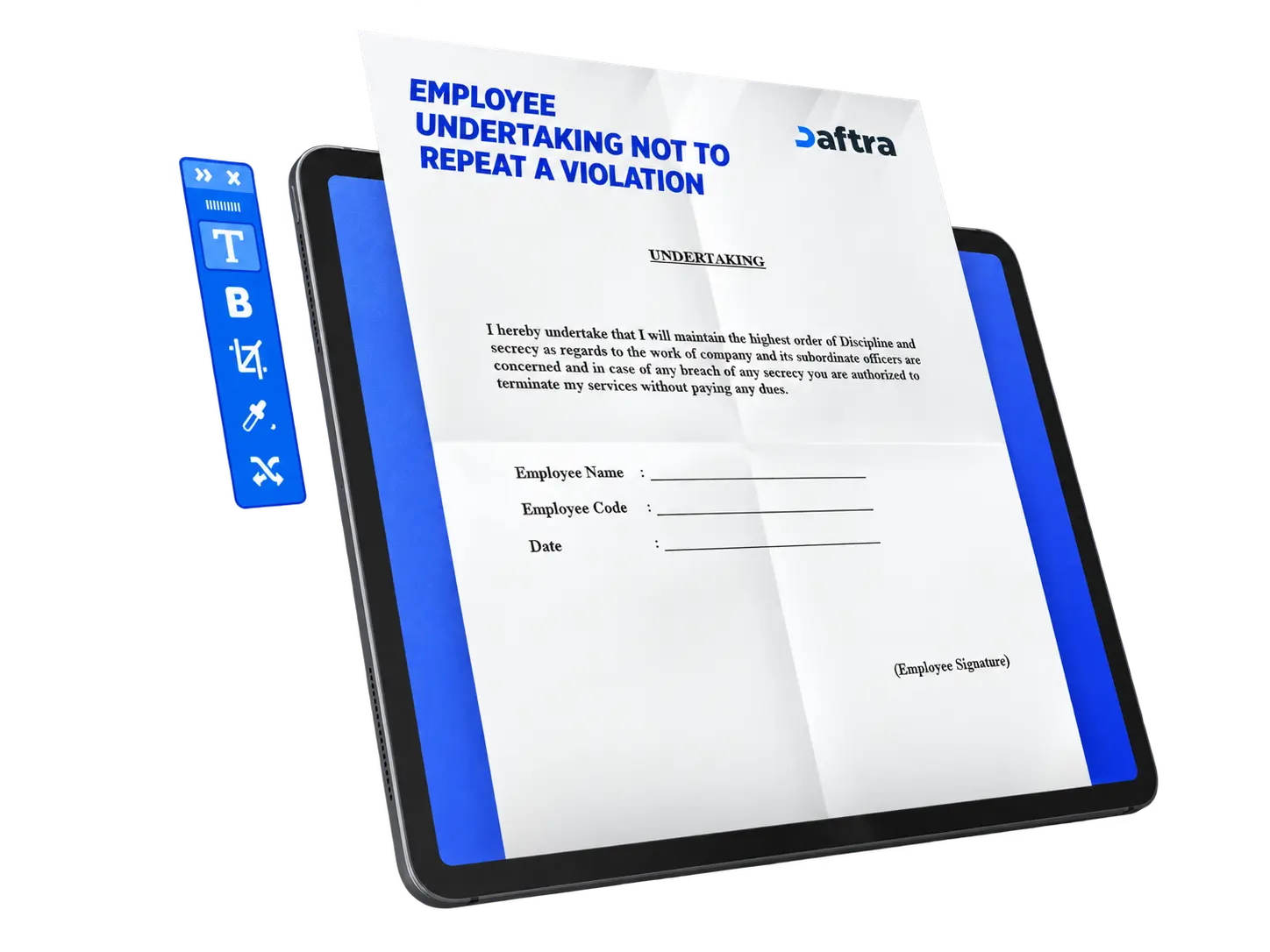
 Manage Employee Undertakings and HR Records with Daftra
What Is an Employee Undertaking Not to Repeat a Violation?
An undertaking letter not to repeat a violation is a formal document in which the employee acknowledges their commitment not to repeat the violation in question in the future. It serves as a written, signed record proving the employee's acknowledgment of their mistake and acceptance of responsibility, and it acts as an assurance to the company of compliance with the applicable policies and instructions.
The undertaking template is prepared after the violation occurs and includes the details of the violation, the date of the undertaking, its terms, and the name and signature of both the employee and the company. If the violation is repeated or the terms of the letter are breached, it can be relied upon as a formal document for taking the necessary regulatory or legal action.
Why Is an Employee Undertaking Not to Repeat a Violation Important?
An employee undertaking not to repeat a violation is an effective organizational tool that helps businesses regulate workplace conduct and reinforce compliance with internal policies. Its key benefits are as follows:
- Clarifying obligations: The template helps clarify the violation in question and states the employee's obligations explicitly, fostering mutual understanding and reducing repeat mistakes.
- Reinforcing discipline and accountability: The undertaking is a formal document that holds the employee responsible for not repeating the violation, and it serves as a reference when evaluating workplace conduct in the future.
- Supporting disciplinary measures: The template acts as a preventive administrative measure that helps deter the employee from repeating the violation, and it supports management in taking the appropriate regulatory action if the undertaking is breached.
You May Also Download
What Are the Components of an Employee Undertaking Not to Repeat a Violation?
The components of an undertaking not to repeat a violation are as follows:
- Details of the undertaking party (the employee): The full name, job title, and contact details of the party bound by the undertaking.
- Details of the recipient (the company): The name of the entity or person to whom the undertaking is addressed, along with their official position.
- Formal salutation: An official opening line used to begin the undertaking letter in a professional manner.
- Introduction stating the reason for the undertaking and the violation in question: A preliminary paragraph explaining why the undertaking is being written, with a brief reference to the violation it concerns.
- The text of the undertaking not to repeat the violation and to comply with policies: The core section in which the undertaking party acknowledges their commitment not to repeat the violation and to comply with the applicable policies.
- Conclusion: A closing paragraph affirming the seriousness of the commitment and the readiness to accept responsibility.
- Name and signature: Formal proof of the undertaking party's identity and their agreement to the contents of the undertaking.
- Date the undertaking was drawn up: The date the undertaking was written and signed, so it can be officially adopted.
How to Create an Employee Undertaking Not to Repeat a Violation
An employee undertaking not to repeat a violation serves as evidence of the employee's commitment to company policies and instructions and to not repeating the violation in question. The steps for writing the template are as follows:
- Details of the undertaking party: Begin by stating your full name, your job title (if applicable), and your contact details, as is customary in formal correspondence.
- Details of the recipient: Written directly beneath your own details; include the name of the entity or person to whom the undertaking is addressed, their position, and the name of their organization.
- Formal salutation: For example, “To Whom It May Concern” or “Mr./Ms. ……”.
- Introduction: Explain the reason for writing the undertaking, with a brief reference to the violation in question and its date, without going into excessive detail.
- The text of the undertaking: This is the heart of the template, where the employee acknowledges their commitment not to repeat the violation in the future, to comply with the applicable policies and instructions, and to accept responsibility if the terms of the undertaking are breached.
- Conclusion: Confirm commitment to the contents of the undertaking and readiness to fully comply with the instructions governing the work.
- Signature and date: Close the template with a formal phrase such as “Yours faithfully,” followed by the full name, signature, and the date the undertaking was drawn up.
- Review and retention: Proofread the undertaking and verify the details, and keep a signed copy on file for reference when needed.
How Is an Employee Undertaking Not to Repeat a Violation Used?
The template is used to document the offending party's undertaking not to repeat the violation, to comply with the applicable policies and instructions, and not to commit the same violation again.
Who Benefits from an Employee Undertaking Not to Repeat a Violation?
The beneficiaries of an employee undertaking not to repeat a violation are:
- The company or employer: The template helps management regulate workplace conduct, document violations, and support regulatory and disciplinary measures when needed.
- The employee: It gives the employee an opportunity to correct their behavior and comply with policies, and clarifies their responsibilities formally, reducing the likelihood of facing more severe measures in the future.
- The HR department: The template is an organizational tool used to monitor workplace discipline, evaluate behavioral performance, and maintain administrative records.








 Invoicing
 POS
POS Offers
 Installments
 Sales Commission
 KSA E-Invoice Software
 EGY E-Invoice Software
 JO E-Invoice Software
 E-Invoice Software
 Chart of Accounts
 Asset Management
 Cost Centers
 Expenses
 Cheque Cycle
 UAE VAT-Tax
 Product Management
 Purchases
 Purchase Cycle
 Suppliers
 Requisitions
 Stocktaking
 Organizational Structure
 Personnel Management
 Attendance and Leave
 Contracts
 Payroll
 Requests
 Work Orders
 Booking Management
 Rental and Unit Management
 Time Tracking
 Work Flow
 Lease Contracts
 Manufacturing Management
  Client Follow-Up
 Loyalty Points
 Points and Credits
 Memberships
 Insurance Management
 Daftra ERP Full App
 Point of Sales App
 Point of Sales for Desktop – Support Offline Mode
 AI Expenses Scanner App
 Employee Attendance, Sign & ESS App
 E-invoice Reader App
 Inventory Stocktaking App